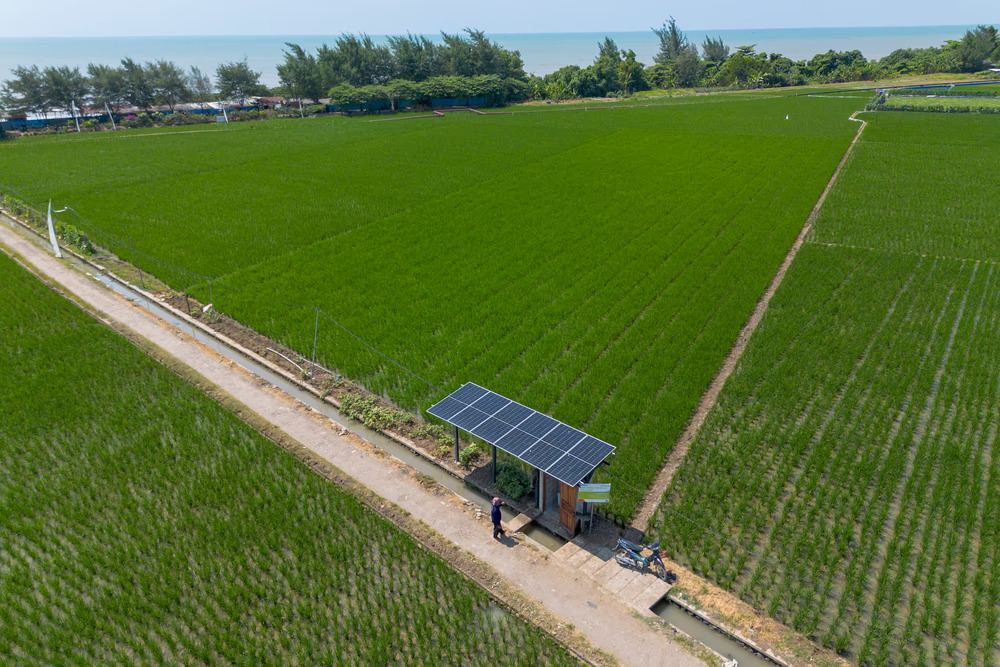
Indonesia has the potential to create 72 million green jobs within the next four years, in line with the development of new and renewable energy, according to a report from the Ministry of National Development Planning (KemenPPN/Bappenas).
This projection comes as a glimmer of hope amid rising waves of layoffs (PHK) triggered by global economic uncertainty.
Based on the Indonesian Green Jobs Roadmap, launched during the Indonesia’s Green Jobs Conference (IGJC) 2025: Turning Vision Into Action last April, the number of jobs with potential to become “green” is projected to reach 56 million in 2025 and increase to 72 million in 2029.
The roadmap will serve as a national guide for policy-making, human resource investment, and programs to drive green economic transformation.
Secretary General of the Ministry of Manpower, Anwar Sanusi, highlighted the strong prospects for green jobs.
“Beyond the fact that sustainable development is gaining global attention, sectors such as organic farming, environmentally friendly land management, and smart farming have significant potential to absorb workers,” Anwar told SUAR in Jakarta, Tuesday (July 22, 2025).
He added that the government has integrated the green jobs roadmap into the National Long-Term Development Plan (RPJPN) and the National Medium-Term Development Plan (RPJMN). Several government training centers have also begun offering courses in green business and environmentally friendly technologies.
Bappenas itself projects that by 2025, the number of green workers in Indonesia will reach about 4 million people, or 2.7 percent of the total workforce, and could rise to more than 5.3 million people, or 3.14 percent, by 2029 under a high-growth scenario.
The term green jobs refers to various types of work that support sustainability, reduce negative environmental impacts, and promote green economic growth.
Meanwhile, economic slowdown and digital transformation have hit several labor-intensive sectors. Data from the Ministry of Manpower shows that as of October 1, 2024, a total of 52,993 workers were laid off, with manufacturing contributing the largest share: 24,013 workers lost their jobs.
Even so, Anwar acknowledged the challenges—ranging from human resources to the fact that the green jobs concept itself is not yet widely understood. “We must ensure there’s a business chain that truly supports green workers in securing a decent livelihood,” he said.
Wicaksono Gitawan, Policy Strategist and Project Manager at CERAH Indonesia, an environmental NGO in Jakarta, explained that the essence of green jobs rests on two pillars: preserving the environment and ensuring decent work.
“Green jobs are not just about being ‘green.’ They must have two sides: contributing to environmental preservation while still being decent jobs for workers,” Wicaksono told SUAR by phone, Tuesday (July 22).
He stressed that green jobs are not limited to renewable energy. Opportunities can be found across sectors—agriculture, manufacturing, construction, science, law, and even creative industries such as fashion.
Great Potential, but Limited by Gaps
Echoing Bappenas, Wicaksono noted that the greatest potential lies in renewable energy sectors such as solar, micro-hydro, and biomass.
He said that while 72 million occupations have been identified as potentially green, the opportunities are still constrained by skill gaps, policy gaps, and funding gaps.
“Companies in the green jobs sector often struggle to attract workers with the necessary technical skills. Many graduates in engineering or renewable energy opt to work abroad due to more competitive offers,” he said.
Skill gaps arise because of the limited number of workers with technical expertise in renewable energy and other green job sectors. Relevant curricula remain scarce in many universities, and even more so in vocational schools in the regions.
“Our survey shows only 45% of university students truly understand what green jobs are. Among the general public, the awareness is even lower,” he added.
Nevertheless, a joint survey by CERAH Indonesia and Suara Mahasiswa UI found that the majority of young people (71%) view the sector as a promising career opportunity and a way to make a positive impact on the environment and society. This aligns with 98% of respondents who believe that an ideal career is not only about income but also about contributing to sustainability.
This trend is not limited to Indonesia. Research by Plan International in 2022 showed that most young people in Asia, Europe, and the United States aspire to have environmentally friendly jobs in the next decade. A Good Energy survey in the UK also found that more young people are placing sustainability as a top consideration when choosing jobs.
For countries, the opportunity is no small matter. Developing green jobs provides dual benefits: reducing unemployment while lowering carbon emissions, minimizing pollution, and restoring ecosystems.
“Green job development is beneficial because it addresses two major issues simultaneously: employment challenges and environmental challenges,” said Wicaksono.
Policy gaps, however, persist, as supporting regulations such as power wheeling or direct purchase agreements (DPAs) have not been fully implemented. This hinders the integration of large-scale renewable power plants into PLN’s grid, which remains dominated by fossil-based electricity.
Wicaksono cited the example of the centralized solar power plant (PLTS) in Way Haru, Lampung, which was built in 2016 to supply electricity to villages but later stalled due to a lack of knowledge transfer and community skills.
“Without skill-sharing, the technology built eventually doesn’t sustain,” he explained.
Funding gaps also pose a major hurdle. Large-scale renewable energy investments are often hampered by electricity oversupply in Java-Bali and limited grid infrastructure. As a result, investment tends to flow into smaller projects with limited job absorption.
Optimism and Caution
Bobby Gafur from the Manpower Division of the Indonesian Employers’ Association (APINDO) said the potential of green jobs should be viewed as a strategic opportunity to strengthen Indonesia’s competitiveness.
“The potential of green jobs is enormous because Indonesia is rich in natural resources, human resources, and carbon resources,” he said.
However, he emphasized the need to detail the roadmap for industrial green transformation so that demand for green workers can be anticipated and a strong ecosystem established.
For small and medium-sized enterprises (SMEs), opportunities in green jobs also exist—in recycling, waste management, and organic farming—though challenges remain in capital, technology, and market access.
“In industries that are already moving toward green transformation, APINDO members are aware of the importance of this transition. Naturally, demand for green workers follows. Sectors like green financing, green manufacturing, and green energy are becoming leading areas that open many job opportunities,” he said.
Several examples of fast-growing policies abroad include:
- Vietnam: the direct power purchase agreement (DPPA) allows private companies to buy renewable electricity directly from producers through the national grid. This has triggered a surge in investment and job creation in the renewable energy sector.
- South Africa: organizations such as Harambe Youth Employment Accelerator connect young jobseekers with green industries, accelerating reskilling and workforce placement in sustainable sectors.
Anwar added that Indonesia’s green job potential is vast. But to turn it into a new engine of the economy, a comprehensive strategy is required—strengthening vocational education, offering incentives to the private sector, fixing regulations that hinder investment, and launching public campaigns to make the concept of green jobs better understood.
“We hope Indonesia can become a high-income country with a stronger and more sustainable economic structure,” he concluded.