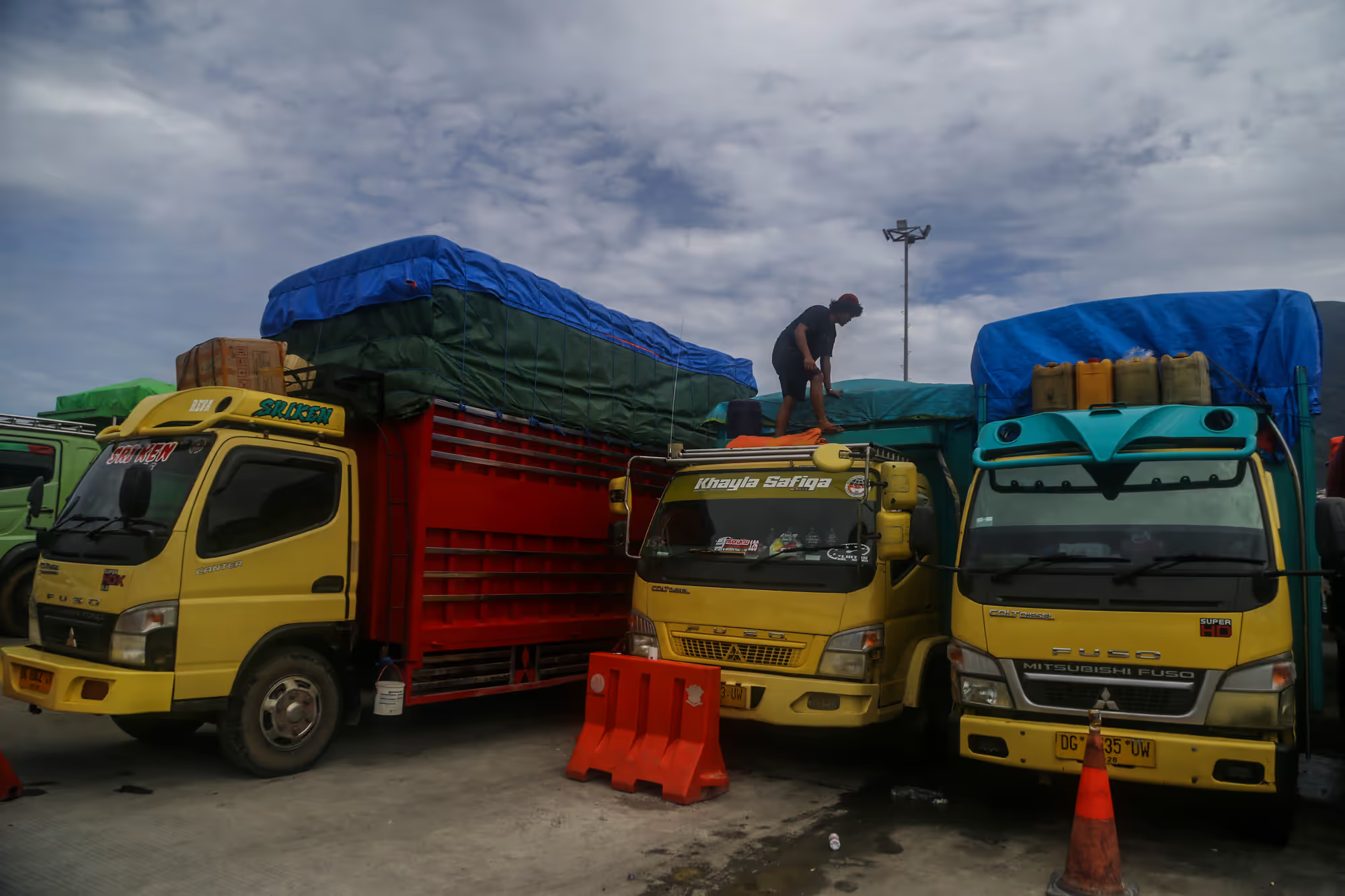
For many years, many have raised the proposal for restricting the operation of overweight and oversized trucks. Yet, there has been no definitive policy known on how to deal with over dimension over loading (ODOL) problem, and it is unclear when it will take effect.
Recently, Transportation Minister Dudy Purwagandhi said that efforts to tackle ODOL problem in Indonesia was urgent and there should be no delay in its implementation. He mentioned that trucks exceeding dimensions and loading limits have caused severe impacts in various aspects, such as fatal traffic accidents, road infrastructure damage, and increased air pollution.
Logistics companies are also eagerly awaiting the implementation of the zero ODOL policy. However, there must first be a clear, sustainable roadmap that can accommodate the interests of all parties—including entrepreneurs, drivers, and the public.
Steffanus Suryaatmadja, a logistics entrepreneur and owner of Siba Surya, expressed confidence that this policy would have positive effects if implemented according to a set targets.
“A good policy like zero ODOL must be supported. Essentially, it should be consistent and fair to all parties,” Steffanus told SUAR in Jakarta on Wednesday (08/06/2025).
He also said that additional benefits of implementing zero ODOL include enhancing Indonesia’s national economic competitiveness, as logistics costs could be reduced.
To ensure the long-term sustainability of zero ODOL, Steffanus emphasized the need for a monitoring team. This measure aims to provide a long-term solution that is easy to monitor.
Reducing costs of logistics
In addition to strict monitoring, comprehensive efforts to lower overall logistics costs are also crucial. Yukki Nugrahawan, Chairman of the Indonesian Logistics and Forwarders Association (ALFI) Institute, urged the government to collaborate with industry players to reform the national logistics system through five prioritized policies.
"Reforming the national logistics system is vital to improving Indonesia’s competitiveness, especially in terms of logistics costs," Yuki said.
ALFI proposed five policy recommendations:
- Improving logistics infrastructure on land, sea, and air.
- Enhancing fiscal governance and logistics trade processes to be simple, efficient, and optimal.
- Harmonizing regulations and bureaucratic procedures to be straightforward and hassle-free.
- Promoting fleet revitalization to improve logistics operational performance.
- Improving the capacity of logistics entrepreneurs, supply chain actors, and human resources in the logistics sector, especially in digitalization and management of land, sea, and air logistics systems.
Technical team formation
In a House of Representatives meeting on August 5, the government, the House, and the Independent Drivers Alliance (API) agreed to establish a joint team to formulate policies for Zero Over Dimension Over Loading (ODOL). The policy is scheduled to be implemented in 2027, delayed from the previous plan of 2026.
Deputy House Speaker Sufmi Dasco Ahmad said that the technical team aims at accommodating all demands from stakeholders and develop phased and measured implementation steps for zero ODOL.
“This is important to ensure traffic safety and protect road infrastructure from damage caused by overweight loads. We are committed to ensuring no one will get adverse impacts,” Sufmi said.
The technical team is scheduled to start working in the fourth quarter of 2025, with implementation stages as follows:
- 2025–2026: Developing technical regulations, socialization, and pilot programs on major logistics routes.
- 2026: Limited application in prioritized sectors such as mineral transportation, construction materials, and heavy goods.
- 2027: Full implementation of zero ODOL across all national road networks.
Transportation Minister Dudy Purwagandhi said that this joint team will review technical aspects such as vehicle capacity, freight standards, licensing regulations, and the education processes for industry players.
“We agree on the need for a collective commitment to enforce zero ODOL. We will follow up on several concerns immediately,” he said.
According to the Ministry of Transportation, over 60% of freight vehicles in Indonesia still fall into the ODOL category in 2024. Each year, road damage caused by ODOL vehicles reaches Rp 43 trillion, from infrastructure maintenance costs and social costs from traffic accidents.
ODOL vehicles also contribute to high traffic accident rates. Data from the Indonesian Traffic Police Corps (Korlantas Polri) shows that in 2023, there were more than 1,200 traffic accidents involving oversize and overloaded vehicles, mostly happening on key logistics routes such as Java and Sumatra.
Drivers need protection
Meanwhile, Suroso, Chairman of the Independent Drivers Alliance (API), stated that logistics drivers are fully supportive of the Zero ODOL policy implementation for legal certainty and driving safety.
“We will monitor the implementation of Zero ODOL in 2027. We want legal certainty, protection, and education so that this transition does not become an undue burden,” Suroso said.
In response to the situation, transportation observer from the Indonesian Transportation Society (MTI), Djoko Setijowarno, emphasized that implementing zero ODOL (Over Dimensional Over Load) without a clear roadmap is akin to a paper tiger. The problem is also likely compounded by the failure in improving existing weighbridges.
"The tools used to control oversized and overloaded trucks, namely the weighbridges or Motor Vehicle Weighing Units (UPPKB), are inffectual," Djoko told SUAR on August 5, 2025.
Djoko said that monitoring instruments such as weighbridges are not functioning well.
Many weighbridges in many regions are not fully operational or are even abandoned. Based on 2021 data, only about 88 of the 134 existing weighbridges were working. This problem seems to discourage truck drivers from entering the weighbridges.
He suggested that the government should immediately develop a clear roadmap for implementing zero ODOL by 2027 and also focus on improving the weighbridges.