
On the shore of Tomogi, a village in Nagasaki Japan, the waves roll in hard, crashing against the reef surrounding the village surrounded by the ocean. Three men, Mokichi, Ichizo and Jiisama, residents of Tomogi Village are tied to a cross perched between the sturdy rocks of the open sea.
The three were sentenced to death for refusing to renounce their Catholic faith. For four days, they endured the cold and the roaring sea, until the tide finally drowned their bodies.
The execution was also witnessed by Nagasaki Governor Inoue Masashige at the time along with missionaries and hundreds of other Tomogi residents who could only mourn silently.
The scene from the movie Silence (2016), directed by Martin Scorsese, is still strong in the memory of Anton Supit, President Commissioner of PT Sreeya Sewu Indonesia. The film is a dramatization of the true story of the mass persecution of Catholics in Japan during the Tokugawa Shogunate (1603-1867).
For him, this is not just a spectacle. "I made a pilgrimage to the original place in Nagasaki," Anton recalled to SUAR in Jakarta, Friday (09/25/2025).
"In the past, Catholics were forced to step on fumi-e, plates engraved with the face of Christ. Those who refused were tortured and forced to walk thousands of kilometers in winter."
Historical drama movies based on true stories are an integral part of Anton's life. He complements this with spiritual pilgrimages, which are also a passion of his.
SUAR managed to interview Anton at a restaurant in Jakarta. "My hobby may not be of interest to readers," he says modestly.
But a plate of noodles broke the ice and got Anton talking. The veteran businessman was eager to share memorable pilgrimage stories and true story films that have stayed with him.
"More than just entertainment, pilgrimages and movies are a way to find happiness that makes life more meaningful," he said.
Happiness is simple
For Anton, everyone's happiness should be determined by their own passions.
"We decide what we want, and we look for what suits us , because what is good for others does not mean it's good for us. Blessed are those of us who don't have materialistic obsessions," Anton said.
Anton has proven to live up to the values he believes in. As a prominent figure in the business world, he keeps a low profile. Graying hair is a sign of experience, not aging.
The experiences and encounters Anton had throughout his life's journey, enriched by the spirituality honed in pilgrimages to various holy places, helped him achieve this maturity of life's values.
Pilgrimage, for Anton, becomes more than a journey to uncover wisdom from history, but also a path of self-discovery.
"As a Catholic, it's hard to rank the best pilgrimage destinations, but the Holy Land of Jerusalem, the Vatican, and the Grotto of Lourdes are certainly the most memorable. I've probably been to Lourdes 15 times, but I still want to go back, so it's not just a sightseeing trip," she says.
Every meaningful pilgrimage for Anton not only strengthens his faith, but also gives him satisfaction, especially when he discovers interesting historical stories along the way. For example, when Anton made a pilgrimage to Florence in the heart of Italy, and visited the Piazza de Santa Croce basilica.
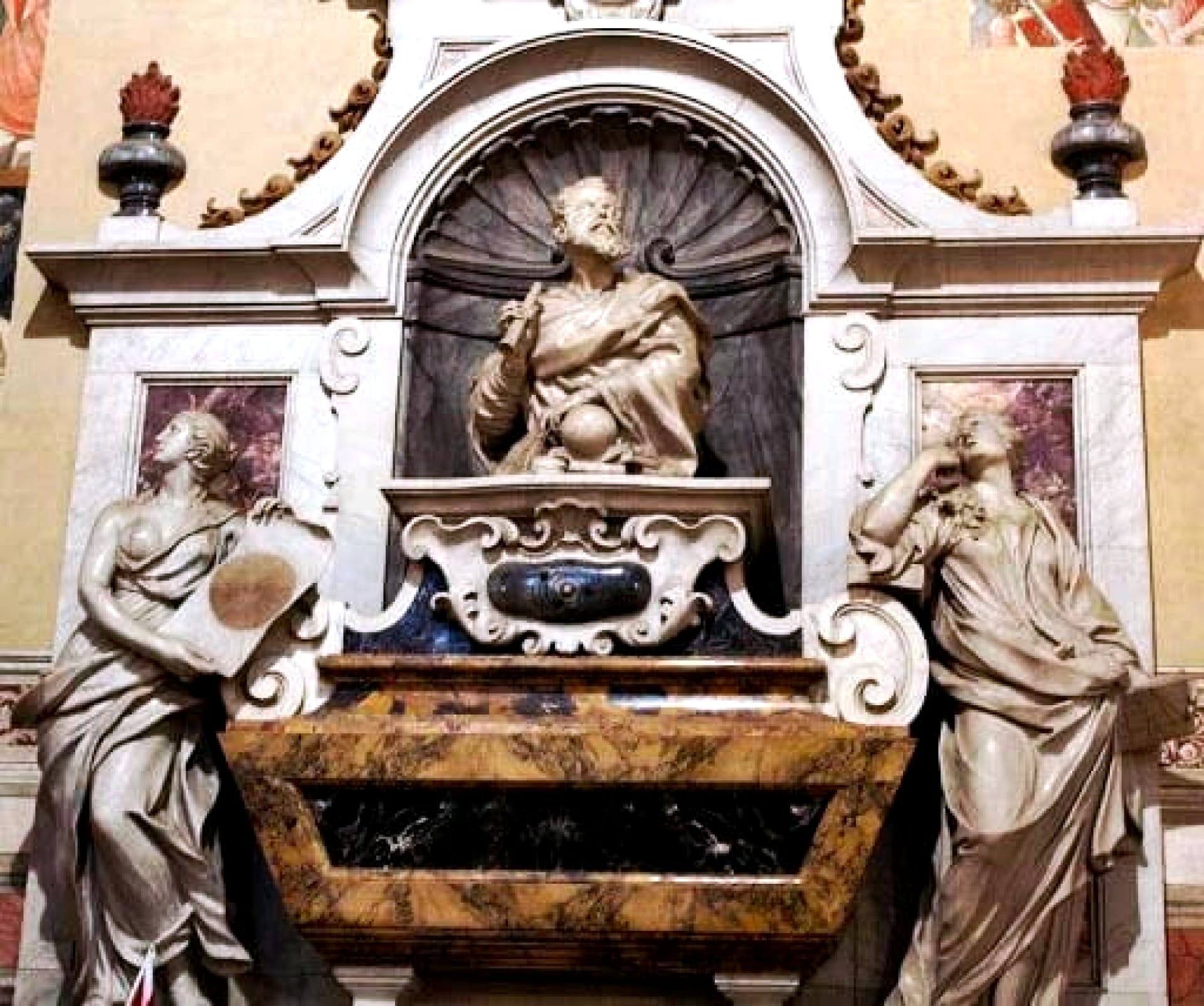
"In the Church, you can see the tombs of figures like Michaelangelo, Galileo Galilei, and Niccolo Machiavelli. It's just a grave, but that simple thing has its own happiness. Other people might find it strange, but I think, everyone has their own way. I'd rather do something like this than, say, go to a casino," Anton says, laughing at his joke.
Anton made a pilgrimage to a chapel in Oberndorf bei Salzburg, a small town on the border of Austria and Germany. The chapel was the location where Father Joseph Moore played the song"Silent Night" for the first time on Christmas Day in 1818. The historical significance of the location means that the chapel is known as the "Stille Nacht Kapelle" to this day.
"I delved into the history as well. Father Moore composed the song when he was serving a small church in the Alps. He saw a clear, starry sky at night, quiet and lonely. He imagined that it was on such a night that Jesus was born. He wrote the lyrics describing such an atmosphere," he said.
There's a thrill that runs through Anton's heart every time he visits historical sites or walks through locations where Catholics have died for their faith.
"The place where the martyrs died makes me remember that my purpose in life is to serve God, do good, and make others happy. Their stories make me grateful to be able to embrace my faith in safety and freedom, while it is very difficult for them to worship," he said.
Witnessing miracles
Anton hadn't finished his story when a call made his phone ring. He had to rush off for another appointment at a shopping center in Senayan, South Jakarta.
"Do you have a vehicle? If not, come with me. While chatting on the way, we'll continue the story." An offer that was hard to refuse. Less than a five-minute pause, the conversation was resumed, this time in a sedan driving through Jakarta traffic.
Of all the pilgrimage trips Anton has made, there is one that he remembers the most because he witnessed a miracle at the pilgrimage site with his own eyes.
"Einstein said that for some people miracles don't exist. But for others, miracles happen all the time. That's why I love movies about miracles, like Miracles from Heaven," Anton said, referring to Patricia Riggen's movie, which was released in 2016.
He experienced this miracle when he had the opportunity to make a pilgrimage to the Cathedral of Naples in southern Italy. Inside the historic building is a reliquary containing the blood of St. Januarius, a first-century martyr sanctified by the Catholic Church. The people of Naples believe that, at certain unexpected moments, the blood, which has dried for thousands of years, can melt like fresh blood.
"When I arrived in Naples, it was already late. My tour guide was reluctant to continue the trip. There were all sorts of excuses, but I insisted. I asked a local, 'San Januario?', and he held up two hands, four fingers on the right, five on the left. I understood what he meant."
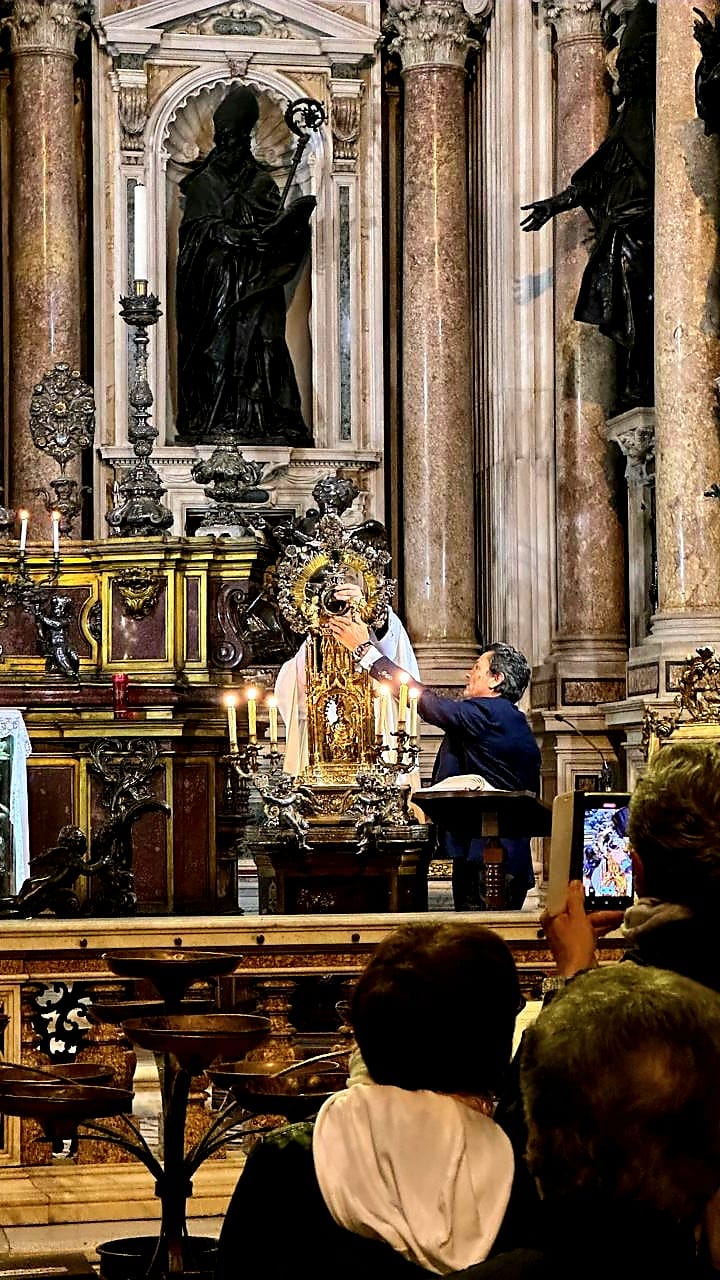
Anton hurried into Naples Cathedral. A few other pilgrims were still there, praying in silence. At exactly nine in the evening, a miracle occurred. A priest showed the pilgrim congregation the small tube in which the blood of St. Januarius was stored. With his own eyes, Anton saw the blood dripping.
It was a faith-provoking event that Anton was truly grateful for. Not twice in his life would he have the opportunity to witness such an event, despite the various reasons given by the tour guide who was reluctant to take him. Anton did not forget to capture the moment with his camera.
"Something simple, that makes us grateful, is not necessarily felt by others. I am lucky to experience and meet people who teach me that beyond this life, there is another life," she says.
Before we knew it, the sedan was nearing its destination. SUAR then launched the ultimate question before the sedan pulled up.
"How do you define happiness?" the author asked.
Then Anton replied: "I remember a movie called The Bucket List. In the movie, Morgan Freeman said that the ancient Egyptians believed there were two questions to be answered when one dies: whether you were happy in life, and whether your life made other people happy."
"And it's in the Gospel, 'Love the Lord your God with all your heart and with all your soul and with all your mind, and love your neighbor as yourself.' When I can practice that, I am happy and feel that life has meaning."