Indonesia is increasingly aggressively encouraging the development of waste-to-energy (WtE) technology. With a target of 33 WtE project sites, it will take US$ 2.72 billion or equivalent to Rp 45.4 trillion to develop a waste-to-energy power plant (PLTSa) with a capacity of 452.7 megawatts (MW) until 2034.
WTE projects are not only a solution to the chronic urban landfill crisis. It is also a great opportunity for the development of new and renewable energy (NRE) that attracts foreign investment - especially EU countries.
Blue Continent countries are indeed supporting efforts to develop the renewable energy sector made from waste. During the inauguration of the EU Investment Desk at the BKPM Building (30/9/2025), Investment Minister / BKPM Rosan Roeslani said that European countries showed strong interest in investing in Indonesia. One of them is in the renewable energy sector.
Data on the realization of European investment in Indonesia shows a positive trend. Namely, doubling from US$ 2,232.50 million in 2020 to US$ 4,594.90 million in 2024. This increase in investment value is in line with the surge in the number of projects, from 9,275 units to 39,178 units.
This shows Europe's great confidence in Indonesia's investment climate, especially in strategic sectors such as new renewable energy (EBT).
The EU's keen interest in Indonesia's renewable energy sector is, in part, triggered by its ambitious decarbonization targets and is actively seeking opportunities to channel green(ESG-compliant) investments. The establishment of the EU Desk aims to create more efficient communication channels and clarify bureaucratic processes, as well as remove barriers to investment realization as seen during the 2020-2024 period.
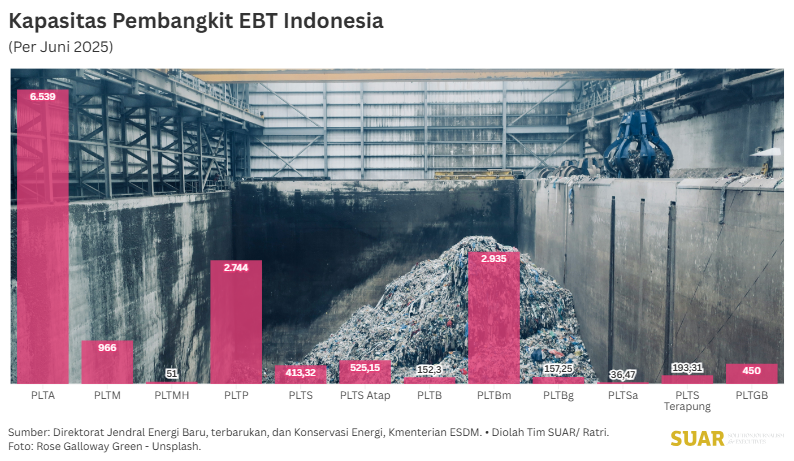
Cumulatively, Indonesia's total renewable energy capacity reached 15,162.80 MW as of June 2025, which is dominated by hydropower and thermal power plants. The contribution from WtE or waste-to-energy projects is still very small, only 36.47 MW.
This means that the PLTSa sector has potential room for growth. This is considering the large population and daily waste volume that has yet to find a solution.
Previously, in 2013, the Indonesian government also received technical support from the European Union (EU) under the Trade Cooperation Facility (TCF) program to conduct a study and create a Waste to Energy Guidebook.
Until 2024, there are 12 WtE project points. The target is to develop 33 WtE projects by 2034 with a total capacity of 452.7 megawatts (MW). This is estimated to require funding of IDR 45.4 trillion.
This big ambition also received support from the Indonesian Private Electricity Producers Association (APLSI). According to APLSI Chairman Eka Satria(Kontan, 30/9/2025), while waiting for the ratification of the Presidential Regulation related to WtE to replace Perpres Number 35 of 2018, APLSI is ready to play a role in providing policy input, communicating the readiness of private investors, and bridging collaboration with the government.
In an effort to increase the attractiveness of WtE or PLTSa projects for investors, the Indonesian government has revised the electricity purchase tariff scheme to around US$0.20 per kWh. The tariff is a significant increase from the previous upper limit of around US$0.1335 per kWh.
This new, more attractive tariff includes the reimbursement of tipping fees, which previously had to be borne by local governments and were often a fiscal drag at the local level.
By integrating waste management costs into electricity tariffs, the government seeks to simplify funding mechanisms, provide higher revenue certainty to PLTSa developers, and cut bureaucratic licensing channels, thereby accelerating the realization of projects that currently lack capacity.