
by: Rohman Wibowo & Benedictus Krisna Yogatama
The 19 percent export tariff adjustment for a number of commodities from Indonesia, which was announced by US President Donald Trump, does not fully benefit the domestic industry. Large countries such as China have strong potential to diversify the market for their products to get around the trade war with the US.
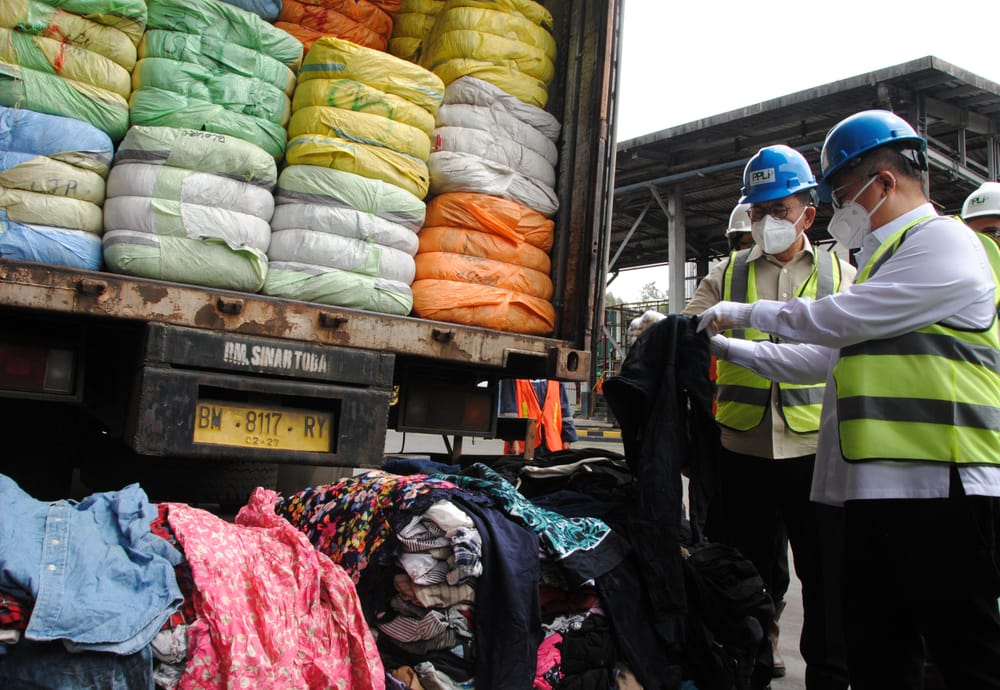
As a result, superior commodities from the Bamboo Curtain Country such as textiles and textile products and steel are considered to be flooding the domestic market.
Chairman of the Indonesian Fiber and Filament Yarn Producers Association (Apsyfi) Redma Gita Wirawasta said that textile entrepreneurs, both in the upstream and downstream sectors, are wary of the amount of tariffs imposed by competing countries such as Vietnam, South Korea and Japan.
However, the main thing that is highlighted is the amount of tariffs for China. Because, talking about China and competing countries in the textile industry, Redma is worried that the domestic market share can also be brushed off. In fact, when profits from exports stagnate, the domestic market is the only hope to survive and continue production.
However, the obstacle is how much imported goods, mostly from China, can be reduced. The trigger is that textile imports of yarn, fiber and apparel from China are notoriously cheap compared to local factory production.
"The most logical thing is (diversion to) the domestic market, this is a bit difficult. Because imports have become an addiction for industry players and the government. But the name is opium if it is not stopped, it can die (textile industry)," said Redma.
Textile companies, especially in the upstream sector, are always missed by imported Chinese goods. Redma said, the reason is because the Ministry of Industry (Kemenperin) always recommends the fulfillment of raw materials for the textile and garment industry sourced from Chinese imports. The trigger for the flood of Chinese imports is because there are allegations of quota games so that there are a number of companies that become import proxies.
In suppressing the onslaught of Chinese products, Redma together with 20 corporations that are members of Apsyfi have sent a letter to the Ministry of Industry. The goal is to evaluate import recommendations so far.
This import quota issue was also highlighted by the United States Trade Representative, which triggered the application of high tariffs to Indonesia, different from other Southeast Asian countries. Redma said that the import approval process was considered by the US to be non-transparent. "We see one or two groups of companies that get a very large import quota. (But) there are (companies) whose import quotas are cut," he said.
Thus, he said, there needs to be clear legal certainty and transparency regarding imports. This is for the good of the textile business ecosystem in the country, amidst the uncertainty of international trade, especially due to the United States' reciprocal tariffs. Imports must be controlled to maximize the distribution and absorption of local production by the community. If not, there is a high possibility of company budget efficiency that results in a reduction in labor, depending on a decrease in production and factory income.
Broadly speaking, the amount of Indonesia's textile industry exports to the United States accounts for one-third of total exports. In other words, the turnover will decrease by 10 percent-15 percent, if the textile industry is no longer fully dependent on the US market.
The amount of revenue decline has not yet calculated the impact of the onslaught of imported Chinese goods. "If the domestic market can be maintained, entrepreneurs can be safe actually from upstream to downstream. Domestic products, yes, are indeed expensive, but all costs for production revolve in the country," Redma explained.
On the point of state presence, Redma does not deny the need for incentives for entrepreneurs. Incentives such as adjustments to electricity tariffs are considered to be effective if they can cover production costs and prices that have risen due to the implementation of tariffs and the impact of the flood of Chinese imports.
For Redma, the willingness of the government of competing countries ranging from China, India to Vietnam to raise the textile industry must be a precedent that the Indonesian government must emulate. "Well, whether government incentives can cover costs due to the imposition of tariffs. If so, there is no problem," said Redma.
The Domestic Component Level (TKDN) regulation is also considered to be able to boost the competitiveness of local products. Redma emphasized that so far the fulfillment of TKDN massively applies to government spending and is most effective for the production needs of TNI-Polri uniforms - most of the benefits of which can be taken by the domestic industry. "Well, if TKDN is expanded to daily clothing, it can help," he said.
The spirit of the triumph of domestic products is not a figment of the imagination. He cited Pakistan, which does not hesitate to reward more incentives for retailers who sell local production. The shopping center there, Redma said, is dominated by products made by the nation's children. Foreign or imported products are given little space. "So it is not the percentage of TKDN that is raised, but the magnitude is expanded," he said.
Meanwhile, referring to World Bank data, China's textile imports are relatively on an upward trend, which was originally US $ 3.96 million in 2019, then reached US $ 4.37 million three years later. During that period, the number of textile imports from Panda Country to Indonesia was always in the top four main commodities.
Steel that is not mighty
Turning to the steel commodity, the trend of steel exports from China has begun to move up. According to an analysis by SMInsight's steel and mining industry expert, Widodo Setiadharmaji, apparently China's exports of finished steel products reached 58.15 million tons from January to June 2025 or during the escalation of Trump's tariff period. This export amount increased by 9.2 percent when compared to the same period the previous year.
As for Indonesia, imports of finished steel from China increased from 1.29 million tons to 1.34 million tons, or up about 3.9 percent in the January to April 2025 period, according to data from the Global Steel Trade Monitor (GSTM). This number does not include imports of semi-finished products, which jumped from 39,000 tons to 830,000 tons. For the latter commodity, Indonesia even applies a 0 percent export tariff.
The large quantities of finished steel and steel billets from China then triggered price pressure in the global market. Still referring to the analysis from SMInsigt which quoted the BIGMINT report, it was noted that the export price of hot-rolled coil (HRC) from China in June 2025 was at US$ 445 per ton FOB Rizhao.
For industries from importing countries, this is not a breath of fresh air. "This price reduction increases the penetration of Chinese products into various global markets, but at the same time suppresses domestic prices in importing countries and narrows the space for local producers to compete reasonably," said Widodo, who is also Executive Director of the Indonesia Iron and Steel Industry Association (IISIA) in his analysis, quoted Sunday (20/7).
According to Widodo, the government must quickly strengthen trade security policies while tightening market surveillance and enforcing regulations more consistently. "Such as anti-dumping, countervailing duty, and safeguard," he said, who also emphasized the need for real implementation of the Domestic Product Usage Improvement (P3DN) program, import substitution strategies, and the application of non-tariff instruments such as the Indonesian National Standard (SNI).
Domestic protection
Executive Director of the Center of Reform on Economics (CORE) Indonesia Mohammad Faisal said that imports of superior commodities from China will hit the domestic steel and textile industries. Talking about textiles, for example, this industry is the most affected by the invasion of imported products, especially since consumer goods directly touch the community.
"The textile industry has difficulty surviving, due to competition between domestic companies and the onslaught of imported goods, both legal and illegal. Not to mention the unsynchronized domestic policies that affect the competitiveness of the industry," he told SuarSunday.
Then, the steel industry, said Faisal, actually had a shrinking market share before the US export tariff issue. This is inseparable from the level of government demand, which is one of the largest consumers of this industry. "In the last government (President Joko Widodo), the focus was on infrastructure development, so the absorption of iron and steel products was relatively large, and it was dominated by products from China as well," he said.
But now, Faisal said President Prabowo Subianto's development direction is somewhat different from the previous regime. As a result, there will be less demand for finished steel and steel billets.
"Yes, of course it affects the demand for iron and steel. On the other hand, over supply from China occurs to Indonesia. This means that there will be an extraordinary increase in competition due to over supply, while demand shrinks," he said.
As for what the government can do, the safeguard mechanism for tariffs and anti-dumping duties is already in place. However, Faisal said that these efforts were not enough because the policies were temporary. "There needs to be a medicine that can overcome the problem in the long term. For example, there are incentives for industry players to increase their competitiveness on the production side," he said.
Other than that, "Domestic industries must really innovate in terms of production and innovate to find a relatively more limited market," he added.
Industry Minister Agus Gumiwang Kartasasmita stated that although the tariff on steel imports in the US reaches 50 percent, higher than the 19 percent tariff on other products, the US still relies on imports to meet its ply steel needs.
"To increase competitiveness, national industry players must be more efficient in the production process so that the added value of the products produced becomes higher," Agus said in his remarks at the PT Tata Metal Lestari Plywood Product Export Release to the United States, at Tanjung Priok Port, Jakarta, Friday (18/7).
On this occasion, the Minister of Industry acknowledged President Prabowo Subianto's expertise in negotiating with US President Donald Trump, as Indonesia managed to obtain more favorable tariffs compared to competing countries. This is an important asset for increasing the competitiveness of the national industry.
"Therefore, the national industry needs to optimize the export of its products to the American market to take advantage of the low import duty rates for Indonesia compared to other countries," he said.