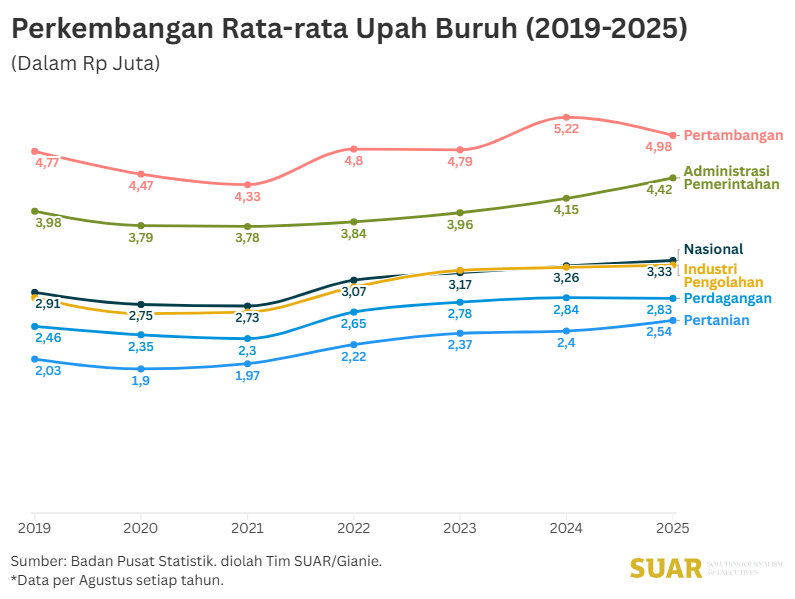
The Central Bureau of Statistics in early November submitted a report on the condition of labor wages based on the results of the August 2025 National Employment Survey. The average wage of laborers nationwide showed an increasing trend after recovering from the Covid-19 pandemic.
Compared to last year, the average wage of laborers in August 2025 has reached IDR 3.33 million per month, an increase of 1.94% compared to August 2024. When viewed over a longer period, that is since the pandemic hit, the average labor wage grew 21% (2020-2025). Although wages fell in 2021, the average wage of laborers is now higher than before the pandemic. In 2019, the average labor wage was IDR 2.91 million per month.
When viewed by business field, workers in the information and communication sector received a higher wage of IDR 5.28 million per month. This figure increased by almost 6% compared to last year. Other workers who received higher wages were also found in finance and insurance (IDR 5.12 million), electricity and gas procurement (IDR 5.07 million), and mining (IDR 4.98 million). There are five other businesses whose workers receive higher wages than the national average, namely those working in government administration, in real estate, professional and corporate activities, in transportation, and health.
In the most labor-intensive business field, agriculture, the wage received by workers is IDR 2.54 million per month. Although below average, this wage has increased by 5.5% compared to last year.
Workers in two other businesses that also absorb large numbers of workers (trade and manufacturing) also receive wages below the national average. Workers in trade earn an average wage of IDR 2.84 million per month. Somewhat higher, workers in the processing industry receive a wage of IDR 3.27 million per month.
Many factors influence the amount of wages that workers receive. Apart from the level of education and work experience, the increasing scale of the economy, which is influenced by the high demand for goods and services, is also a determinant. An economy that moves due to the high demand side will increase business income. Government policies also play a role in improving the economy or increasing wages, related to setting the minimum wage or increasing the salary of the state civil apparatus.
The business fields that showed the highest increase in wages compared to last year were education and government administration, with increases of 6.72% and 6.55% respectively. Workers in the education sector, despite the highest wage increase this year, earned IDR 3.05 million per month. This figure is still below the national average. Meanwhile, workers in the field of government administration this year received a wage of IDR 4.43 million per month.
The continuous increase in the amount of wages received by laborers or workers will improve people's purchasing power for the better. This is of course if the government can keep the prices of goods stable so that the wages received are not eroded by inflation.