
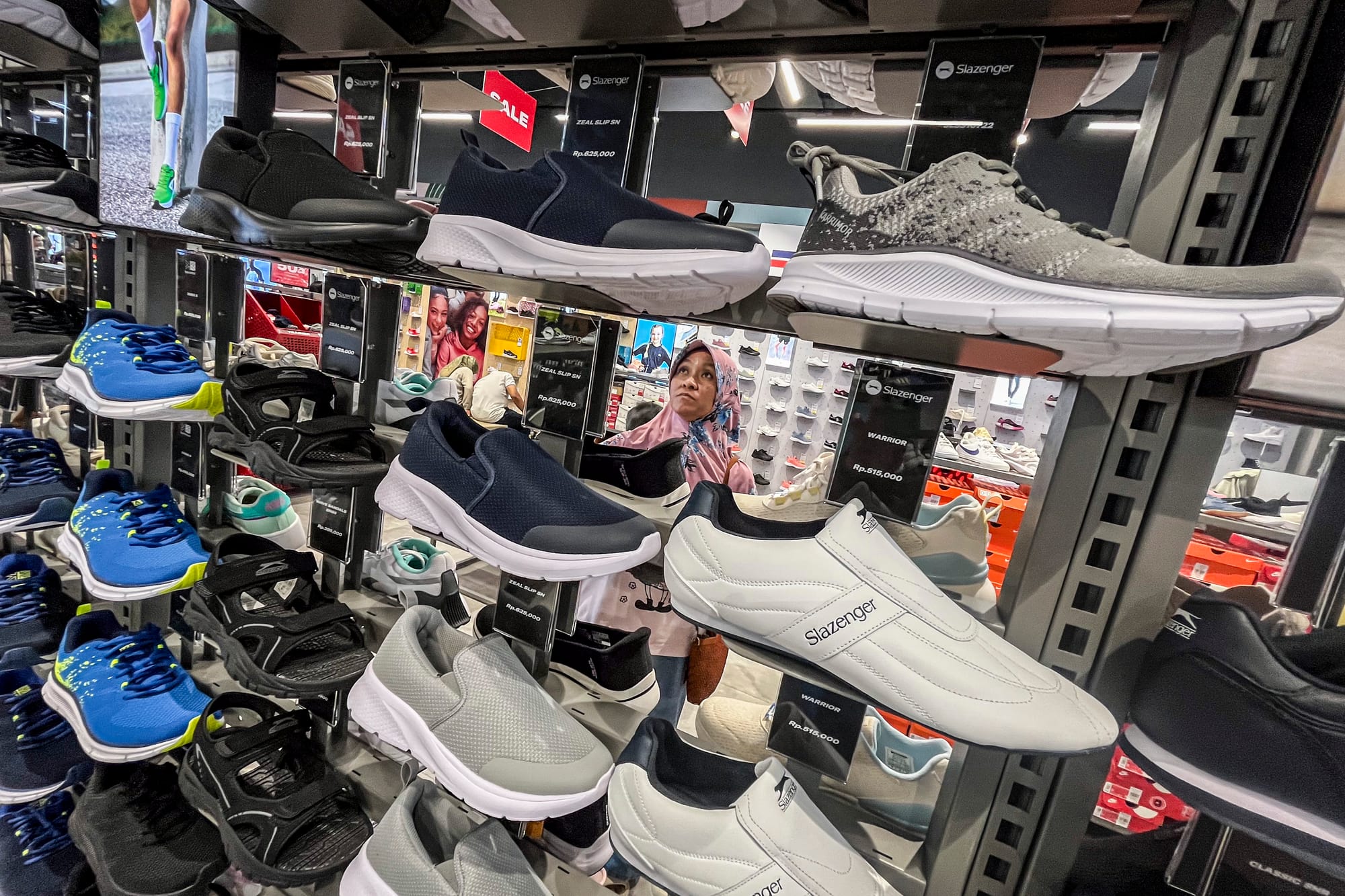
In the midst of the uncertain global economic situation and the rampant news of layoffs in the national manufacturing sector, an optimistic story comes from the footwear industry. It is predicted that this business sector will continue to grow significantly.
During the first six months of 2025, the footwear industry showed an impressive performance by recording a 13.6% surge in exports compared to the same period last year. This was conveyed by the Minister of Industry, Agus Gumiwang Kartasasmita, when releasing the export of shoes produced by PT Yih Quan, in the Industropolis Batang Special Economic Zone, last week, as quoted by SUAR from an official statement.
Meanwhile, the export value of footwear in the January-June 2025 period reached US$ 3.77 billion or equivalent to around Rp 61.83 trillion at an exchange rate of Rp 16,400 per US dollar. This shows the achievement of local product competitiveness in the global market.
For example, PT Yih Quan Footwear Indonesia exported 20,000 pairs of Converse shoes worth a total of US$ 160,000 from KEk Industropolis Batang, Central Java. The details are shipments to the United States worth US$ 100,000 and to Australia worth US$ 60,000.
Converse is a brand of Nike Inc from the United States, which has long entrusted the production of its products in Indonesia. PT Yih Quan Footwear Indonesia has successfully exported Converse products to 37 countries with the largest export destinations in five countries. Namely, the US, Belgium, Mexico, Canada, and Australia.
"This export is a momentum that is a clear proof of the strength of the Indonesian footwear industry ecosystem, which is supported by collaboration between the government, industry players, the Batang industrial area, the Aprisindo association, and global buyers such as Nike," said Industry Minister Agus Gumiwang.
Based on information from the Ministry of Industry (Kemenperin), in the second quarter of 2025, the leather and footwear industry sector recorded rapid growth of 8.31%, far exceeding national economic growth of only 5.12%. By February 2025, the industry had absorbed 921,000 workers, an increase of 35% from the previous year.
Furthermore, Agus Gumiwang revealed that from January to August 2025, 18 large-scale footwear companies invested Rp 10 trillion. These investments, he said, are expected to significantly increase production capacity and create more than 100,000 new jobs.
Indonesia is currently the world's 6th largest footwear exporter with a market share of nearly 4% globally. The country with the largest population in ASEAN successfully reduced the reciprocal tariff on footwear exports to the United States - from 32% to 19% - which is the lowest tariff among ASEAN countries.
According to Agus, the reciprocal tariff reduction opens up strategic opportunities to further strengthen the export competitiveness of Indonesian products.
Agus stated that amidst the current tariff and non-tariff challenges, the export of Converse shoes to the United States is an important proof of the sustainability of Indonesia's large exports to the market.
Agus stated that amidst the current tariff and non-tariff challenges, the export of Converse shoes to the United States is an important proof of the sustainability of Indonesia's large exports to the market.
In the first half of last year, the value of Indonesian footwear exports to the US reached US$1.03 billion, or nearly 50% of the total national footwear exports. This shows the large role of the US market for the domestic footwear industry.
Not all entrepreneurs have been successful
However, Chairman of the Nusantara Footwear Entrepreneurs Association (Hipan), David Chalik, stated that not all entrepreneurs can taste the sweetness of exports abroad at a time when there is a positive export movement from well-known global brands, such as Nike, Puma, and Adidas operating in Indonesia.
"Keep in mind that exports that move only belong to foreign brands. Nike, Puma, Adidas are still moving because they are big brand owners where the country of origin of the brand is also quite in demand, especially in America," David told SUAR (26/8/2025).
On the other hand, according to David, shoe exports are now facing uncertainty along with the US import tariff policy. This condition makes entrepreneurs choose to wait and see.
Still, David is optimistic that in the future, the footwear industry will improve. He does not deny that the industry as a whole has not grown significantly.
What about the domestic industry? "It is still running in place. For the retail market, both daily and e-commerce, it is not growing significantly. Finally we are stuck in place," he explained.
In response to the challenges, David Chalik provides some constructive suggestions that could be key to the industry's growth.
- The government can strengthen supervision of dumping imports of finished shoes.
- The government relaxed import regulations for production support components, such as imports of outsoles, textile uppers, and synthetic leather, allowing local manufacturers to improve efficiency and innovation.
- Promote the labor-intensive industrial credit program (KIPK) with designations targeting middle-class producers.
Chalik admitted that the KIPK program has been in motion since last year and has been running in the large-class shoe industry to support foreign investment. "And, since this time it has begun to switch to the middle-class shoe industry," Chalik said.
He hopes that with easier access to capital, middle-class shoe industry players can expand their businesses, increase production capacity, and create more jobs.
Fresh breeze
Mohammad Faisal, Executive Director of the Center of Reform on Economics (CORE) Indonesia, agrees with the significant increase in footwear export growth in the first half of 2025. This increase in exports, according to Faisal, could be a breath of fresh air for the national economy.
"I see that there is indeed an increase or acceleration of footwear export growth in the first semester of this year. And this could indeed be a good signal in the midst of global economic pressure," Faisal told SUAR (23/8/2025).
Faisal detailed data on the growth of footwear and shoe exports in the shoe semester of 2025, which was most significant to the Americas and Europe. However, Faisal also noted that this positive trend does not apply to East Asian markets, which tend to stagnate. The only exception was exports to South Korea, which showed an increase.

However, Faisal cautioned that the surge in exports to the United States in the first semester could be a front-loadingphenomenon , as exporters anticipate the increase in import tariffs to be imposed by the US.
Although a reciprocal tariff of 19% has been announced, the implementation has not been effective in the first semester. "They are anticipating the increase in import tariffs that will be imposed by America in the future," Faisal explained.
However, he also added that exports increased in several other countries, such as in Europe, Australia, and Korea. This shows that global demand for footwear products is still quite strong.
Going forward, the main challenge is to anticipate various trade barriers, both in the form of tariffs and non-tariffs. Faisal hopes that the global footwear market will continue to improve, which in turn will attract more investment into the sector in Indonesia.
Regarding the European market, Faisal sees a great opportunity with the agreement of the Indonesia-EU CEPA (Comprehensive Economic Partnership Agreement). In SUAR's records, this makes the import duty for Indonesian footwear products to Europe 0%, while other countries' products are still subject to import duties of 9%-15%.
Although the agreement is not yet effective, Faisal believes that the Indonesia-EU CEPA will have an impact on tariff reduction, so that the market penetration of Indonesian footwear exports to the European Union will be stronger. "This should have an impact on tariff and non-tariff reductions," said Faisal.
Some time ago, to the media crew, Eddy Widjanarko, Chairman of the Indonesian Footwear Association (Aprisindo) was also optimistic that footwear exports would be bright. Throughout 2024, the export value of footwear will reach US$ 7 billion.
"This year, the target is a 7%-8% increase with a value of US$ 7.5 billion," said Eddy.