


On Tuesday (12/16/2025), technology-basedstartup entrepreneurs hoped that the government would create regulatory certainty and a more favorable growth ecosystem so that startups could more freely contribute to pursuing the 8% economic growth target.
Head of Regulatory & Logistech at the Indonesian Venture Capital Association for Startups (Amvesindo) Even Alex Chandra said that regulatory certainty will help startups expand their funding sources, while a friendly ecosystem will pave the way for more impactful innovation.
So far, he said, there has been a significant knowledge gap regarding startup business practices. The inability to understand the characteristics of innovation, which is expensive, risky, and time-consuming, has led to the assumption that initial losses will continue to be projected for some time to come.
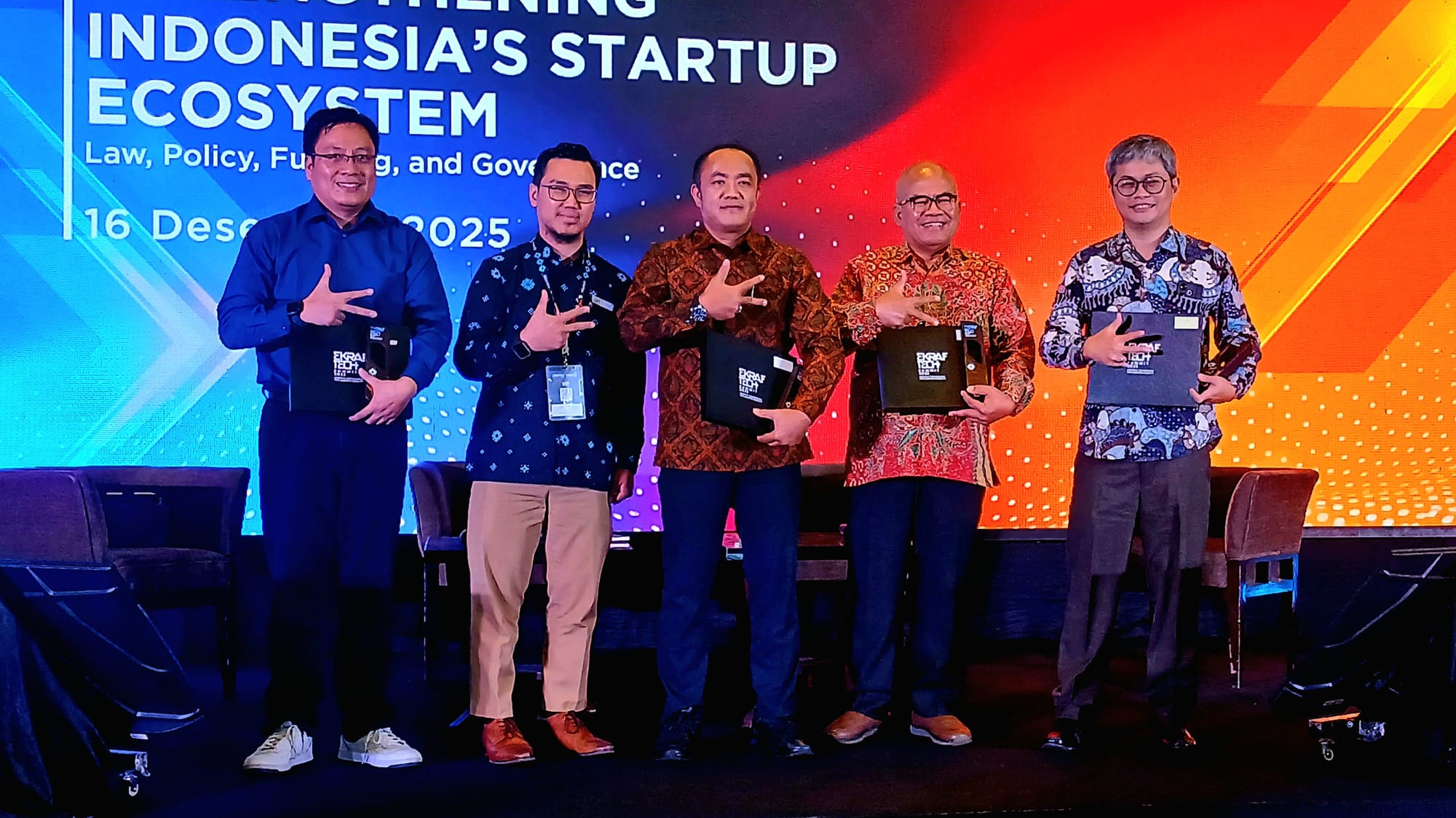
"In principle, investment brings ideas to life. Ideas give birth to innovation. Innovation opens up new businesses, and this is what creates jobs. For investment, you have to be bold, as well as consistent. We can't just think that once we've made an investment, that's it. It doesn't work that way," said Alex during a discussion on "Strengthening Indonesia's Startup Ecosystem" in Jakarta on Tuesday (12/16/2025).
Alex explained that the lack of knowledge about startup business practices ultimately affects the characteristics of startup regulations in Indonesia, which focus on permits and reports rather than the growth and concrete contributions of these companies to the creation of quality jobs and economic growth. In fact, the number of reports does not necessarily indicate progress, let alone the development of business scalability.
"Regulations that are thought to be good actually hinder innovation and make investors uncomfortable because they become focused on reporting rather than running their businesses. These regulations are ineffective because they not only affect companies, but ministries and agencies also become focused on producing positive reports rather than growing the ecosystem," he said.
If such regulatory characteristics are not immediately improved and a friendly growth ecosystem is not realized, Alex is concerned about the direct consequences, namely sluggish startup growth, followed by a brain drain of Indonesian digital talent to countries that are more supportive and appreciative of them. In fact, it is this digital talent that has been touted as the golden generation.
"If the state is absent, talent will leave, and the country will become nothing more than a market. We have been complaining that Indonesia is only a market, but we forget that many regulatory premises actually 'drive away' the nation's talent, to the point that they do not want to return," said Alex.
According to Alex, startup-friendly regulations are characterized by data synchronization between ministries and agencies to avoid overlapping and inconsistent information that could lead to contradictions during implementation. In addition, adaptive governance that takes into account Indonesia's bureaucratic structure, legal culture, and economic reality is needed, rather than simply copying startup regulations from other countries.
"Without synchronized regulations between ministries, synchronization between the central and regional governments, and compatibility between databases and public information systems, don't expect investors to be enthusiastic about developing startups in Indonesia," Alex concluded.
Mutual understanding
Responding to Alex's concerns, Amien Sunaryadi, Chairman of the Ministry of Finance's Tax Supervisory Committee, acknowledged that startup financing in Indonesia is relatively limited, not because of unwillingness or lack of enthusiasm for startup businesses, but because of the fear that startup players will be caught up in criminal charges of speculative state losses.
Amien explained that every state expenditure for specific financing, in this case startups, is audited by the Board of Audit by comparing inputs with outputs. If a certain amount of state-owned enterprise or state budget profits are spent to finance startups, the risk of failure and loss must be minimized, if not eliminated altogether, whereas the nature of the startup business cannot grow with that kind of approach.
"The government must be certain that startups have good intentions, so there should be no conflict of interest, gratification, or kickbacks. If a startup funding is considered detrimental to the state, treat it first as a business decision. Find out whether there is mens rea or not. If none is found, there is no reason to imprison the perpetrator under the state loss article," explained Amien.
According to Amien, only with this paradigm shift will the confidence of state-owned enterprises and the state budget to finance startup projects grow in tandem with the growing demand for financing from startup players who have been afraid to accept injections of funds from state-owned enterprises/the state budget for fear of being caught up in criminal charges for causing state losses.
"What we must oppose is bribery, kickbacks, and extortion. Business decisions that result in losses but are made without malicious intent should not be opposed. That's business—sometimes you win, sometimes you lose. Whether a decision is successful or not is determined by the business itself, not necessarily by the state's losses," he asserted.
Sharing Amien's view, Senior Attorney General Idris F. Sihite revealed that Indonesia ranks 69th out of 143 countries in the Rule of Law Index published by the World Justice Project.
The index, which measures the level of legal compliance, found that Indonesia's score was below the global and regional average, even though such a score guarantees good economic growth, certainty in the fulfillment of human rights, and firm and targeted handling of corruption.
"The specter of state losses is a specter created a priori by law enforcement officials. In fact, the legal process is mechanical and unhurried. With a commitment to certainty, there is no need for concern because there is a standard formula for determining the extent of losses arising from criminal elements based on strong evidence: association publications, reports, contracts," explained Idris.
In addition to emphasizing a paradigm shift in law enforcement, Amvesindo Chairman Eddi Danusaputro reminded startups that they also need to establish transparent and accountable corporate governance early on as part of their corporate culture. If transparency is implemented, every expenditure can be accounted for in a governance system with integrity.
"This integrity issue can only be resolved if the ecosystem is improved collectively. Amvesindo is working to improve governance through cooperation with venture capital associations in Singapore, Malaysia, and Vietnam to develop a maturation map to guide startups in completing due diligence during fundraising and IPOs," Eddi emphasized.
With a supportive growth ecosystem, targeted regulations, and transparent startup players, Eddi believes that the startup seeds currently scattered across Indonesia can accelerate their respective capacities to make a real contribution towards 8% economic growth.