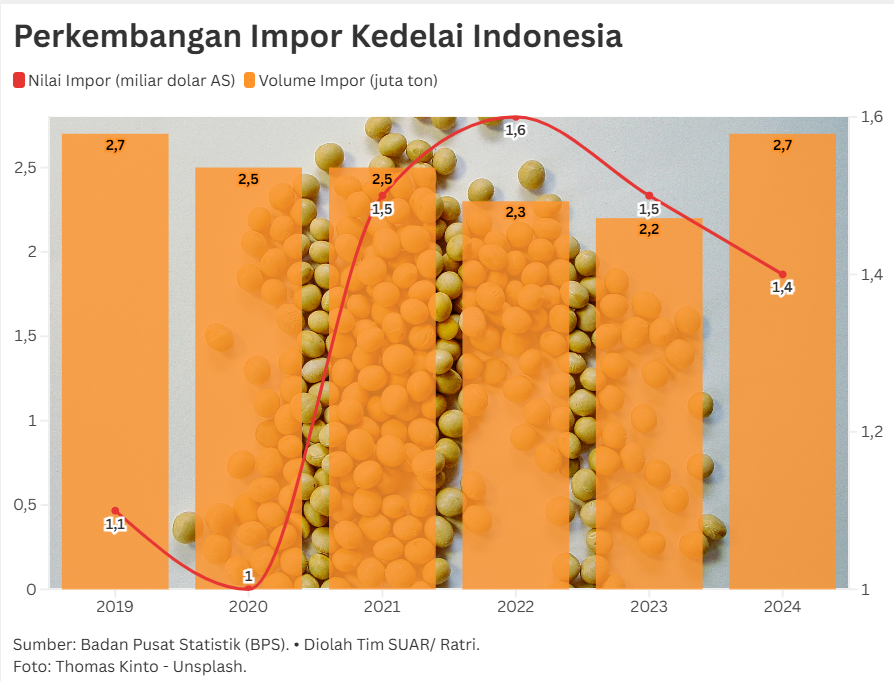
Data from the Central Statistics Agency (BPS) shows that the trend of Indonesia's soybean import volume is stable, with an average of over 2.5 million tons per year. In 2019, the soybean import volume was 2.7 million tons. It dropped to 2.2 million tons in 2023, but surged again to 2.7 million tons in 2024.
Meanwhile, the import value also fluctuates with the dynamics of global prices and exchange rates, reaching a peak of US$1.6 billion in 2022. The high volume of soybean imports is inseparable from the large demand or national soybean consumption, which reaches around 2.9 million tons to 3 million tons per year.
The United States is Indonesia's main soybean supplier, accounting for almost 90% of total import volume, followed by Canada. The trend of imports from the United States shows a decline in volume from 2017 (2,637,125.0 tons) to 2023 (1,949,365.2 tons). However, it surged again in 2024 to 2,378,735.9 tons.
On the other hand, imports from Canada show an increasing trend, from 12,104.0 tons in 2017 to 261,530.7 tons in 2024. In addition to these two countries, Argentina and Brazil have also exported soybeans to Indonesia in recent years.
The main factor of dependence on soybean imports is the low domestic soybean production. Although Indonesia has a large land potential, local production per year is still very minimal.
For comparison, in 2023, the national soybean demand was recorded at around 2.59 million tons. While domestic soybean production in that year only ranged from 346,821 tons to 400,000 tons, only able to meet about 13-15% of the total demand. Future production projections are even expected to decline.
Facing this challenge, the Indonesian government through the Ministry of Agriculture (MOA) continues to push to make soybeans a national strategic commodity and a priority for the self-sufficiency program. One of the main efforts voiced in 2025 is to revive integrated programs such as Pajale (Padi, Jagung, Kedelai). This program focuses on increasing the Planting Area Addition (LTT) to encourage massive expansion of soybean planting areas, especially in irrigated paddy fields after rice harvest.
In addition to land expansion, the long-term strategy towards soybean self-sufficiency lies in increasing productivity through the use of local superior seeds that are adaptive to Indonesia's climatic conditions and pest resistant, as well as strengthening farmer institutions and adequate financial support.
Although ambitious, the soybean self-sufficiency target is expected to be realized in the next few years, similar to the success claimed to have been achieved in rice and corn commodities. With synergized policies, research and full support for farmers, Indonesia's aspiration to enjoy tempeh and tofu made from 100% local soybeans is hopefully not just a dream.