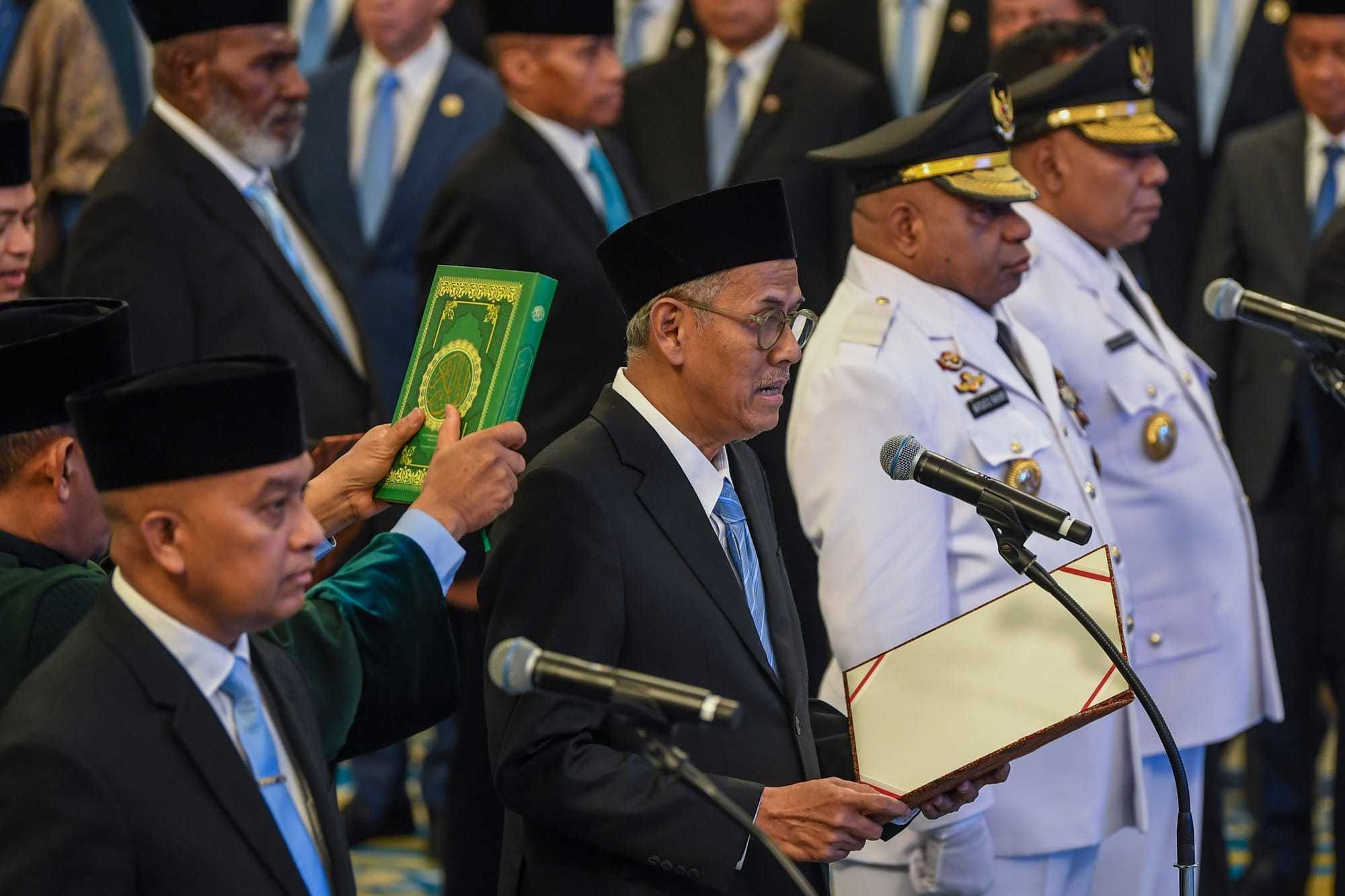
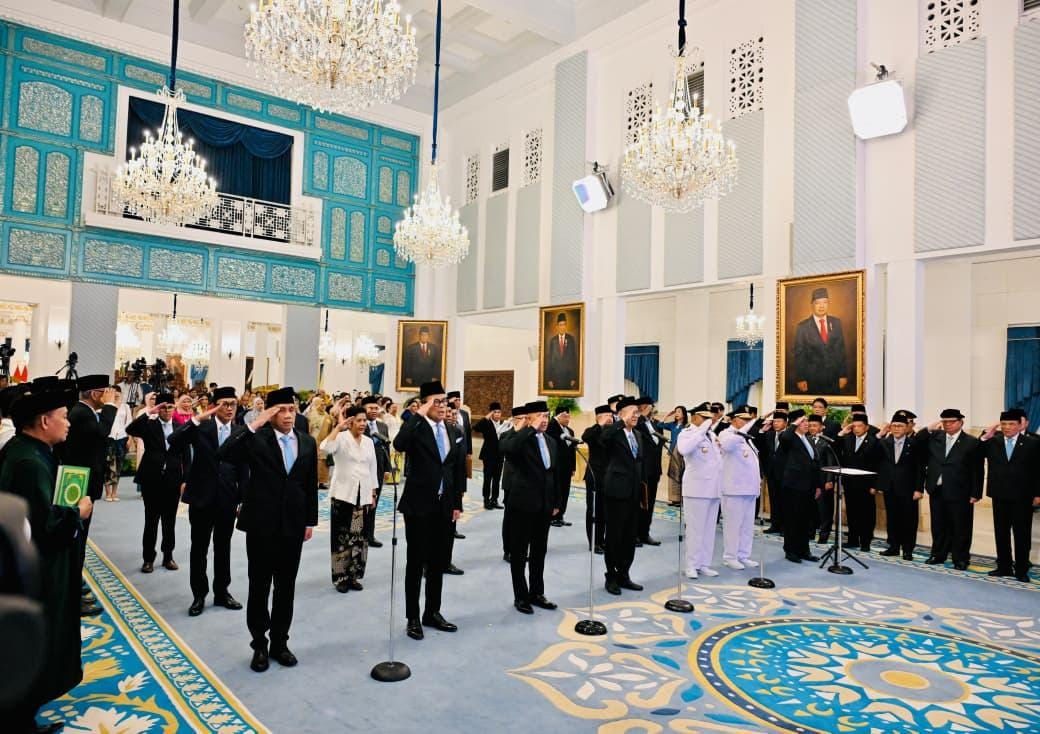
President Prabowo Subianto again inaugurated two new deputy ministers, and a number of other government officials in a cabinet reshuffle on Wednesday (8/10/2025).
The re-shuffling of the Deputy Minister positions and a number of officials is the fourth time in recent months, or less than a year since he served as president.
The two officials include Akhmad Wiyagus as Deputy Minister of Home Affairs (Wamendagri), while Benyamin Paulus Octavianus became Deputy Minister of Health (Wamenkes).
In addition, Prabowo also inaugurated a number of officials and heads of agencies and institutions as well as the Governor and Deputy Governor of Papua and 10 Ambassadors Extraordinary and Plenipotentiary (LBBP) for several friendly countries.
Some of them are Head of the BUMN Regulatory Agency Dony Oskaria, Deputy Head of the BUMN Regulatory Agency Aminudin Maruf, Deputy Head of the BUMN Regulatory Agency Tedi Bharata, Governor of Papua Matius Fakhiri, Deputy Governor of Papua Aryoko Alberto Ferdinand Rumaropen.
Dony previously served as Deputy Minister of BUMN as well as Chief Operation Officer of the Danantara Investment Management Agency. He was chosen last September as Acting Minister of BUMN after Erick Tohir moved to become Minister of Youth and Sports.
The replacement at that time raised the issue of a merger between the Ministry of BUMN and Danantara because the President only appointed Doni as Minister of BUMN ad interim. However, the merger is still in the review process, according to the Minister of State Secretary, Prasetyo Hadi some time ago.
As before, this reshuffle seemed sudden. Dony admitted to receiving a call from Cabinet Secretary Teddy Indra Wijaya to come to the Palace an hour before.
Meanwhile, Anggito Abimanyu was elected as Chairman of the Board of Commissioners of the Deposit Insurance Corporation (LPS), also inaugurated were Doddy Zulverdi, Suminto, Ferdinan Dwikaroja Purba.
The Governor of Papua, Matius Fakhiri emphasized that the main priority of his government is the development of Papua's human resources, especially through the education and health sectors which are considered the main foundation for regional progress.
"We will coordinate with ministries and institutions, as well as the Committee formed by the President, to accelerate development steps," he added.
The number of Merah Putih cabinet which consists of more than hundreds of people is considered to burden the state finances in the five years of his government, according to experts.
The Prabowo government also split nine new Ministries in the previous government into 21 new ministries, with seven coordinating ministries.
Still wait and see
Economist from the Center for Strategic and International Studies (CSIS) Deni Friawan assesses that this change is a natural thing in every government because reshuffling is the prerogative right of the President.
"It will be good, if the reason for the change is to improve the running of the government so that it can accelerate or improve the implementation of government programs and have a good impact on society," he said.
Conversely, it will have a negative impact if the reasons are not genuine, such as political motives and merely distributing positions. "If it happens too often and doesn't have a real impact, because besides making the cabinet and budget 'fatter,' it could imply that the president is not capable of choosing their assistants," he said.
He said that investors have been hesitant and tend to 'wait and see' regarding the policies taken by the Prabowo administration.
"They certainly see it not just in terms of who the replacement is, but also how the policies taken by the minister or deputy minister are realized."
"Essentially, investors will weigh the risk and reward return of their investment. If the reward return is high compared to the risk, they will invest in Indonesia. If not, they will wait or hesitate," he added.
Director of Research at Bright Institute, Muhammad Andri Perdana, said that a reshuffle is not a bad thing in itself, as long as it is done to improve the performance of ministers who are considered not optimal. "Investors will see that the government is serious about improving management," he said.
So far, he believes that the swelling number of cabinet members is not automatically directly proportional to the increase in economic performance. He cited that since the limit on the number of ministers was removed, the government's performance has not shown a positive correlation with economic indicators, from tax revenue to public purchasing power.
The more cabinet members there are, he said, the less efficient the results of these budgets are in terms of their impact on the community's economy.
"Because if you look at the economic impact, it's the opposite. The more cabinet members there are, it doesn't necessarily improve government performance, that's the point," he said.
Secretary-General of the Indonesian Forum for Budget Transparency (Fitra), Misbah Hasan, said that the addition of two Deputy Ministers to the cabinet makes the cabinet even larger.
The bloated cabinet of the Prabowo administration could also have an impact on the swelling of the operational budget, especially central government employee spending.
Misbah estimates that there will be an increase in employee spending of 20 percent to 30 percent. "This will inflate employee spending and spending on goods/services, including employee benefits, official travel expenses, food and drinks, and so on," he told SUAR in Jakarta (10/8).
Gema Dzikri Harisma and Ridho Sukra contributed to this article