Migrant workers are foreign exchange heroes for the country. Every year, not a few funds flow into the country from various parts of the world where Indonesian migrant workers have a diaspora.
However, the fate of Indonesian migrant workers is not entirely fortunate and prosperous. The skill factor is still an obstacle to getting a better job and income.
The SUAR team explored the thoughts of business leaders, regulators and economic observers through the Business World Universe Survey on the problems of Indonesian migrant workers and what businesses can do to help migrant workers.
Survey results:
- The government is considered unable to overcome the unemployment problem (56.7%).
- Sending workers abroad can solve the problem of unemployment (63.3%), although it is short-term.
- Only a small proportion of migrant workers (PMI) have not earned a decent income abroad (10%). The rest have earned a decent income.
- Factors that influence migrant workers to earn a decent income abroad: skills and education (50%), careful preparation (13.3%), and mastery of foreign languages (13.3%).
- The government cannot solve the unemployment problem alone, it needs joint steps involving many parties.
- The business world can play a big role in addressing the problem of unemployment and migrant workers.
- The private sector should be involved in providing skills training for prospective migrant workers and in channeling migrant workers to destination countries.
Indonesian migrant workers are classified as workers with low education and skills, even classified as unskilled. Referring to data from the Ministry of Protection of Indonesian Migrant Workers, the majority of Indonesian migrant workers' education level is elementary to high school (96%).
Private companies in Indonesia have many specialized skill areas, which if developed for prospective migrant workers, would increase the bargaining power of prospective migrant workers when working abroad. Skilled (certified) migrant workers will fill formal, high-income jobs.
Good collaboration with various parties, especially with private companies, in producing skilled migrant workers will improve the welfare of migrant workers. With the better life of migrant workers, the blessings for their families back home and also for the government will be greater through the flow of remittances.
From the income earned by migrant workers, families in the country are also blessed through remittances, aka money sent to families in the country. Remittances from migrant workers contribute to a country's economy through income equality, increased purchasing power and economic growth.
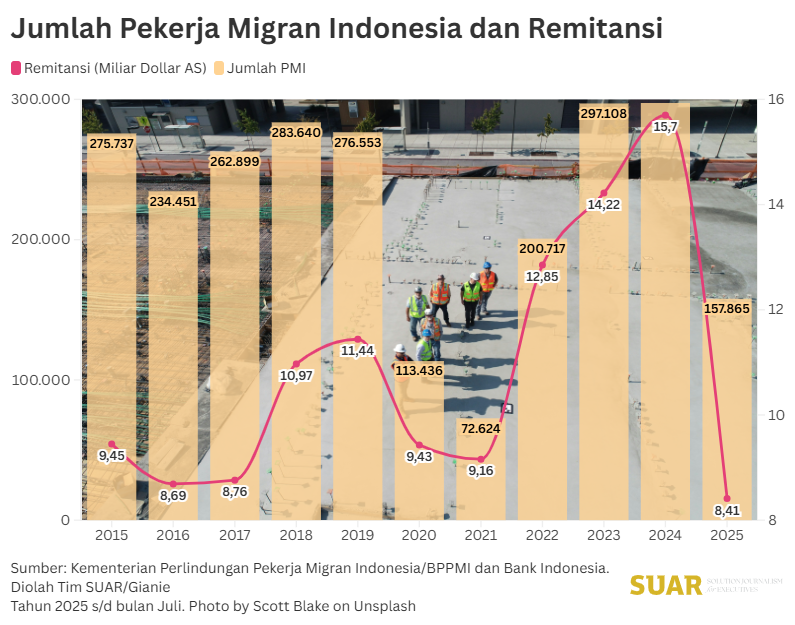
Bank Indonesia data shows that the amount of PMI remittances tends to increase, especially after the economy recovers from the pandemic. In 2024, the highest number of remittances was recorded at US$15.7 billion, a 10% increase compared to the previous year. The amount of remittances entering Indonesia contributed 1.1% to the gross domestic product (GDP, 2024).
Methodology:
The Business World Universe Survey was conducted on July 22-August 7, 2025. Interviewees (respondents) were selected by purposive sampling from the business world, regulators, and economic observers. From the business world, the position of the resource persons varied, ranging from directors, managing directors, to owners. From the regulators, there are regional heads and council members.
Read more here, Chief.
Author: Gianie