

Good morning Chief...
The following is important information related to the development of the business universe that needs attention today based on the curation of the SUAR Team.

How Indonesia deals with Trump's tariffs

Facing the decision of President Donald Trump's administration to slap tariffs on Indonesian products entering the United States of America of up to 32%, the government will continue to renegotiate.
In addition, a combination of deregulation and encouragement of direct transactions between business actors was also carried out. Business to business cooperation is considered to be a way out of the threat of Indonesia-United States trade needs.
Long before the tariffs were introduced, the Government encouraged the private sector to immediately agree on trade or investment transactions with their counterparts in the United States. Progress:
The signing of a US$1.25 billion wheat purchase memorandum of understanding (MoU) between Indonesian and US businesses
The total value of B2B deals reached has exceeded the value of the trade deficit complained about by the US side.
Some other developments are busines to business agreements that have been signed:
PT Pertamina (Persero) has signed a memorandum of understanding related to the import of crude oil from the United States (US). In the cooperation document or Memorandum of Understanding (MoU), Pertamina is ready to buy LPG, gasoline and crude oil from the US.
FKS Group and PT Sorini Agro Asia Corporindo Tbk have signed an agreement to purchase corn from Cargill, including Sorbitol Syrup and Sorbitol Powder, Maltitol, Dextrose Monohydrate, Maltose Syrup, and Maltodextrine.
The government is also preparing a long-term foundation through regulatory reform. The government considers that Indonesia still has the opportunity to change the final outcome of the tariff policy, by emphasizing Indonesia's strategic position in global trade.
Full news can be read here.

A New Economic Driver Called Jastip
The economy at the Jakarta Fair Kemayoran (JFK), or PRJ as it is more commonly known, has become more dynamic thanks to the jastip business.
Jastip is a business model where an individual, referred to as a jastiper, offers to buy and deliver goods from a specific location (e.g. an exhibition, another city, or an exclusive store) to a customer who cannot access that location in person.
Jastipers earn a service fee from each transaction, allowing customers to get their desired items without having to come in person, while creating flexible economic opportunities for jastipers.
Some tenants at PRJ admitted that they benefited from the presence of the jastiper. Their merchandise sells better because there are marketers who can reach a wider area, not only in the exhibition area. Meanwhile, the jastipers benefit from the margin of sales to clients who are located in distant places.
They have a unique marketing method, utilizing information technology that allows consumers who cannot come to the store to know the advantages of the products offered.
Full news can be read here.
Hoping for Copper Tariff Blessings

Copper prices have soared to record highs after United States President Donald Trump announced plans for a 50% tariff on imported copper. Trump's policy triggered a shock in the global market. Amid this commotion, Indonesia has a strategic opportunity to take over part of the market and strengthen its fiscal resilience through exports and export duties.
The surge in copper prices due to Trump's sentiment brought copper prices to a level of US$5.676 per pound or around $12,510 per ton, an increase of 3.58% in one day.
This increase reinforces the global trend since 2024 due to supply deficits from Latin America and soaring demand from the electric vehicle and AI sectors. Bank of America projects prices will hit US$5.44 per pound in 2026, while the International Copper Study Group predicts global consumption this year will reach 25.88 million tons.
While major copper exporting countries such as Peru and Mexico are preparing to be affected by tariffs, Indonesia is in a different position.
Export data from Satudata Kemendag shows that from January to April 2024, Indonesia exported copper ore worth US$2.26 billion and copper products and derivatives worth US$781 million.
Most of these exports are not destined for the US, but rather for China and other Asian regions. This means that the burden of US tariffs on copper is not a major risk for Indonesia, but rather a potential to fill the global supply gap.
To read more, please click here.
Public Schools and Poverty
The Ministry of Social Affairs (Kemensos) has begun piloting the implementation of the People's School in two locations, namely Sentra Handayani Jakarta and Sentra Terpadu Pangudi Luhur (STPL) Bekasi. This simulation was carried out before the students started school on July 14, 2025.
This simulation activity took place for two days on Wednesday and Thursday, July 9-10, 2025. The students will undergo learning trials and stay in the dormitories that have been provided.
The Sekolah Rakyat program for the 2025/2026 academic year will begin this month in 100 pilot locations across Indonesia. Of these, 63 will begin matriculation on July 14, 2025 and 37 will start at the end of July 2025.
Chairman of the Sekolah Rakyat Formation Team, Prof. Muhammad Nuh, emphasized three main keywords that became the philosophical foundation of the Sekolah Rakyat program, namely ennobling, reaching the unreachable, and enabling the impossible from the children of poor families.
Full news can be read here.

The Decent Living Gap
Indonesia is a country with a relatively low cost of living based on the World Population Review 2025. In the report, Indonesia is in 37th position with a cost of living of US$567 or Rp9 million per month. As a comparison, Nigeria is the country with the cheapest cost of living, which is US$355 per month. Meanwhile, Monaco is the country with the most expensive cost of living, which is US$6,538 per month.
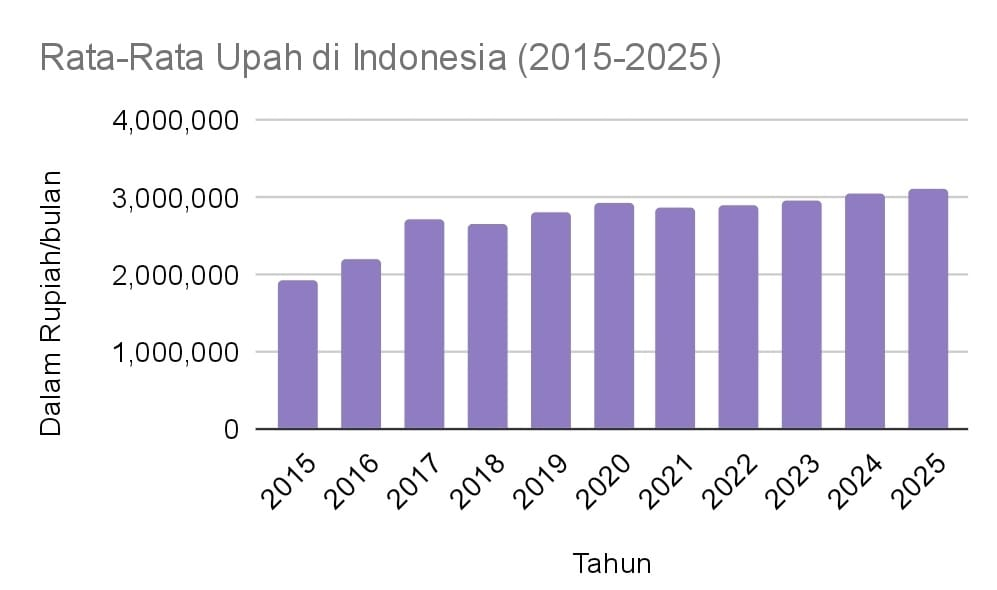
However, in Indonesia, the cost of living of US$567 per month is far above the average wage or income of people in Indonesia, or can be said to be high for most Indonesians. Data from the Central Statistics Agency (BPS) states that the average wage in Indonesia in the last ten years (2015-2025) ranged from IDR 2 million to IDR 3 million per month. It was only in 2024 that wages reached Rp3,040,719 and in 2025 to Rp3,094,818.
The relatively higher cost of living compared to the income received shows that there is still a social gap. Judging from BPS data on the Gini Ratio, the gap in the welfare of Indonesian society is still quite wide, with an index of 0.381 (2024).

Singapore International Jewelery Expo 2025
For some people, jewelry is a lifestyle that cannot be separated. Some jewelry such as diamonds to pearls are targeted for collection, especially for women. In addition to jewelry stores, jewelry exhibitions are also events that are often visited to add to jewelry collections.
The 2025 International Jewelry Exhibition will be held at Sands Hall, Marina Bay Sands Singapore from July 10 to 13, and participants are required to register in advance. It is also a meeting place for jewelry collectors and buyers.
In addition to the exhibition, there will be jewelry door prizes starting from 2 thousand Singapore dollars depending on the type. This event is a collaboration between ICCS (Italian Chamber of Commerce in Singapore) and IEG Asia for the renewal of the cooperation agreement.

Leonardo da Vinci
Have a great day, Chief.
Team SUAR