The government is rolling out a series of measures to curb the rising tide of financial crime, including taking down thousands of online gambling sites, blocking dormant bank accounts, and encouraging public reports of suspicious activity.
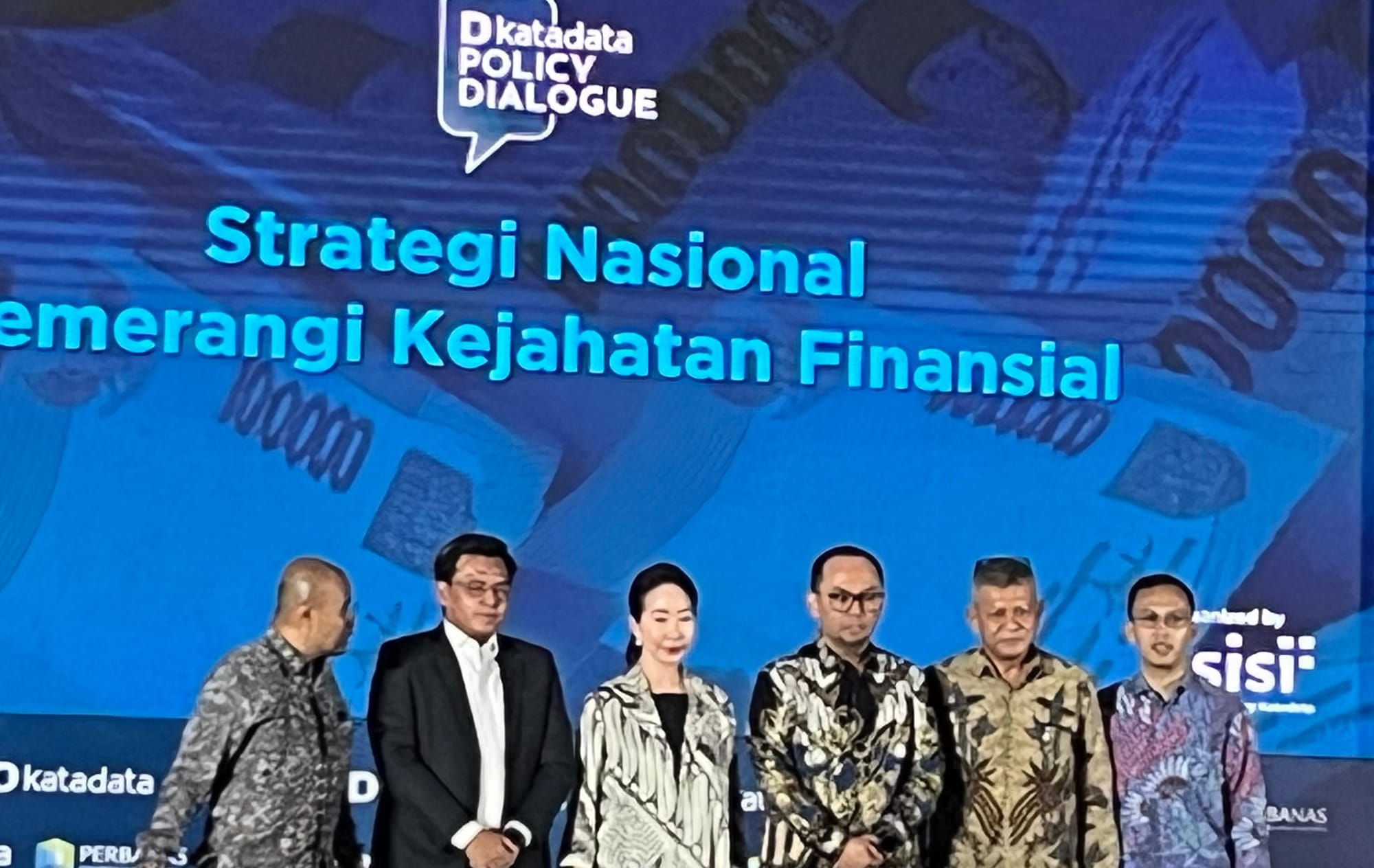
Deputy Commissioner for Market Conduct Supervision and Consumer Protection (PEPK) at the Financial Services Authority (OJK), Rizal Ramadhani, outlined the approach at the Katadata Policy Dialogue: “National Strategy to Combat Financial Crime,” at JS Luwansa Hotel, Jakarta, Tuesday (Aug. 5).
Rizal said the Illegal Financial Activity Eradication Task Force (Satgas Pasti), together with the Indonesia Anti-Scam Center (IASC), continues to monitor and tally public losses from digital fraud. By end-June 2025, OJK recorded total losses of Rp 4.1 trillion, with Rp 348.3 billion of victim funds successfully frozen.
Victims come from a wide range of professional backgrounds. “Perpetrators of financial crimes are increasingly sophisticated, exploiting the names of public figures and celebrities to build trust before draining victims’ accounts,” he said.
The modus operandi has also evolved. No longer relying on phone calls and SMS alone, perpetrators now operate actively across digital platforms—such as WhatsApp, X (formerly Twitter), and other messaging apps.
In response, Satgas Pasti is strengthening coordination with ministries, industry associations, and relevant agencies. “Even the bad actors are collaborating; we need to be even more solid in our own collaboration,” Rizal said. He added that perpetrators have long leveraged technological advances before authorities fully recognized the threat. IASC data show a significant surge in digital fraud in recent years.
“Even the bad actors are collaborating; we need to be even more solid in our own collaboration,”
As a mitigation step, OJK has asked banks to block more than 25,900 accounts suspected of involvement in online gambling and online fraud.
Freezing Dormant Accounts Squeezes Online Gambling
Blocking dormant accounts has become necessary, officials say, because criminals often use these “sleeping” accounts to park online gambling proceeds.
“In 2024, we estimated online gambling turnover could reach Rp 981 trillion. Thanks to the efforts of banks, regulators, and the task force, we brought it down to Rp 359 trillion,” said PPATK head Ivan Yustiavandana at the same event. In the first half of 2025, PPATK data show online gambling flows at just Rp 99.6 trillion—far below last year’s level. Without government intervention, Ivan warned, turnover by end-2025 could have reached Rp 1.1 quadrillion.
“With the current intervention framework, we are optimistic that online gambling flows can be reduced even further—possibly into negative territory,” he said.
—graphic isnt available
Technology-Based Strategies
Curbing financial crime requires more than freezing dormant accounts. Teguh Arifiyadi, Director of Supervision for Certification and Electronic Transactions at the Ministry of Communication and Digital (Komdigi), said the government faces evolving challenges in shutting down online gambling sites and countering perpetrators’ ever-changing tactics.
“Previously, online gambling sites used ordinary domains—say, slot.com. Now they keep shifting: adopting IP-based addresses, changing keywords, and even using image-based content to evade detection,” he said.
To address this, Komdigi aims to stay one step ahead with 24/7 cyber patrols to block such sites—going so far as to pose as gamblers to trace the bank accounts being used.
“Komdigi has even had to pose as gamblers to track the accounts being used.”
“We have to join the game to obtain their initial deposit accounts. We then forward these account numbers to OJK and PPATK for blocking. To date, we have identified more than 76,000 accounts linked to online gambling,” Teguh said.
He also stressed the importance of public participation in helping the government curb online gambling transactions. Komdigi reported that public submissions on online-gambling content have risen sharply—from 110,000 reports in 2017 to 100,000–200,000 per month—reflecting growing public awareness.
Economic and Social Impact
At the same event, National Economic Council (DEN) member Firman Hidayat outlined the negative impact of online gambling on gross domestic product (GDP), noting that funds diverted to gambling could otherwise support productive consumption or investment.
“When that money is used for online gambling—especially when 70% of it flows overseas—the multiplier effect for the domestic economy disappears. This drags down our GDP,” Firman said.
DEN’s preliminary study estimates that in 2024 alone, online gambling shaved 0.3 percentage points off economic growth. In other words, if last year’s growth was 5%, it could have reached 5.3% without online gambling. DEN’s preliminary study estimates that in 2024 alone, online gambling reduced economic growth by 0.3 percentage points.
DEN’s preliminary study estimates that in 2024 alone, online gambling shaved 0.3 percentage points off economic growth.
Online gambling also carries serious social consequences. Fakhridho Susrahardiansyah, Executive Director of Katadata Insights Center, presented findings from an independent study. “The data tells us the impact of online gambling is massive and not limited to economics. There are social effects we don’t always see,” he said.
He cited BPS data showing an increase in divorce cases linked to gambling. In addition, 75% of online gamblers reportedly use narcotics to maintain stamina.
The burden is felt most by lower-income households. “Seventy-one percent of the 9.8 million online gamblers earn under Rp 5 million,” Fakhridho noted.
While recent government interventions have produced positive results, Teguh Arifiyadi cautioned that blocking alone cannot be a permanent solution, as perpetrators continue to innovate. “As long as there are players, online gambling won’t disappear. What we can do is raise digital and financial literacy across society,” he said.
Fakhridho echoed the point, calling for stronger public education, firm law enforcement, and the adoption of technology to tighten oversight. He added that inter-agency collaboration and broad stakeholder synergy are essential to combating this destructive financial crime.