
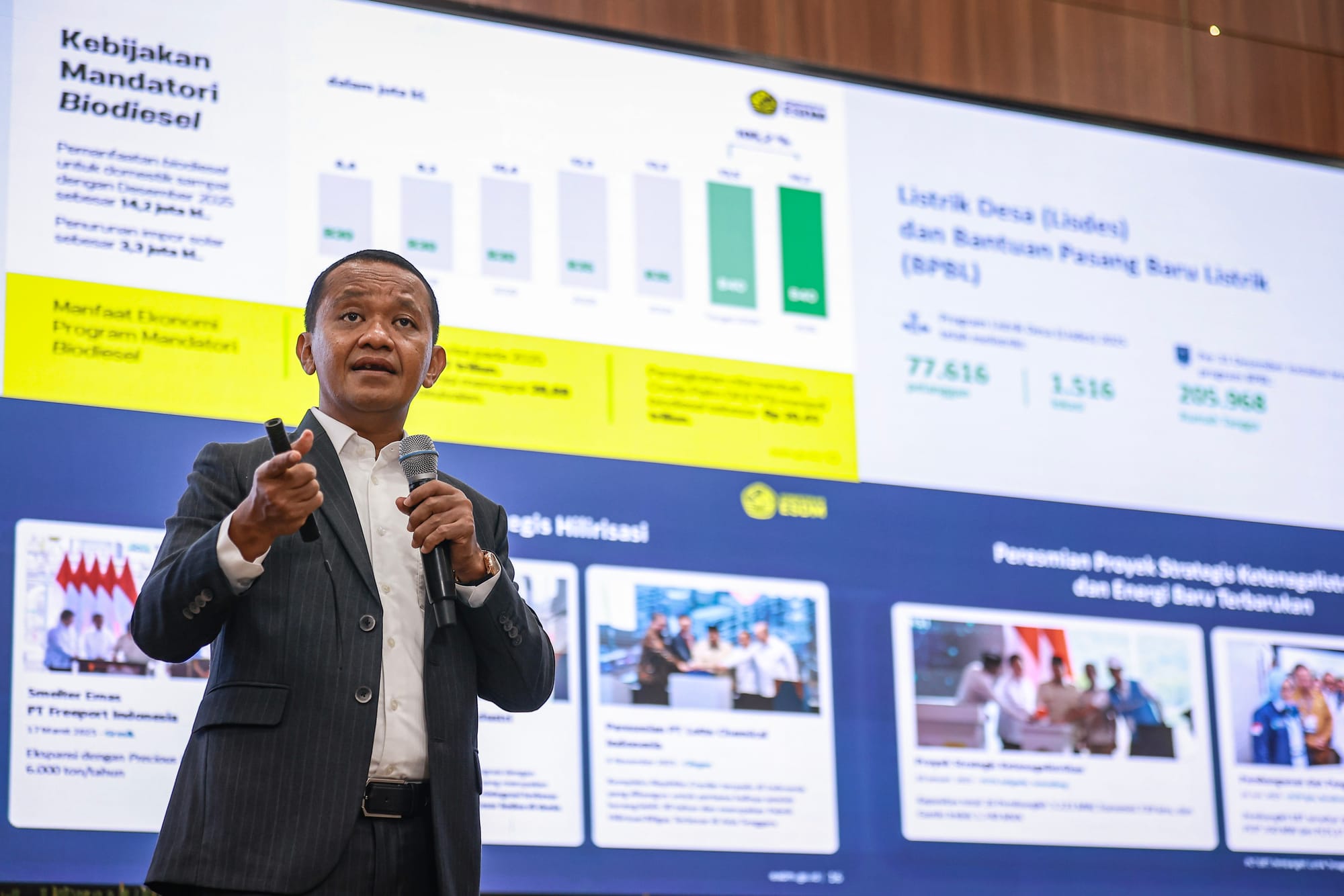
The Ministry of Energy and Mineral Resources (ESDM) on Thursday (January 8, 2025) targeted the mandatory implementation of B50 biodiesel in the second half of 2026 to stop diesel imports, following successful trials in the first half of 2026.
Renewable fuel blended with 50% crude palm oil (CPO) is predicted to be one of the national energy security strategies in 2026.
Minister of Energy and Mineral Resources Bahlil Lahadalia said that the B50 biodiesel trial is currently underway and is targeted for completion in the first half of 2026. If the results are as expected, the government will immediately announce full implementation in the second half of next year.
"For B50 biodiesel, it is already in the trial phase and will be completed in the first semester of 2026. If it is successful, we will launch it. Thus, if we use B50 and the RDMP, which we will inaugurate in the near future, is already in place, then we will no longer import diesel fuel in 2026," said Bahlil at the 2025 ESDM performance press conference on Thursday (8/1/2026).
According to Bahlil, the availability of domestic crude palm oil (CPO) raw materials is a key factor in the success of the B50 program. The government considers the national palm oil supply to be adequate, so that increased domestic consumption will not interfere with export performance.
"B50 for palm oil is not a problem. All that remains is to set export quotas and domestic requirements. Our focus is on energy sovereignty," he said.
The B50 program itself is a continuation of the mandatory B40 biodiesel policy, which throughout 2025 has been proven to significantly reduce diesel imports. According to records from the Ministry of Energy and Mineral Resources, diesel imports fell from around 8.3 million kiloliters (kl) in 2024 to around 5 million kl in 2025. The distribution of B40 biodiesel even reached 14.2 million kl, or 105.2 percent of the target of 13.5 million kl.
"The mandatory biodiesel policy, I am grateful that our diesel imports in 2024 will still be around 8.3 million kiloliters, then in 2025 it will drop to 5 million kiloliters. So what is the reason for this? Our biodiesel program, B40," said Bahlil.
In addition to reducing imports, the implementation of B40 also has a significant economic and environmental impact. The government has recorded foreign exchange savings from the reduction in diesel imports amounting to Rp130.21 trillion.
In terms of the environment, this policy has reduced carbon emissions by up to 38.88 million tons of CO₂ equivalent. Meanwhile, the added value from processing CPO into biodiesel has reached Rp20.43 trillion.
Going forward, Bahlil emphasized that the government remains consistent in pushing for the mandatory implementation of B50 in 2026. However, its implementation will be carried out gradually and selectively in accordance with the specifications of national diesel fuel requirements.
"For B50 biodiesel, trials will be completed in the first semester of 2026. We will see in the second semester. If it is successful, we will launch B50," he explained.
With the implementation of B50, the government estimates that imports of diesel fuel with a cetane number (CN) of 48, which is commonly used for motor vehicles and public facilities, can be stopped.
However, imports of diesel fuel with a higher CN, namely CN 51–52, will still be carried out to meet the needs of heavy equipment in the mining sector, including at PT Freeport Indonesia (PFTI), because domestic production capacity is still insufficient.
"To date, we have not been able to produce enough Solar 52. We still have the option of importing Solar 51 from abroad because domestic industry is not yet sufficient," he explained.
Beyond biodiesel, the government is also finalizing the development of bioethanol as part of its renewable energy diversification efforts. The bioethanol roadmap is currently in the final stages of completion, with a mandatory implementation target of 2028 at the latest.
"The roadmap is still being developed, but I can assure you that it will be mandatory by 2028 at the latest. Perhaps 2027–2028. The roadmap will be completed soon," said Bahlil.
Overall, Bahlil emphasized that the B50 policy is not merely an energy program, but part of a larger strategy to reduce import dependency, strengthen the national palm oil industry, and promote energy sustainability through the Refinery Development Master Plan (RDMP) project, which the government is currently accelerating.
Boost competitiveness
The Indonesian Palm Oil Farmers Association (POPSI) has reminded the government to exercise caution in its plan to increase the biodiesel mandate to B50 in 2026, which is accompanied by discussions of an increase in palm oil export levies.
This policy is considered risky as it could undermine the competitiveness of the national palm oil industry and have a direct impact on farmers' welfare.
POPSI Chairman Mansuetus Darto believes that if the implementation of B50 is too aggressive and dependent on funding from the Palm Oil Plantation Fund Management Agency (BPDP), the upstream palm oil sector could potentially become a victim.
"Funds for rejuvenation, productivity improvement, human resource strengthening, and ISPO certification will be marginalized," he told SUAR.
He explicitly requested that the government thoroughly examine the impact of the B50 biodiesel implementation plan. He warned that the policy could potentially lead to an increase in palm oil export levies (PE) and put pressure on farmers.
"If it is true that B50 increases the PE and puts pressure on farmers, then the side taken in favor of the small people should be questioned. The energy transition should not be paid for with the suffering of farmers," said Mansuetus.
Regarding funding, palm oil export levies currently range from USD 75 to USD 95 per ton. POPSI notes that every USD 50 increase in export levies has the potential to reduce the price of fresh fruit bunches (FFB) for farmers by around IDR 435 per kilogram.
This situation is feared to further reduce farmers' income amid limited BPDP funds, which are expected to run out in mid-2026.
Indonesia Palm Oil Strategic Studies (IPOSS) in its 2026 Indonesian Palm Oil Industry Outlook study noted that since the B30 trial in 2018, CPO consumption for biodiesel has increased significantly and created structural demand that is relatively insensitive to price fluctuations.
The implementation of B40 in 2025, as well as the potential transition to B50 in 2026, is expected to further tighten global CPO supply. In the B40 baseline scenario, global CPO prices are projected to be in the range of USD 1,050–1,150 per ton CIF North West Europe in the first half of 2026. If B50 is realized in the second half of 2026, the additional domestic demand of around 2.1 million tons of CPO has the potential to push prices up to the range of USD 1,130–1,200 per ton.
He also warned of the risk of disruption to cooking oil supplies. "Don't let fuel take precedence over food," he said. According to him, the current biodiesel scheme is too dominant, unlike when B15–B20 was in place.
"If the funding runs out before April 2026, where will the money for B50 come from?" he said.
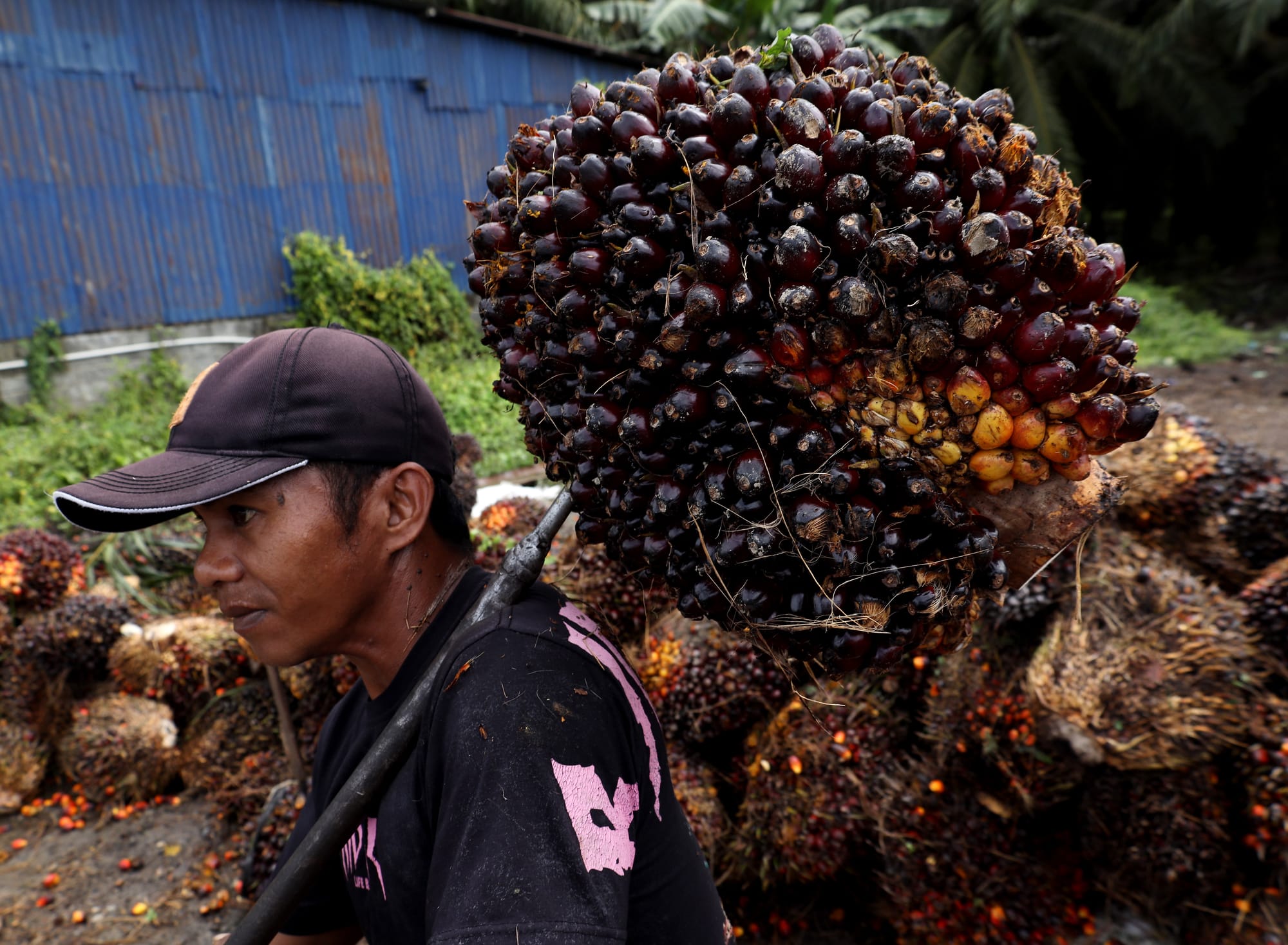
Similarly, the Palm Oil Farmers Union (SPKS) has asked the government to evaluate its biodiesel policy, although it does not reject the program. The head of SPKS's Advocacy Department, Marselinus Andry, believes that the implementation of biodiesel has not been inclusive of smallholder palm oil farmers.
According to him, there is still no policy ensuring that biodiesel raw materials are sourced from farmers or plantation cooperatives. On the other hand, the biodiesel industry still depends on government subsidies, thereby widening the gap in the use of funds from the Plantation Fund Management Agency (BPDP), which should support smallholder plantations.
Marselinus warned that increased blending could potentially trigger an increase in CPO export levies and weaken the competitiveness of national palm oil.
"Therefore, SPKS proposes limiting biodiesel blending to a maximum of 30 percent, taking into account domestic industry needs, exports, and the subsidy burden," Andry told SUAR.
He also highlighted the lack of integration between biodiesel development and increased palm oil productivity in the upstream sector.
"Every increase in blending is always met with the opening of new land, which risks triggering deforestation and threatening the credibility of Indonesian palm oil," he said.
Disrupt exports
The government's plan to implement a mandatory B50 biodiesel program in 2026 is considered
The Chairman of the Indonesian Palm Oil Association (Gapki), Eddy Martono, said that the implementation of this policy requires a more flexible approach. "It cannot be rigid; it is necessary to consider the dynamics of world oil prices and global CPO prices, which are currently volatile," said Eddy.
Gapki projects that CPO demand to support the B50 program will increase dramatically. If B40 alone requires around 13.5 million tons of CPO, then B50 is estimated to consume up to 17.4 million tons. Coupled with food demand, total domestic consumption could reach 28.4 million tons.
"With national production stagnant, high domestic consumption has the potential to reduce Indonesia's palm oil export volume," he told SUAR Jakarta (8/1).
In his speech yesterday, President Prabowo Subianto said that Indonesia may seize an additional 5 million hectares of oil palm plantations this year.
Last year, a task force consisting of the military, police, and prosecutors took over 4.1 million hectares of land that was said to be operating illegally in forest areas, targeting large palm oil companies and small farmers.
Indonesia, the world's largest palm oil producer, has a total of 16.8 million hectares of palm oil plantations.
Some analysts predict that the seizure, coupled with the biodiesel project, could put further pressure on global prices by disrupting production.