The fisheries sector is included in the 2025 economic stimulus package through employment programs. From the abundant maritime potential, the government wants to revitalize pantura ponds and modernize fishing boats. Not only to absorb more labor, the stimulus must lead to the welfare of fishermen.
By 2023, there are more than 3 million workers or fishermen who depend on this sector for their livelihood. Most of them are in areas along the northern coastline or pantura of Java Island, which requires greater attention.
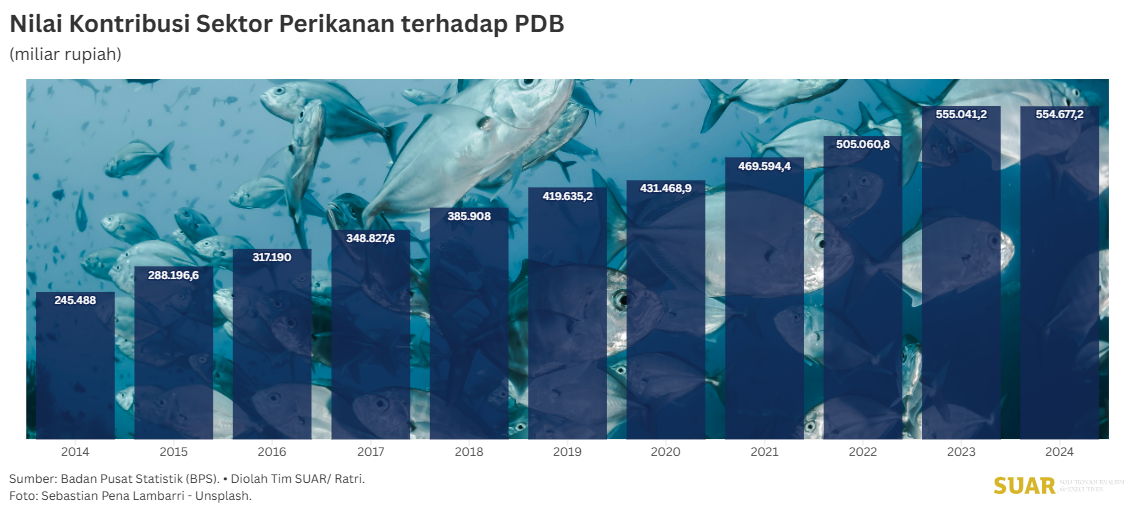
In the past decade, the contribution of the fisheries sector to gross domestic product (GDP) has continued to increase. If in 2014 its contribution was recorded at IDR 245,488 billion, by 2024 it will double to reach IDR 554,677.2 billion. This contribution is the second largest contribution in the agriculture, livestock, forestry and fisheries sector group.
The value of capture fisheries production has consistently increased from IDR 180 trillion in 2019 to IDR 206 trillion in 2023, although it was corrected in 2020 due to the pandemic. The production value of aquaculture, although not as high as capture fisheries, is also growing. Namely, from IDR 263 trillion in 2019 to IDR 272 trillion in 2023.
This increase in production cannot be separated from the government's efforts through priority programs. For example, the development of aquaculture to increase exports (shrimp, lobster, seaweed) and the implementation of quota-based Measured Fishing (PIT) which aims to maintain the sustainability of fish resources while optimizing the value of the catch.
Through this new economic stimulus package, the government wants to focus on improving the capacity and welfare of fishermen. Some of the flagship programs that are directly related to this sector include the initiation of the Merah Putih Fishermen Village, the pond revitalization program in the Pantura area, and efforts to modernize fishing boats.
Until now, the fisheries sector in Indonesia is still plagued by many problems, ranging from the degradation of production equipment to distribution chain problems and a decrease in purchasing power or fishermen's welfare. Therefore, the fishing boat modernization and pond revitalization programs are crucial.
Modernizing fishing fleets or vessels will improve the effectiveness of fishing operations, reduce bycatch, and ensure compliance with international standards. Meanwhile, the revitalization of ponds, particularly in the north coast, is needed to address environmental degradation issues and increase more sustainable aquaculture production.
This focus on upstream and downstream aspects is expected to be the key to transforming structural challenges into competitive advantages, while improving the welfare of fishermen.