
The internet promises a hassle-free future. Now, reading the news does not need to wait for the latest news to be printed on newsprint that will only be circulated tomorrow. Gaining knowledge can now be done by reading books or journals from Kindle, e-Books or online subscriptions without having to buy at bookstores or rent them at libraries. Also, if you want to listen to music, all it takes is a tap of the Spotify or YouTube Music app button, without having to buy compact discs (CDs) or cassettes and play them on expensive stereo sets.
But when was the last time you read the news on your device online and actually felt well-informed, before being diverted to another topic that didn't really matter. Or with so many e-Books piling up on your Kindle or Ipad, when did you actually finish reading one book and not opt for endless scrolling on social media.
The same risk occurs when the listener chooses to listen to music via streaming. Just like reading an e-Book, listening to music by streaming through a mobile device runs the risk of not actually listening to the music, where the song becomes background noise that is easily ignored.

Music is a form of cultural manifestation that is too expensive to ignore. It is also too useful to ignore. There have been many studies that have proven that music, when played to children at an early age, will help their intelligence and improve their cognitive abilities.
At the other extreme, many scientific studies have also concluded that music can prevent dementia and cognitive loss in the elderly. Beyond such therapeutic functions of music, at the end of the day, for most of us music is a means of entertainment, relief, and if you're not a hard-core art connoisseur, it's the easiest and cheapest form of art appreciation to engage in.
listening to music by streaming through a mobile device has the risk that you are not actually listening to the music.
Spotify, Apple Music, and YouTube and other streaming services, which nullify music's attachment to its physical aspects have a tendency to nullify the meaning of music. For almost 100 years, from when music was first recorded on Thomas Alfa Edison's iron cylinder, to about two decades ago when music was printed on compact discs (CDs), this art form has had an inseparable relationship with its physical aspects. You can be a collector of vinyl records, CDs, and cassettes, but there will never be a collector of MP3 files or FLAC high-resolution music files.
For the last hundred years, the experience of listening to recorded music has always involved the consumption of physical means and in an era when the world was less connected by the internet and social media, the ritual of listening to music could only be done in solitude, involving music played through the most expensive stereos with amplifiers and speakers costing billions to using cheap boomboxes that could be bought at Palmerah Market.
Listening to music for inner enrichment is becoming increasingly difficult at a time when most consumers are choosing to save themselves the hassle by relying solely on what streaming platforms have to offer.

But there is a subset of consumers - a growing number of them - who refuse to give up and instead seek out the most hassle-free, most complicated and most expensive way to listen, those who choose to listen to music on vinyl.
For those of you who are not too familiar with the world of music, this comes as a shock. The vinyl record is a music storage format that was born about 80 years ago and was abandoned and almost died out in the late 1980s when the world switched to the compact disc format.
In terms of practicality, vinyl is the least friendly format, because in order to get maximum satisfaction from this format, you have to spend a lot of money to build a decent stereo system, from speakers, amplifiers to turntables with all kinds of stuff (a standard quality needle and cartridge can only be bought for Rp 3,000,000 to Rp 10,000,000. Just for the needle!). Even vinyl records are not cheap (re-releases of classic rock albums like The Who, The Beatles or The Rolling Stones can be had for Rp 600,000 to Rp 800,000. Or if you want to buy a high-end release from the Mobile Fidelity label, the same album can cost up to Rp 3,500,000).

But even with all the hassle and expense of the process, more and more music lovers in Indonesia are choosing the silent path of vinyl records. Every year, regular events such as Record Store Day are packed with music lovers, mostly from Generation Z. These are young people who have lost touch with physical formats, but have found their way to vinyl records. These are young people who have lost touch with physical formats, but have found their way to vinyl records.
Also, the proliferation of record stores in Jakarta, ranging from PHR Records, Atlas, Turn and Turn, is never empty of customers. The second-hand and pre-loved record sales centers such as Blok M Square, Pasar Santa or Mangga Dua Mall are always crowded and not just on weekends. Not only in Jakarta, but in second-tier cities such as Bandung, Solo, Yogyakarta and Surabaya, more and more record shops are selling collections that are no less advanced than record stores in Tokyo, Chicago or Berlin.
Sales centers for second-hand and pre-loved vinyl records such as Blok M Square, Pasar Santa or Mangga Dua Mall are always crowded.
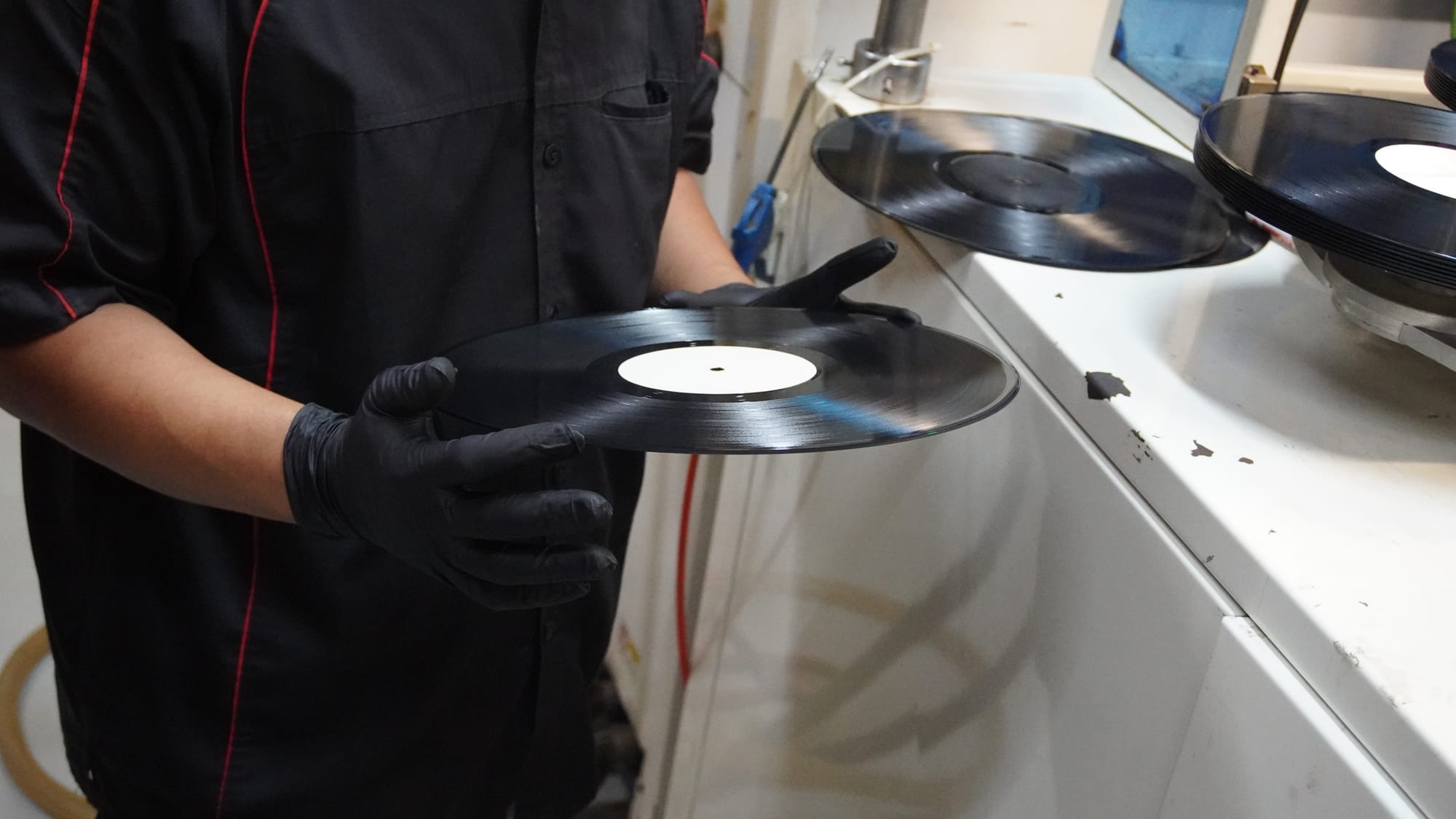
This ecosystem of supply and demand became even more complete when in mid-2023 a vinyl record factory in Cengkareng, Tangerang, a PHR Pressing production facility, reopened after almost half a century of absence from Indonesia. (The last factory in Indonesia operated by the state-owned record company Lokananta in Surakarta closed in the early 1970s).
The establishment of this vinyl copy factory was designed to meet the needs of music labels in Indonesia who wanted to release music from local artists in this format. And almost 85 percent of the albums printed by PHR Pressing are new music from young artists such as Bernadya, Petra Sihombing, Nadin Amizah and Hindia. This fact also breaks the notion that vinyl records are a nostalgic format reserved for playing old music. Instead, vinyl records are now the latest trend in the global music industry.
Of course, this trend wouldn't mean much without real progress on the business side, and the data shows that there is great progress and opportunity in the vinyl business. In 2023, the total sales value of vinyl records was $239.4 million and is projected to rise to $275.31 million in 2024. This figure is expected to rise further to around $3.5 billion by 2033. From 2016 to 2023, the number of records sold rose from 13.1 million to 49.6 million, a jump of more than 300 percent in eight years.
Music, when enjoyed in the right way-and only through the vinyl format-not only enriches the mind, but can create meaningful business solutions for all involved in the industry.