

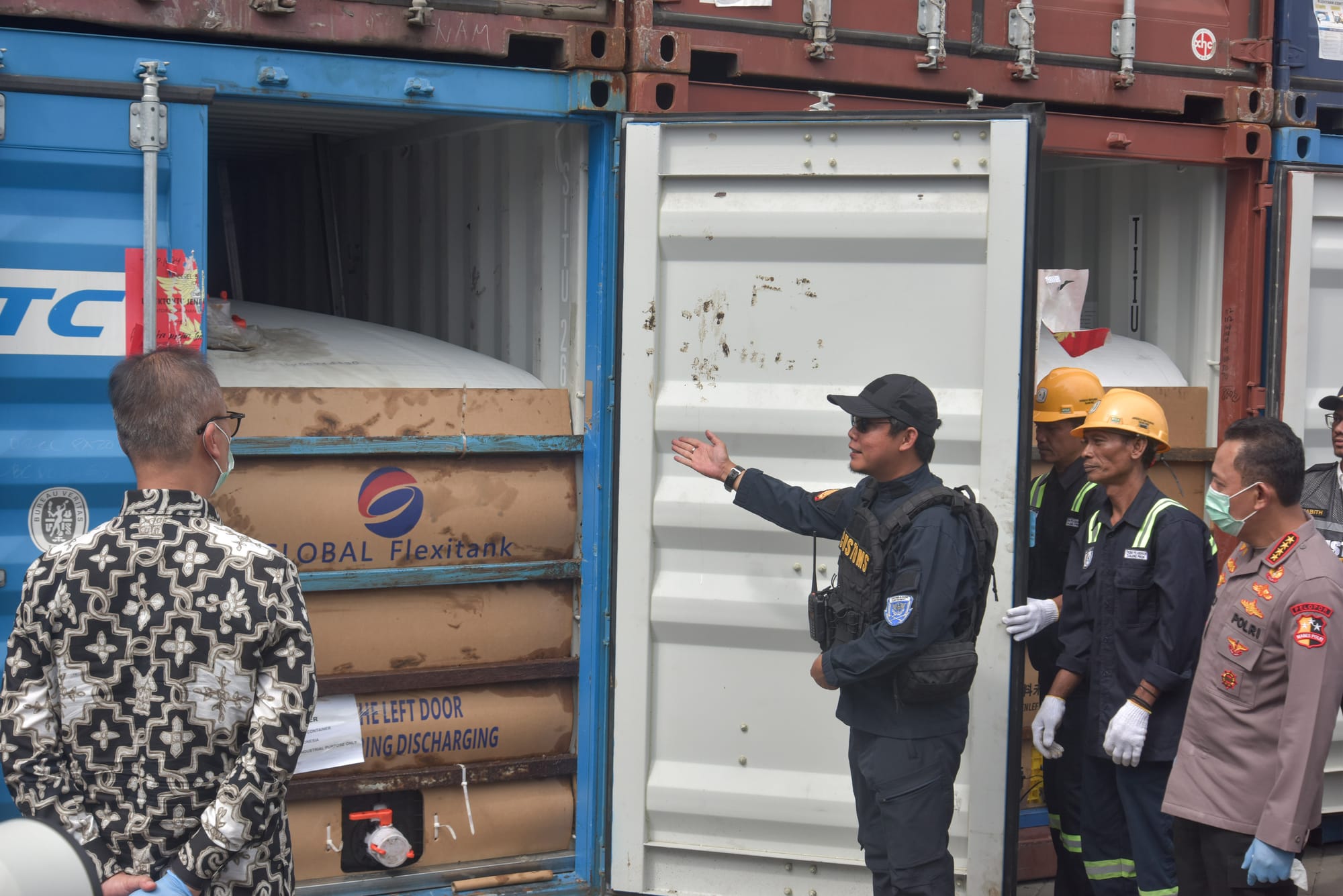
The successful joint operation of the National Police Special Task Force for State Revenue Optimization (Satgassus OPN), the Directorate General of Taxes, and the Directorate General of Customs and Excise of the Ministry of Finance to thwart the illegal export of 87 containers of palm oil derivative products is proof of the state's commitment to upholding fiscal integrity and prioritizing value-added non-oil and gas commodities that have the opportunity to significantly increase state revenue.
The achievement was announced in a joint press conference with the National Police and the Ministry of Finance at Tanjung Priok Port, Jakarta, Thursday (6/11/2025). Also attending the event were Minister of Industry Agus Gumiwang Kartasasmita and Director General of Foreign Trade of the Ministry of Trade Tommy Andana, representing Minister of Trade Budi Santoso.
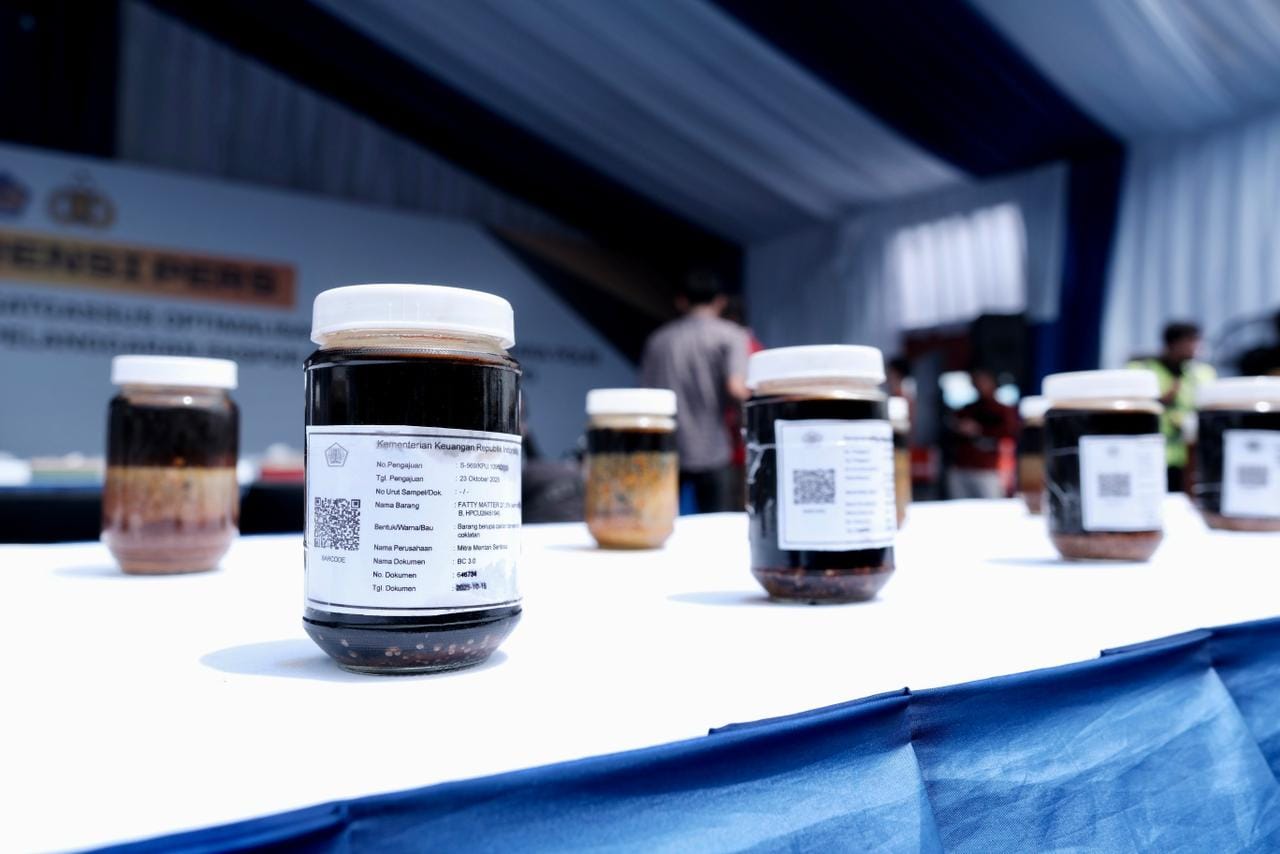
Director General of Customs and Excise at the Ministry of Finance, Djaka Budhi Utama, explained that the disclosure stems from the discovery of export license notifications for 87 containers of fatty matter belonging to PT MMS at Tanjung Priok Port, Jakarta, between October 20-25, 2025. The fatty matter in the 87 containers was recorded to have a net weight of 1,802 tons worth IDR 28.7 billion.
As an export product, fatty matter is an export product that is not subject to export duty. In the downstream palm oil industry, this by-product of biodiesel processing is a raw material for the production of solvents, cleaners, and other derivative chemical products that have promising added value.
However, after going through the search and laboratory test results of the DJBC of the Ministry of Finance and IPB University witnessed by Satgassus OPN, the export products tested were proven to contain crude palm oil derivative products instead of fatty mater. This commodity is classified based on the Minister of Industry Regulation Number 32 of 2024 concerning Classification of Palm Oil Derivative Commodities so that it is subject to export duty provisions.
"The arrest is still under further investigation, including the collection of additional evidence. What is certain is that collaboration is crucial between the Ministry of Industry, the Ministry of Trade, the Ministry of Finance, and the National Police to ensure that Indonesia's palm oil industry is more transparent, fair, accountable, and contributes optimally to the state," Djaka told the media.
Reinforcing Djaka's explanation, National Police Chief General Listyo Sigit Prabowo revealed that the findings of Satgassus OPN, DGT, and DGCE began with the suspicion of an extraordinary surge in exports of fatty matter commodities that rose by almost 278% and became an anomaly. The deepening conducted by the joint operation team proved that the suspicion was correct based on scientific evidence.
"Fatty matter commodities are currently not subject to exit fees and are not commodities in the lartas category. This loophole was used to smuggle and resulted in state losses, with a transaction value of Rp2.8 trillion," said Listyo.
Industry Minister Agus Gumiwang Kartasasmita expressed his highest appreciation and gratitude for the hard work in uncovering this violation. The reason is that illegal exports not only harm the country by eliminating the potential for added value, but also have the potential to disrupt the supply chain of raw materials for the domestic processing industry.
"I want to give a message to business actors that the government will not compromise on all forms of fraud, including fraud in export activities. This order is a deterrent effect, and further guidance will be carried out," Agus said.
Going forward, Agus emphasized that the government will look at 282 companies that are suspected of having a similar crime mode, namely export permit notifications that do not match the commodities being traded. He hopes that palm oil business players can refer to Minister of Industry Regulation No. 32/2024 as a guideline for monitoring the export of palm oil derivative commodities.
"We have set technical specifications, and that should be followed by business actors. If there are deviations, HS code escapes, of course that cannot be tolerated. We will strengthen in the future to close all loopholes in leakage of state revenue as directed by the President," Agus concluded.
Strategic commodities
Apart from being part of the effort to save state revenue, especially non-tax state revenue (PNBP), this law enforcement operation is also proof of the state's attention to the export of non-oil and gas commodities that have strategic added value such as crude palm oil.
The Central Bureau of Statistics underlined that the growth of export performance of 9.91% worth USD 74.32 billion, as well as the growing contribution of the food and beverage industry of 6.42% to GDP in Q3 2025 could not be separated from the added value of crude palm oil exports.
On an annual basis, the Indonesian Palm Oil Association (GAPKI) noted that until August 2025, the value of Indonesia's palm oil exports reached US$24.785 billion, up 42.88% compared to US$17.347 billion in the same period in 2024.
"The increase in export value was mainly driven by the average CPO price for the January-August 2025 period which reached US$ 1,204/ton CIF Rotterdam, higher than US$ 1,009/ton in the same period in 2024," wrote GAPKI Executive Director Mukti Sardjono in a written statement on the GAPKI website.
SUAR has asked GAPKI Chairman Eddy Martono for confirmation. However, he admitted that he was not aware of the issue. "Well, I'm not clear what the case is, so I can't comment yet," Eddy said when contacted. SUARThursday (6/11/2025).
With this strategic value, Executive Director of the Center of Reform on Economics (CORE) Indonesia Mohammad Faisal believes that the government's move to crack down on violations of palm oil exports is appropriate and reasonable. This is because, in addition to taxation, oil and gas, coal and crude palm oil exports are components of PNBP that have important added value to the state treasury.
"The calculation of CPO revenue, apart from export duties, is also from export taxes, so monitoring is important for containers so that the number of exports matches the realization. If until then it is lower than what is recorded compared to the fact, then the difference is clearly very significant in affecting state revenue, "Faisal told SUAR.
Through this action, Expert Staff for Connectivity and Service Development of the Coordinating Ministry for Economic Affairs Dida Gardera hopes that business actors will be able to encourage Indonesian palm oil productivity to be maximized, especially since currently, Indonesia has around 16.38 million hectares of palm oil land. Of this amount, 53 percent is managed by the private sector, 6 percent by state-owned enterprises, and 41 percent by independent farmers.
"However, the average productivity is still below 4 tons per hectare, while large companies can reach 10-12 tons per hectare. Through the People's Palm Oil Replanting (PSR) program, it is hoped that productivity can increase two to three times in the next four years," Dida said in Jakarta, Tuesday (4/11/2025).