

The performance of the Prabowo Subianto-Gibran Rakabuming Raka (Prabowo-Gibran) government in one year is considered stable and there is still room to grow.
This is based on the results of research by independent institution IndoStrategy on the performance evaluation of the Red and White cabinet that was inaugurated on October 20, 2024.
In general, the Prabowo-Gibran administration received an average score of 3.07 on a scale of 0-5, meaning that the Prabowo-Gibran administration is categorized as moderate. A scale of 0 indicates poor and a scale of 5 indicates good. In detail, a score of 0-2 for poor performance, a score of 2-4 moderate performance, and a score of 4-5 good performance.
The research was conducted from early September to October 13, 2025 with 424 respondents from 34 provinces in Indonesia using a purposive sampling method.
Respondents were selected based on the criteria of at least undergraduate education (S1) and having permanent jobs such as teachers, lecturers, activists, employees, and entrepreneurs.
Data collection is done by providing written questions that are answered with an assessment based on a score on a scale of 0-2 (low), 2-4 (medium), and 4-5 (high).
IndoStrategy Research Director Ali Noer Zaman said a number of positive achievements had been made by the Prabowo-Gibran government, especially in the field of corruption eradication which scored 3.50 (moderate to good category).
However, the public is still waiting for new breakthroughs in the fields of food price stability (3.00), law enforcement and human rights (2.93), and job creation (2.65) which are still in the medium category.
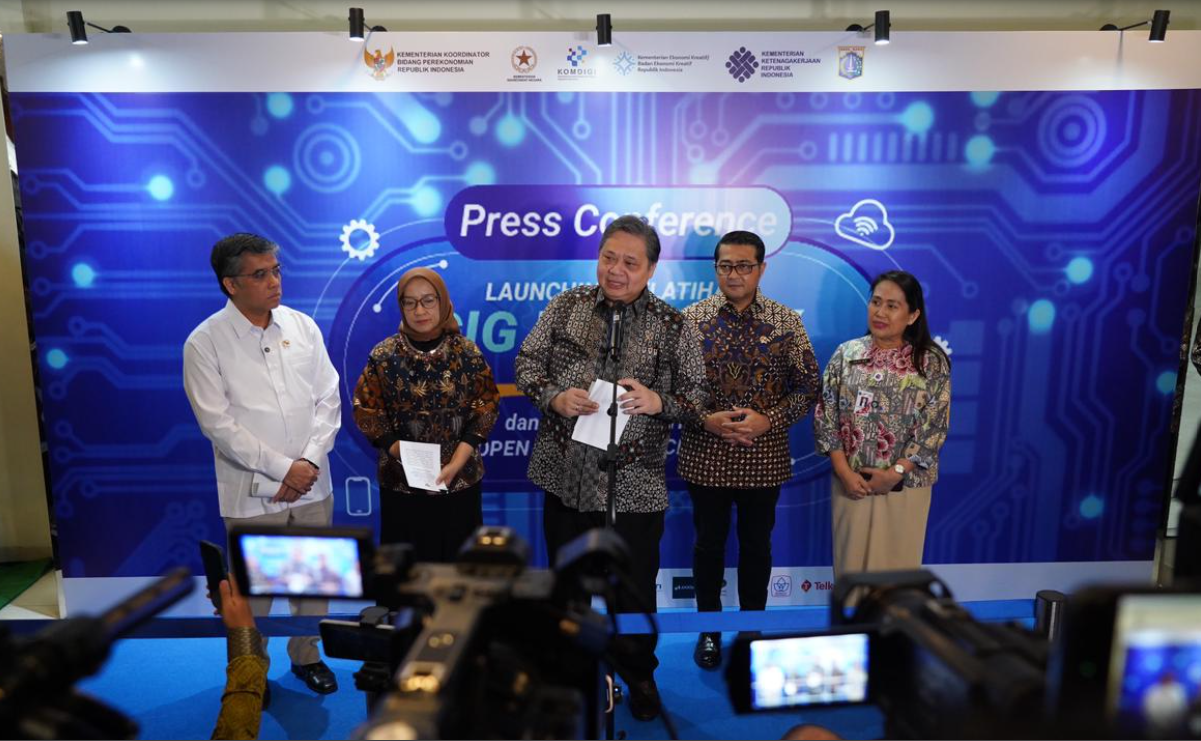
"The public also appreciates the government's courage to reshuffle the cabinet for better performance," he said at a press conference on "One Year of the Prabowo-Gibran Government" in Jakarta (17/10).
Even so, people are still waiting for the realization of the government's big promises such as the "17+8" program which is a national priority agenda.
A number of areas of governance are also considered quite good such as political stability and security (3.16), democracy and freedom (3.14), and government transparency and accountability (3.12). Meanwhile, investment and economic growth (3.09) and stability of goods prices (3.00) also showed positive trends.
President's flagship and priority programs
Indostrategi also conducted research on the Prabowo-Gibran government's Work Program, the Free Nutritious Meal Program (MBG) was recorded as the flagship program with the lowest rank from other programs. Rank 1 is occupied by the free health check program or CKG. "The Free Nutritious Meal Program received a medium score of 2.68," Ali said.
The 2.68 score for MBG is moderate, but compared to other programs surveyed by IndoStrategy, it is still low. The cause of the low score was influenced by massive information about cases of mass poisoning of students after eating MBG in a number of regions. In addition, the public also often compares the implementation of the program with similar programs in developed countries.
Read also:
 Benedictus Krisna Yogatama
Sekolah Rakyat (3.13), and Sekolah Unggul Garuda (3.00) were well received. However, the public hopes that these programs will be managed more professionally and have strong institutions.
Meanwhile, Koperasi Merah Putih (2.77) and the Three Million Houses Program for Low-Income Communities (2.69) still require accelerated realization.
IndoStrategy's 10 Best Ministries
Ali said Indostrategi also conducted research on the performance of ministries that have succeeded in carrying out their functions well.
IndoStrategy uses an assessment method with a scale of 0 to 5, with details of 0-2 (poor performance), 2-4 (moderate performance), and 4-5 (good performance).
Here are IndoStrategy's top 10 ministries: Ministry of Primary and Secondary Education (Abdul Mu'ti) with a score of 3.35, Ministry of Foreign Affairs (Sugiono) with a score of 3.32, Ministry of Religious Affairs (Nasaruddin Umar) with a score of 3.26.
Ministry of Higher Education, Science and Technology (Brian Yuliarto) with a score of 3.22, Ministry of Agriculture (Amran Sulaiman) with a score of 3.21, Ministry of Finance (Purbaya Yudhi Sadewa) with a score of 3.15.
Ministry of Home Affairs (Tito Karnavian) with a score of 3.14, Ministry of Defense (Sjafrie Sjamsoeddin) with a score of 3.13, Ministry of Forestry (Raja Juli Antoni) with a score of 3.08, Ministry of Investment/BKPM (Rosan Roeslani) with a score of 3.08.
The Ministry of Education and Culture which received the highest score was due to Abdul Mu'ti as the minister who was considered successful in presenting a number of innovations, ranging from the redistribution of state civil apparatus (ASN) teachers, renewal of the teacher and principal performance system, to the new student admission system.
Ali assessed that the Ministry of Education and Culture led by Abdul Mu'ti succeeded in presenting innovations that were adaptive to equalizing the quality and needs of education in the digital era.
IndoStrategy Managing Director Visna Vulovik said the Prabowo-Gibran government is still in the phase of institutional consolidation and coordination between ministries.
"The public needs to give the Prabowo-Gibran government the opportunity to consolidate and coordinate, given the large number of cabinet members. But on the other hand, the public must also continue to supervise so that the government continues to work hard," he said.
He assessed that the number of ministries is higher than the previous cabinet, which requires adjustments in the budget and division of tasks.
IndoStrategy Strategic Recommendations
In its report, IndoStrategy provides eight main recommendations for the Prabowo-Gibran government to strengthen performance in the second year, namely Strengthening coordination across ministries and overcoming overlapping policies, Improving legal governance and human rights, including the settlement of past cases, Carrying out bureaucratic reform consistently and substantially.
Encourage real job creation and labor policy reform, Improve budget transparency and public communication, Affirm the neutrality of the TNI-Polri and strengthen civilian supremacy, Strengthen equitable regional and village development and Implement data-based social programs and accountability, including Sekolah Rakyat and Free Nutritious Meals.
Consumption Rate Rises
In a separate place, Minister of Finance Purbaya Yudhi Sadewa said that economic conditions in the one-year period of President Prabowo Subianto and Gibran Rakabuming Raka's administration began to improve. One of them is marked by the level of public consumption which is recorded to have increased.
"We saw an improvement in public consumption in September," he said at the One Year of Prabowo-Gibran Government event at JS Luwansa Hotel, Jakarta (16/10).
The Minister of Finance said that the government will again launch an economic stimulus package to boost economic growth to 5.67 percent in the fourth quarter of 2025.
Chairperson of the Indonesian Employers Association (Apindo) Shinta Widjaja Kamdani admitted that there are still sectors that are weakening amid the improvement of the national economy. The decline in these sectors is indicated by the decline in the Consumer Confidence Index (IKK).
The sectors that are still under pressure so far are labor-intensive sectors, namely textiles and garments. In addition to the textile and garment industry, the furniture industry also experienced a decline of around 10 percent to 20 percent. Then the automotive sector, which saw a decline of around nine percent, and the property sector, where demand fell by 40 percent.
Shinta asked the government to look at supply and demand as a whole. In terms of demand, people's purchasing power must be boosted.
Similarly, Executive Director of Reforms on Economics (CORE) Mohammad Faisal said that one of the government's biggest homework in the past year was the lack of quality job creation even though investment continued to grow.
"Indicators of job creation are still weak," said Faisal at the forum '1 Year of Prabowo-Gibran: Optimism on 8% Economic Growth', Thursday (16/10/2025).
As employment is limited, the purchasing power of the economy is limited. As a result, public consumption has slowed down. In the end, the economy cannot grow.
"This is the biggest homework note that has not been completed well this year, namely job creation," he said.
Efforts to encourage job creation include encouraging regulations and improving the ease of doing business so as to attract investment. In addition, it is also necessary to stimulate and incentivize labor-intensive industries that can directly absorb a lot of labor.