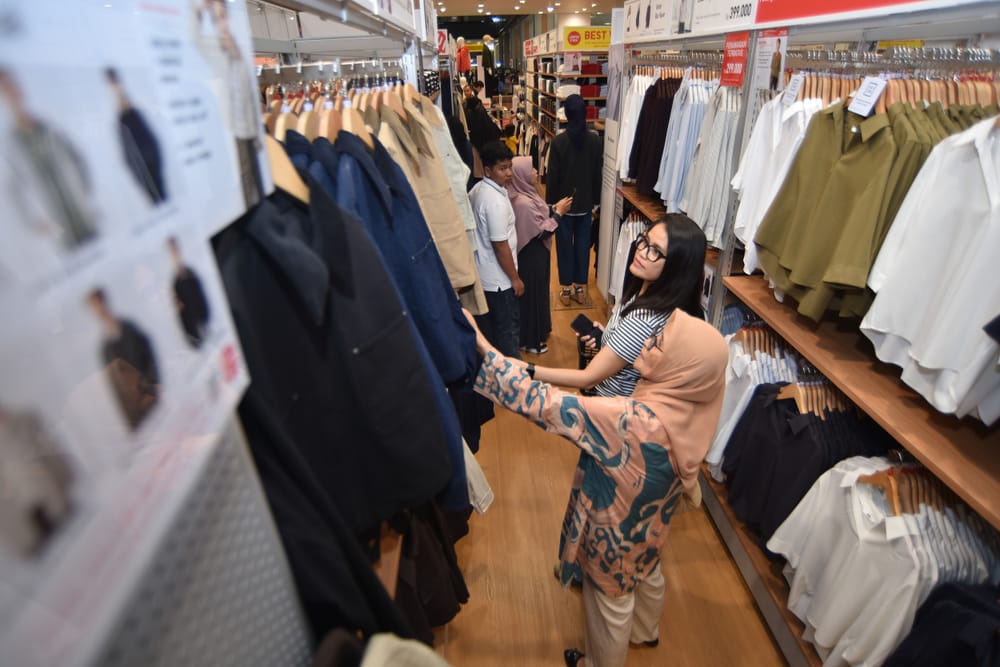

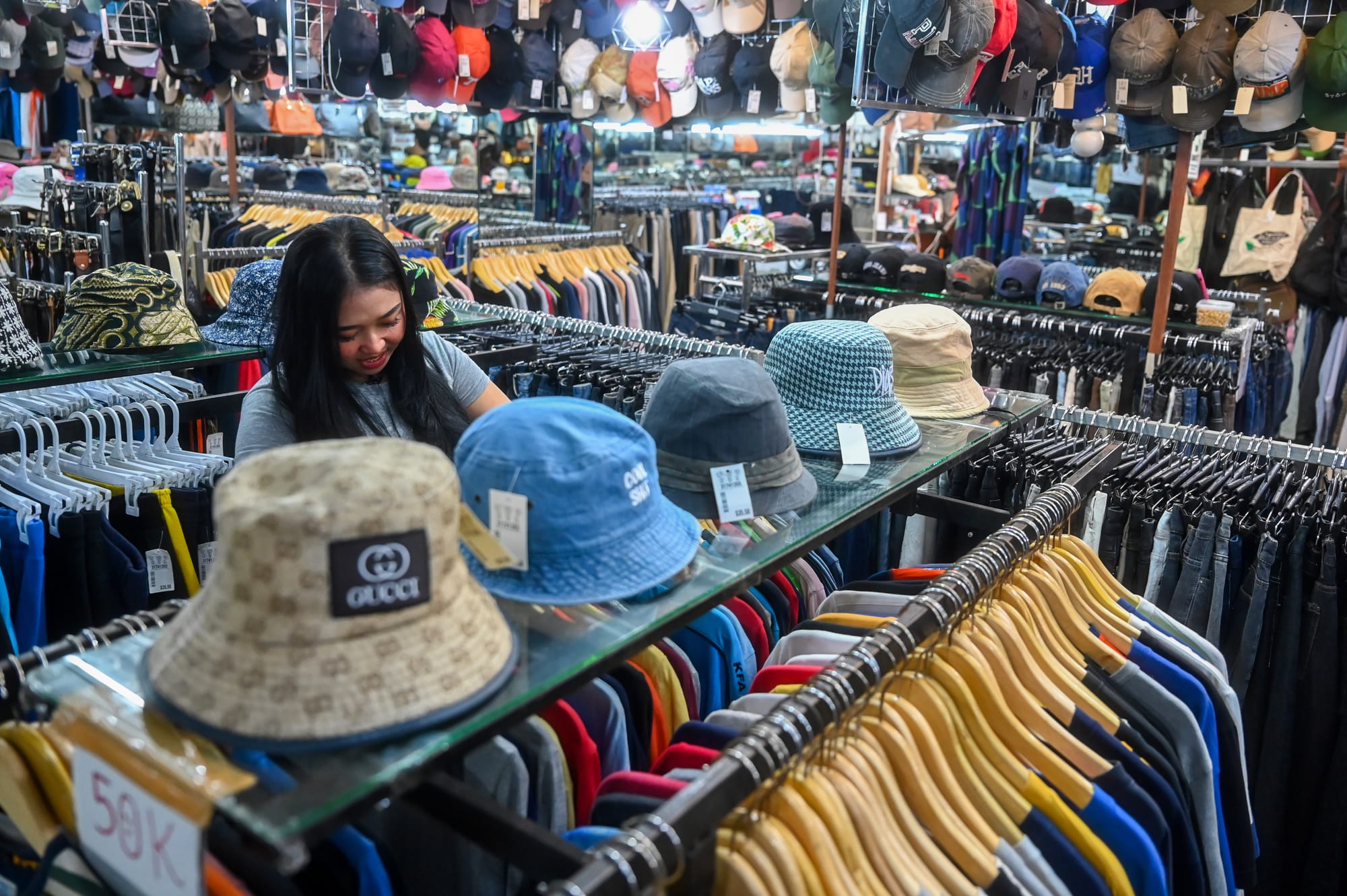
She doesn't always intend to buy. But when she goes to the mall, 24-year-old Kustina Rani's steps almost always end up in the aisles of bookstores, clothing racks, or coffee shops displaying cute items with the logo of BTS (방탄소년단), her favorite Korean boy band.
"It's fun to see the latest trends, what items are on the market. We don't always have money," Kustina told SUAR (31/7/2025).
For middle-class Gen Z, who were born and raised with the onslaught of online discounts and the glitter of shopping malls, shopping is not just about taking things home. It's also about comparing the real price with the one on the screen, or simply feeling the texture of the fabric and the smell of the paper of a new book.
"Sometimes when I see something nice, I end up buying it from an online store because it's cheaper," she says. "But if you need it fast, you still buy it offline."
There are also some things that are still more expensive. Books at Gramedia, for example, although they can be obtained cheaper online, "if the book is valuable, I buy it at Gramedia too," says Kustina.
Likewise, when his eyes fell on a limited edition tumbler with BTS' image at a coffee shop, he spent more, not for function, but for the emotional value it contained.
The phenomenon of Rojali (the group that rarely buys) and Rohana (the group that only asks) that has been appearing more frequently in shopping centers lately, is not just about thin pockets.
Kustina's story is just one slice of a larger landscape: the story of a generation for whom shopping is an experience, not just a transaction. Behind the crowded storefronts, merchants and retailers are attempting to reread consumer desires, finding the gap between entertainment, value, price, and increasingly fluid loyalties.
More than just a promo
"Consumers used to be brand-oriented, now they are more realistic," said Solihin, Chairman of the Indonesian Retailers Association (Aprindo), the association that oversees retailers in Indonesia.
He explained how "festive" periods such as Lebaran and Christmas, which are usually the mainstay of sales, are now shorter in duration, while the inter-festive distance is actually long. From May to October, for example, there are practically no major national shopping moments.
In response, retailers try various programs: holiday sales, shopping festivals, and entertainment events. But discounts are not enough. There is a "shifting" trend: consumers prefer low-price goods, or come to the store only to look and then buy on e-commerce that offers additional promos.
"The winner in the future is the one who can serve better at a more efficient cost," Solihin explained to SUAR (31/7/2025).
Solihin said that many large retailers have reduced the size of their physical stores to reduce rental costs, while strengthening online channels. Outlets that used to occupy one floor are now only a quarter of it. However, they still maintain an offline presence, in order to maintain proximity and build a direct experience for consumers.
Mindful buying
Not only among Gen Z like Kustina, changes in shopping patterns are also reflected in the data and observations of business actors. Alphonzus Widjaja, Chairman of the Indonesian Shopping Center Association (PPBI), sees how consumers are now more selective in spending their money.
"If you don't need it, don't buy it, or buy items with cheap unit prices," he said after attending the kick-off event of 100 licenses for local UMKM brands and products at the Cililitan Wholesale Center (23/07).
This condition, says Alphonzus, is not entirely a matter of reluctance, but rather a reflection of people's purchasing power that has not fully recovered, especially in the lower middle class. They refrain, even when they are in shopping centers, in order to maintain household financial stability amid global economic uncertainty, exchange rate fluctuations, and gold prices.
As for the upper middle class, caution comes from a different factor: they have the purchasing power, but are now wiser about prioritizing between spending, saving, or investing.
"Compared to last year, the growth of visits to shopping centers is less than 10%," said Alphonzus. "Whereas our target is to increase by 20%-30%."

The same thing was also conveyed by the Central Statistics Agency (BPS) in its press conference on poverty last week (25/07). Ateng Hartono, Deputy for Social Statistics at BPS RI, commented that Rojali's phenomenon does not necessarily reflect poverty, as many occur in the middle or upper class.
"But this is an important signal. Policies should not only focus on reducing poverty, but also on maintaining the resilience of lower-middle-class household consumption," said Ateng.
The goods are not complete
But prices and promos are not the only problem. "It's not just that purchasing power is down, but also that the goods are incomplete, the sizes are not available, or they are late in entering Indonesia," Budihardjo Iduansjah from the Association of Retailers and Shopping Center Tenants in Indonesia (Hippindo) explained to Suar (31/07).
As a result, although visitors come to the mall, they leave without shopping. They end up buying online, or even shopping abroad on vacation.
According to Budihardjo, official retail in Indonesia is burdened by many regulations: official imports pay taxes, SNI standards, BPOM, halal. Meanwhile, online stores sometimes sell unofficially imported goods, without taxes, at lower prices. "We want cheap goods, but the import process is complicated, the cost is high," he said. In fact, 52% of money circulation in the Indonesian economy comes from consumption.
Hippindo is encouraging the Belanja di Indonesia Aja (BINA) movement to restrain domestic spending, while asking the government to ease licensing and open access to legal imports. This is not about closing the market, but about ensuring consumers can find complete goods and competitive prices in the country.
"Don't let people's money be spent in Malaysia, Singapore, or Thailand," said Budiharjo.
From sustain to experience
The Rojali phenomenon also challenges retailers to not only sell goods, but also stories. "Consumers now buy not just goods, but the stories behind them," Solihin said.
This is why there is a trend of sustainable products or environmentally friendly concepts even though they are more expensive. For some consumers, higher prices are fine, as long as there is more value: supporting local farmers, reducing plastic, or social programs.
The shopping experience has also turned into a social experience. New product launches are now characterized by queues, social media posts, and a sense of exclusivity. Malls are changing functions: not just a place to shop, but also a family recreation area, a selfie spot, and a space to feel "updated".
The same is true of Alphonzus' observations. Rojali's phenomenon is not new. Since long ago, Alphonzus said, shopping centers have not only functioned as places for transactions, but also spaces for social interaction, entertainment, and education. People come, look, weigh, ask prices, sometimes buy, sometimes not.
This is why even though the number of "inquiring groups" is increasing, for shopping center operators it is not always a bad sign. In fact, it reflects the function of the shopping center as a lively public space, not just a row of shops.
"Things like asking about prices, comparing prices, are natural. If the shopping place is deserted, that's the danger," said Alphonzus.
Budiharjo added that malls and tenants have also implemented green programs: paid plastic bags, electronic waste exchange with vouchers, and distribution of leftover food. "The market is still small, but important," he said. Retail has also joined the experience trend: noodle festivals, pempek festivals, live music in mall atriums, and cultural collaborations to attract tourists.
The goal: shopping is not just a transaction, but recreation, entertainment, and even a form of identity. Consumer loyalty is no longer about price alone, but also about value and experience.
Even so, behavioral shifting is still happening. For primary items such as shampoo or household needs, consumers are becoming less brand-fanatical. "The important thing is to be clean, have foam, the brand is later," added Solihin. This means that old loyalties are eroding, and retailers must be more adaptive in reading trends.
Digital is no longer the enemy
Another major shift is digitalization. In the past, many were hesitant to shop online, afraid that the goods would not match the photos, or worried about fraud. Now, that trust is growing. The fashion and electronics sectors are even starting to balance online and offline sales, while daily necessities are still more dominant offline.
Solihin from Aprindo sees this trend as both a challenge and an opportunity. Like it or not, it is important to have an online store.

"Retailers have also started to build their own online channels, even for brands that used to be very conventional," said Solihin. Collaboration with e-commerce platforms, interactive digital campaigns, and personalized promos are the new keys to attracting consumers.
Of course, not all segments respond the same. The younger generation is quicker to go digital, while consumers outside big cities remain loyal to physical stores. Therefore, retailers are choosing the "physidal" path: combining physical and digital, in order to reach more segments.
Not just discounts
The government has actually tried various efforts: discount festivals, holiday sales, and national shopping campaigns. But according to Hippindo, the retail sector still needs more. "Our employees haven't gotten the stimulus like the manufacturing industry," said Budiharjo.
He proposed some concrete solutions: for example, employee tax relief, or shopping vouchers directly to the community.
Budiharjo cited Malaysia as an example: the government gives shopping vouchers to citizens, so that shopping remains alive and the economy moves. "If they give cash, they are afraid that it will become an online gambling depot (judol). But if it's shopping vouchers, they will immediately spend it," he said.
The money doesn't disappear; it goes into the VAT tax and stimulates the retail sector.
In addition, collaboration between the government and retailers is also important: promotion of shopping tours, cultural festivals that bring in tourists, and national campaigns to proudly shop for official products. "If our goods are complete and prices are competitive, tourists can shop in Indonesia," said Budiharjo.
Likewise, Alphonzus emphasized, he is optimistic that the Rojali phenomenon will not remain forever if supported by stimulus policies and government steps to curb inflation. He believes that consumer behavior will also return to balance: more courage to spend, not just ask.
"If purchasing power recovers, rojali will definitely decrease," he said. "This phenomenon is only temporary."
However, he emphasized the importance of collaborative efforts: shopping centers need to continuously improve to bring new experiences; while the government can help through incentives, shopping tourism promotions, or direct stimulus to keep the pulse of consumption - an important motor of the Indonesian economy.