

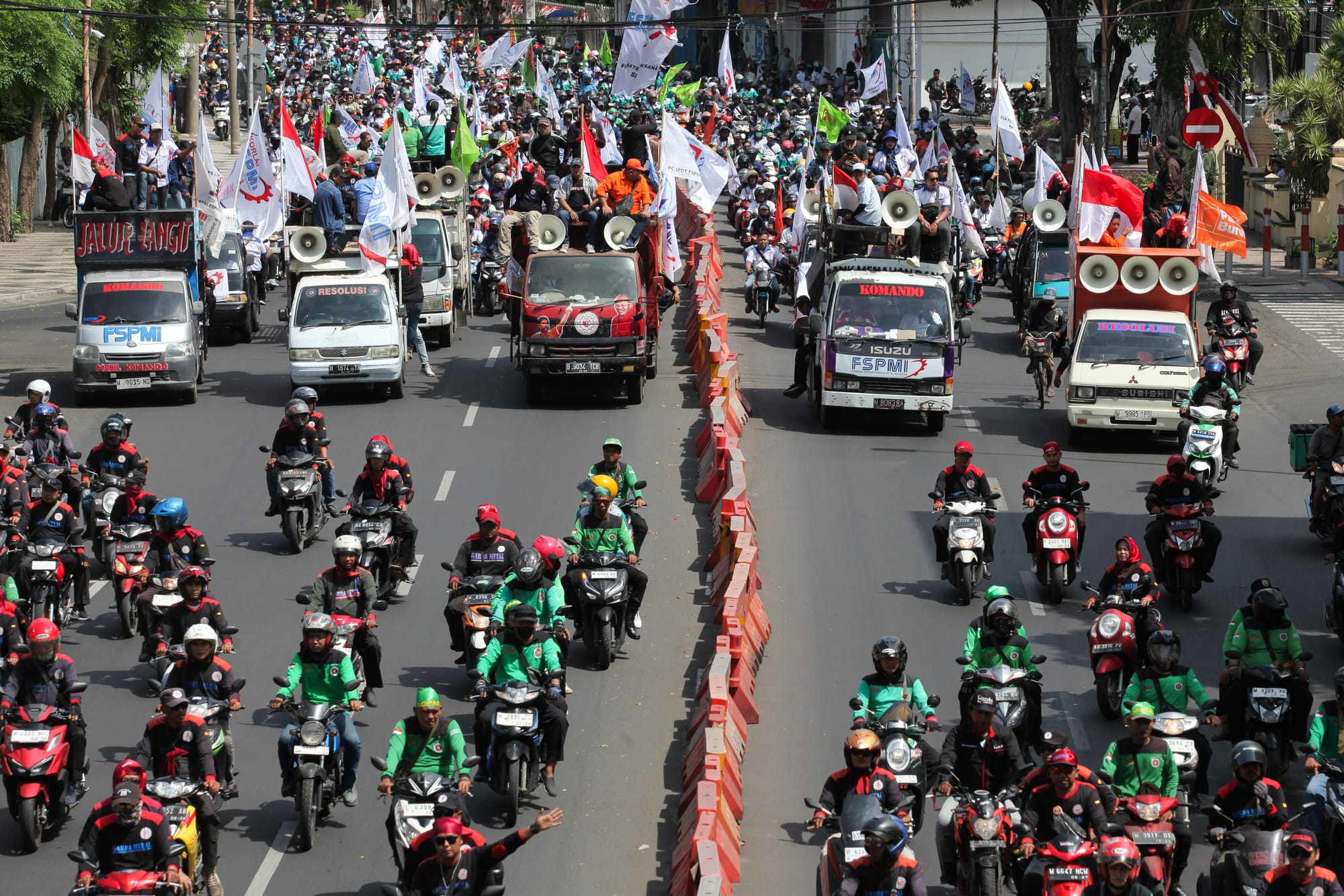
An increase in the minimum wage has again become one of the items demanded by labor demonstrations. For them, regulatory inconsistency has prolonged the problem for years. In fact, workers' welfare is crucial for business productivity to remain competitive and impact the national economy.
The demand to raise wages by 8.5% to 10% was raised in a mass demonstration of workers organized by the Confederation of Indonesian Trade Unions (KSPI) in front of the main gate of the DPR Building, Jalan Gatot Subroto, Jakarta, Thursday (28/08/2025).
Chairman of the Labor Party and KSPI President Said Iqbal led the crowd with speeches expressing the workers' disappointment with the current socio-economic situation.
In addition to the demand for a wage increase, the masses also put forward five other demands. Namely, starting from rejecting termination of employment, eliminating outsourcing, encouraging tax reform, urging the ratification of a new labor law, passing the Asset Forfeiture Bill, and revising the Election Law.
Student representatives also joined the rally. Ridwan Nur Hidayat, President of the Student Executive Board (BEM) of Surakarta University, strongly criticized government policies that are considered ineffective and tend to harm the people.
In addition, Ridwan said, disappointment is also exacerbated by the increase in property tax (PBB) imposed by local governments. They imposed it as a result of the government's proposal to limit transfer funds to the regions as an efficiency effort.
Previously, in early August, a 250% jump in land and building tax (PBB) had sparked demonstrations in Pati, Central Java, by residents and farmers. Eventually, the Regent was forced to revoke the policy a few days later.
"The government always demands that the people follow its policies, but their welfare is not guaranteed. Singapore has high taxes, but its people are prosperous. In Indonesia, the people are getting depressed," Ridwan said.
Wage ecosystem must be built
Responding to the return of the classic minimum wage demands, Chairman of the Manpower Division of the Indonesian Employers Association (Apindo) Bob Azam regretted that the mass demands came from trade union factions and were not based on knowledge of the wage roadmap resulting from the agreement of representatives of employers, workers, and the government who are members of the National Wage Council (Depenas).
"Those who are not involved in the Department of National Development do not want to recognize the agreement. They play outside the existing system, so that consensus never exists. As a result, the forms that arise are always in the form of pressure or pressures like what happens in Europe," Bob explained when contacted by SUAR, Thursday (28/08).
In the roadmap , continued Bob, the Ministry of National Development has considered the formation of a wage ecosystem consisting of minimum wages, bipartite wages, wage scale structures, provisional scale wages, and others. However, the demand articulated by labor unions many times is the minimum wage. It is as if the minimum wage represents the effective wage that workers receive.
"Usually, the minimum wage is around 50% to 70% of the average wage. In Indonesia, the minimum wage is 130 percent of the average wage. As a result, currently, the average wage received by workers is actually below the minimum wage because employers who cannot afford to pay are forced to," he said.
Not only assessing the demands of trade unions as partial, Bob assessed the vagueness and inconsistency of regulations as the cause of the difficulty of employers in determining wages that are able to provide welfare for workers. He specifically pointed to government regulations as rules for implementing the wage provisions contained in the law.
"In 10 years, the PP has changed five times. This means that wage regulations change every two years. How can entrepreneurs calculate wages and make long-term contracts? Seeing the regulations that are changed every two years, investors will also certainly retreat regularly," added Bob.
Bob emphasized that the way out of this wage crisis is to correct the misconceptions that confuse the concept of wages and minimum wages and destroy the structure of wage scales and provisional wages.
"The minimum wage is the lowest wage, not the actual wage. We must build a wage ecosystem, with a minimum wage adjusted to the inflation rate, not used as an actual wage, and regulated by a bipartite agreement of the company's labor union and management. Not unions outside of it," Bob concluded.
Measurable and effective regulation
The wage component is obviously very important in the employment relationship. Therefore, wage regulations are also very decisive and related to many things. Professor of labor law at the Faculty of Law, Universitas Gadjah Mada, Ari Hernawan, emphasized that wage issues should be reviewed within this larger framework.
"Labor demands are still subsistence in nature until now. This is due to the politics of Indonesian labor law which still wants to create cheap labor economically and politically obedient. Employment policy is directed at job security, not job security," said Ari when contacted by SUAR, Thursday (28/08).
Ari admits that it is not easy to find a middle point that brings together the interests of workers and employers in one clear formulation. Therefore, the preparation of wage regulations must be in-depth and very thorough.
The regulation, continued Ari, does not only include a nominal amount. But, it must also include the basic spirit and purpose of wages, wage indicators, the impact of wages on workers and employers, the establishment of regulations, implementing rules, to the effectiveness and sanctions against violations of the rules.
"The point is not to be hasty because the result will only be superficiality," Ari concluded.