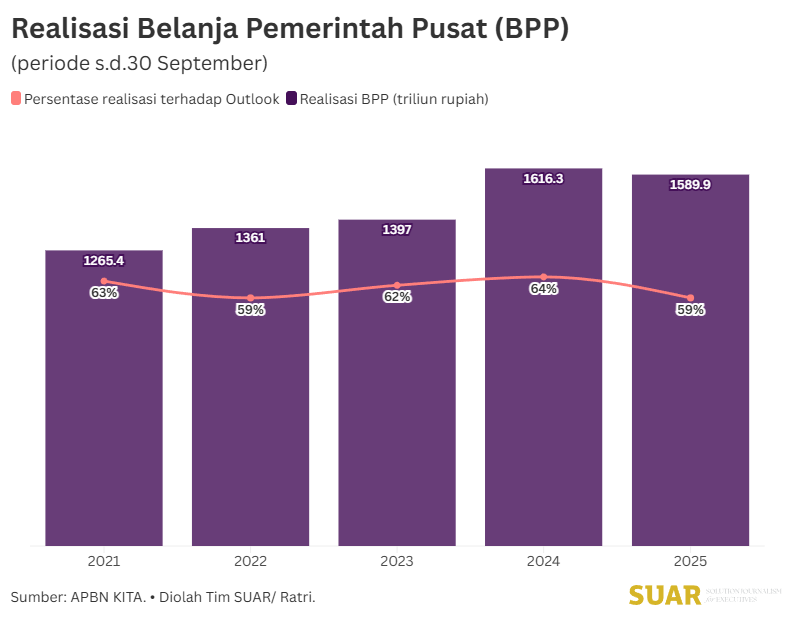
The realization of Central Government Expenditure (CMB) until 30 September 2025 has only reached IDR 1,589.9 trillion or 59.7% of the Semester Report Outlook (Lapsem) target. Expenditure needs to accelerate by Rp 1,292.7 trillion in the last three months to reach the annual target.
Central government expenditure is divided into K/L expenditure of IDR 800.9 trillion (realization of 62.8% of the outlook), among others for priority programs and social assistance, and Non-K/L expenditure of IDR 789.0 trillion (realization of 56.8% of the outlook), among others for pension payments and subsidies.
The realization of expenditure for the Central Government's priority programs amounting to IDR 480.4 trillion has only been absorbed by 51.6% of the IDR 930.7 trillion ceiling as of October 3. Budget absorption in several government priority programs is even below 50%.
In the Strengthening and Protecting Purchasing Power sector, for example, the housing program to build 192.7 thousand houses has only reached 48% of the ceiling of Rp 52.1 trillion. Similarly, in the public service sector, the Free Nutritious Meal program with a ceiling of Rp 71 trillion has only been realized 29%.
In addition, another flagship program that was only inaugurated in the middle of this year, the Sekolah Rakyat and Sekolah Unggul Garuda programs, has absorbed only 8% of the Rp 14.4 trillion ceiling. The low absorption in these basic sectors can have a direct impact on the welfare of the community and the quality of human resources.
Furthermore, in the Public Facilities & Productivity sector. Although several programs achieved realization above 50%, there are two major programs that are still below the target. The Dams, Irrigation, & Operation-Maintenance of Natural Resources Infrastructure program only realized 45% of the Rp 23.0 trillion ceiling and Road and Bridge Preservation realized 35% of the Rp 18.9 trillion ceiling.
This lack of budget absorption for infrastructure development and maintenance has the potential to slow down the pace of connectivity, distribution, and increased agricultural productivity through irrigation, which is key to regional economic growth. Meanwhile, the Price & Production Stabilization sector shows a mixed picture. The Food Barn program has only reached 34% of the Rp 23.2 trillion ceiling.
Under-utilization in Price and Production Stability and especially in energy subsidies and food barns may affect the government's efforts to maintain commodity price stability and overall purchasing power. 100% realization in Bulog/food reserves indicates a focus on strategic stocks, but low absorption in other food programs indicates the need for acceleration.
Finance Minister Purbaya Yudhi Sadewa emphasized that the acceleration of government spending is one of the keys to boosting economic growth at the end of 2025 to 2026, apart from through bank credit growth.
For this reason, the Minister of Finance Purbaya gave a warning regarding funds that were still not absorbed. It is not only K/L spending that has the potential to be reallocated, but also the budget for priority programs.
Related to this, the National Nutrition Agency (BGN) returned the MBG budget allocation of Rp 70 trillion, which most likely could not be absorbed this year. Minister of Finance Purbaya stated that BGN returned a budget of Rp 100 trillion that was requested as an additional budget but has not been disbursed.
Fiscal discipline by curbing the absorption of expenditure fund allocations to the relocation of expenditure fund budgets to programs that have a direct impact on society is a solution to achieving the economic growth target by the end of this year. Failure to achieve the maximum absorption target risks reducing the impact of priority programs on society, including hampering infrastructure development.