


The low taxation ratio in Indonesia has always been a topic of discussion that often ends in a dead end. Why has Indonesia not been able to increase its taxation ratio when compared to other countries?
In fact, Indonesia can actually increase the taxation ratio by implementing two strategies. First, resolve four fundamental tax problems. Second, close five tax leaks. Tax revenue can increase without the need to raise tariffs that can burden the community and the business world.
Tax observer from Danny Darussalam Tax Center (DDTC) Darussalam said, the four fundamental tax problems that need to be resolved to increase the tax ratio consist of unoptimal public participation, tax education that is not inclusive, minimal policy narrative, and challenging data management.
The problem of unoptimal public participation, according to Darussalam, is because the government does not want to hear the voices of taxpayers, as public support is needed to ensure the effectiveness of the tax system.
In developing the tax system, he suggested that the government should consider the needs of the community, future development targets, and the guarantee of public support.
The problem of tax education is not inclusive because there are still many Indonesians who do not understand taxes properly. "What is tax? What's the point? Why do I have to pay taxes?" These questions often arise in the minds of the public and some of them are still confused about taxes.
Therefore, the government – especially the Directorate General of Taxes – needs to increase socialization regarding taxes.
The problem of policy narrative is still minimal, because the government has not optimally narrated every existing policy. For example, the narrative about tax incentives, there are still many people who do not know what tax incentives are. Not all people have an undergraduate degree in economics. Conditions like this should be the government's concern.
When it comes to data, the challenges are still related to how the data is collected, ensuring its validity and analyzing it.
"Actually, there is still a lot of homework regarding this tax, that's why Indonesia's taxation ratio is still low," said Darussalam when he was one of the speakers at the National Webinar on "Improving Taxation Ratio Amid Economic Pressure" in Jakarta (26/8).
The second strategy to increase the taxation ratio in Indonesia is to close five tax leaks.
First, the shadow economy is an economic activity that is not officially recorded by the government. This shadow economy is a leak that targets GDP.
Second, the impact of tax competition (between countries). Due to the desire to promote economic growth and increase investment competitiveness, tax systems are often used; resulting in a reduction in taxable income.
Third, taxevasion to countries with low or no tax rates(offshore taxevasion). For Asia, the favorite country to park funds is Singapore.
Fourth, the practice of base erosion and profit shifting (BEPS). The impact of globalization affects the income that is taxed.
Fifth, the practice of not reporting and not paying the outstanding tax burden, this tax leakage occurs because there is an outstanding tax burden that should be paid, but is not fulfilled.
"These five tax leaks need to be anticipated so that Indonesia does not lose potential revenue," said Darussalam.
"These five tax leaks need to be anticipated so that Indonesia does not lose potential revenue," said Darussalam.
Senior Economist of the Institute for Development of Economics and Finance (Indef) Aviliani said that the potential state revenue from the micro, small and medium enterprisesUMKM) sector could reach Rp 56 trillion per year.
This can be achieved through the final income tax (PPh) scheme of 0.5% of turnover for UMKM with revenues of up to IDR 4.8 billion per year. However, currently, tax compliance from UMKM players is still low.
"The tax system may also need to be improved to make it easier for people to pay taxes," he said.
Currently, UMKM contribute around 60.5 percent to Indonesia's gross domestic product (GDP), or equivalent to IDR 12,639.9 trillion of the total GDP of IDR 20,892.4 trillion.
Considering this potential, the UMKM sector should be able to contribute more to the country's taxation.
Aviliani believes that the 0.5% tariff on turnover cannot be applied for too long. This is because the policy has the potential to cause moral hazard. Namely, business actors may split their businesses to stay below the turnover limit of IDR 4.8 billion.
Aviliani believes that the 0.5% tariff on turnover cannot be applied for too long. This is because the policy has the potential to cause moral hazard.
UMKM are subject to 0.5% final income tax if they have a turnover (gross circulation) not exceeding IDR 4.8 billion in one tax year. This regulation is contained in Government Regulation (PP) No. 55 of 2022.
Aiming for crypto tax
Expert Staff of the Minister of Finance for Tax Compliance Yon Arsal explained that the government is discussing crypto asset taxation policies, as one of the steps to increase state revenue.
So, there is a change in taxation regulations for these digital assets. The new regulation has been issued through Minister of Finance Regulation (PMK) Number 50 Year 2025. The basis for the change is the transition of crypto asset supervision from the Commodity Futures Trading Supervisory Agency (Bappebti) to the Financial Services Authority (OJK).
In the new regulation, the Ministry of Finance sets out a number of key changes to the crypto tax scheme. First, the exemption of Value Added Tax (VAT) on crypto asset transactions on official platforms, as these digital assets are now treated as equivalent to securities.
Second, the adjustment of the final Income Tax Article (ITA) 22. Crypto asset transactions through domestic trading through electronic systems (PPMSE) are subject to a rate of 0.21%, while transactions through overseas PPMSE or self-deposit are subject to a higher rate of 1%.
Encourage the business world
Meanwhile, in a separate place, Chairman of the Supervisory Board of the Indonesia Business Council (IBC) Arsjad Rasjid explained that the goal of developing a superior, competitive, and inclusive national economy is increasingly difficult amidst uncertainty due to global geopolitical and geoeconomic dynamics.
Therefore, the willingness to spur competitive advantage, followed by the alignment of perspectives between stakeholders through the exchange of constructive ideas, is the key to Indonesia's success in finding the best way out to achieve the ideals of the Golden Indonesia 2045.
Arsjad emphasized this thought in the kick-off press conference of the Indonesia Economic Summit 2026 at the Fairmont Hotel, Jakarta, Tuesday (26/08/2025). In the press conference moderated by IBC Vice President for International Affairs Noto Suoneto, Arsjad was a speaker along with IBC Chief of Executive Officer Sofyan Djalil, Minister of Agrarian and Spatial Planning/Head of the National Land Agency 2016-2022.
In front of dozens of media crews, the conference marked the preparation of the Indonesia Economic Summit (IES) 2026 which will be held at the Shangri La Hotel, Jakarta, on February 3-4, 2026. IBC's second international convention is planned to be a space for exchanging ideas and opportunities for policy makers in determining the direction of Indonesia's economic development.
With plans to invite more than 150 government representatives, academics, business and industry players, policy makers, and thinkers from Indonesia and abroad, IES 2026 will carry the theme Coming Together to Boost Resilient Growth and Shared Prosperity.
IBC chose the theme by taking into account the context of the national and international economic situation, and hopes to foster a commitment to not only survive, but also survive the uncertainty by utilizing the potential that exists in the country, but has not been fully exploited.
In his presentation, Arsjad reiterated his goal when establishing IBC in 2023. That is, to create a healthy, transparent, impactful, and competitive business ecosystem, in order to keep the Indonesian economy growing and resilient amid global uncertainty. Through research work programs, policy advocacy, and conferences, IBC helps the government, business and industry players, and civil society align priorities going forward.
In particular, he expects that IES as a leading annual event is able to take on five crucial roles: the universal voice of the national business world; a platform for constructive dialog; an advocate for policy reform; a champion of business-government cooperation; and a steering wheel ingood economic governance.
"In the midst of global uncertainty, growth alone is not enough. We need resilience and equitable distribution of welfare so that growth can be felt by all Indonesians, leaving no one behind," he said.
The Chairman of the Indonesian Chamber of Commerce and Industry for the 2021-2025 period considers inclusiveness as one of the crucial issues in Indonesia's future economic development, but it is rarely considered. In fact, the need for high economic growth cannot forget the poverty that we still have to deal with.
Inclusiveness is one of the crucial issues in Indonesia's future economic development, but it is rarely considered. In fact, the need for high economic growth cannot forget the poverty that we still have to deal with.
"Economic growth should not only be felt in economic centers and only create prosperity at the top, but also be felt in the regions by all Indonesian people, in line with President Prabowo Subianto's vision, namely 0 percent poverty as a foundation for spurring 8 percent growth," he said.
In addition to vertical inclusiveness within the country, economic inclusiveness must also be realized horizontally by highlighting Indonesia's cooperation with ASEAN regional countries as well as ASEAN's connectivity with South American, African, and Middle Eastern countries on critical issues such as energy transition and regional resilience.
Through IES, Arsjad hopes that Indonesia can map the meeting points that have the potential to encourage Indonesian entrepreneurs to go international. "We should not think that we can excel in all sectors, so we must choose the most competitive sector, and develop it. We can win the war, but we cannot win all the battles. So, we have to choose our battle," he said.
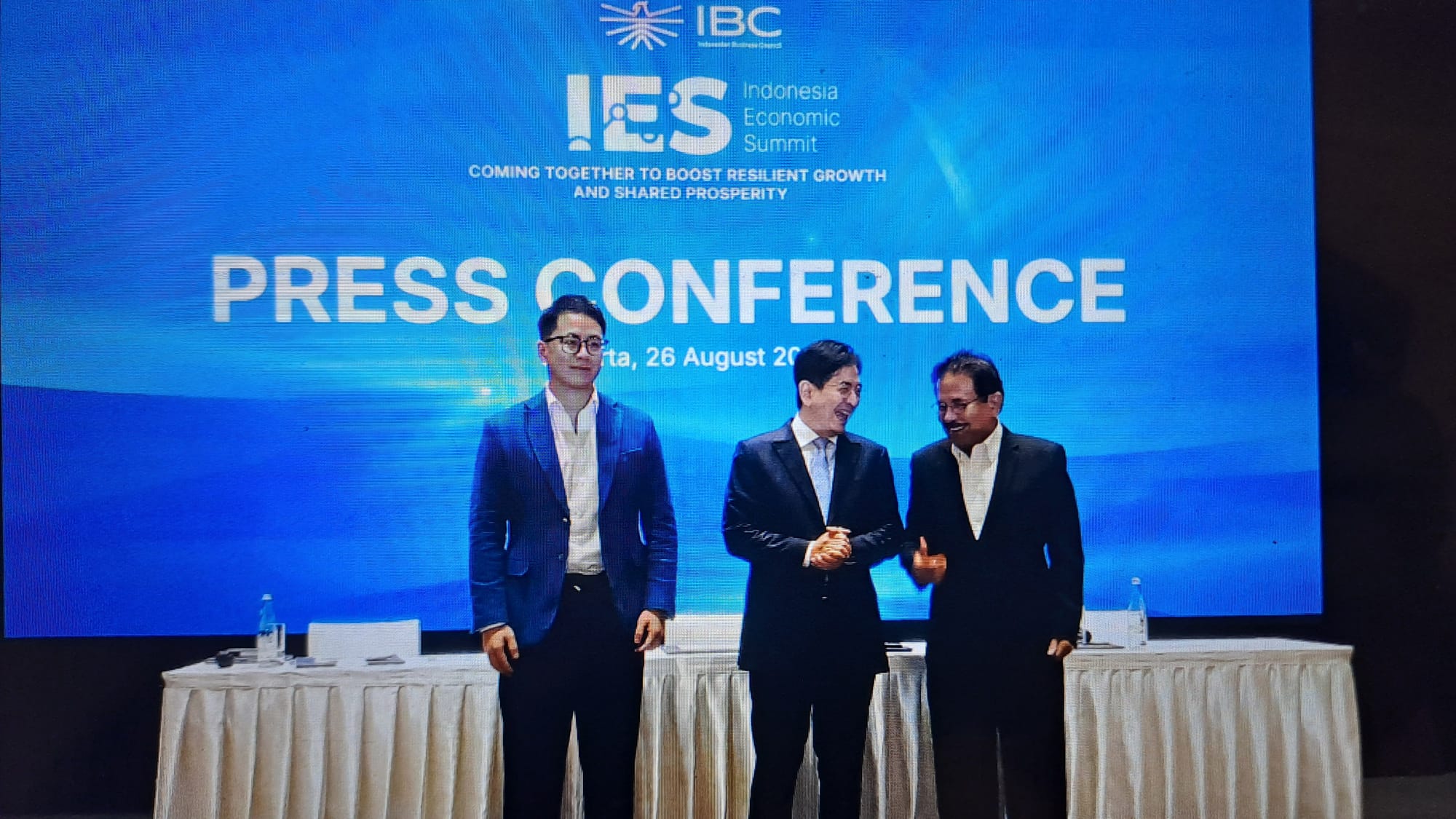
IBC CEO Sofyan Djalil said that one of the studies IBC is currently working on is the expansion of opportunities for Indonesian migrant workers in anticipation of the demographic bonus.
Sofyan noted that Indonesia has never experienced a demographic bonus that makes the population of the younger generation increase suddenly. As a result, the current need for jobs has exploded, while Indonesia's investment attractiveness, both in consideration of ease of doing business, cost of doing business, technological readiness, and talent excellence has not been very strong in the eyes of some investors.
As such, the jobs that can be unlocked from investment are not growing, while the population of job seekers is growing exponentially.
"Therefore, we thought of a solution to send young Indonesians as migrant workers to hone the skills and experience of young Indonesians by working abroad," Sofyan said.
The recommendations that IBC has made, Sofyan continued, are intellectual contributions that encourage a fit for purpose policy. Therefore, the policy research that IBC has made and is making still requires escort so that it can be implemented, not only by the government, but also by business and industry players who are members.
"When we find case studies or empirical experiences that have proven to be best practices, such as the success of companies from our neighboring countries or local practices that have proven successful in the region and can be applied more broadly, it becomes a lesson, and we will empower members by encouraging, why not you're into this?" said the Aceh-born economist.