
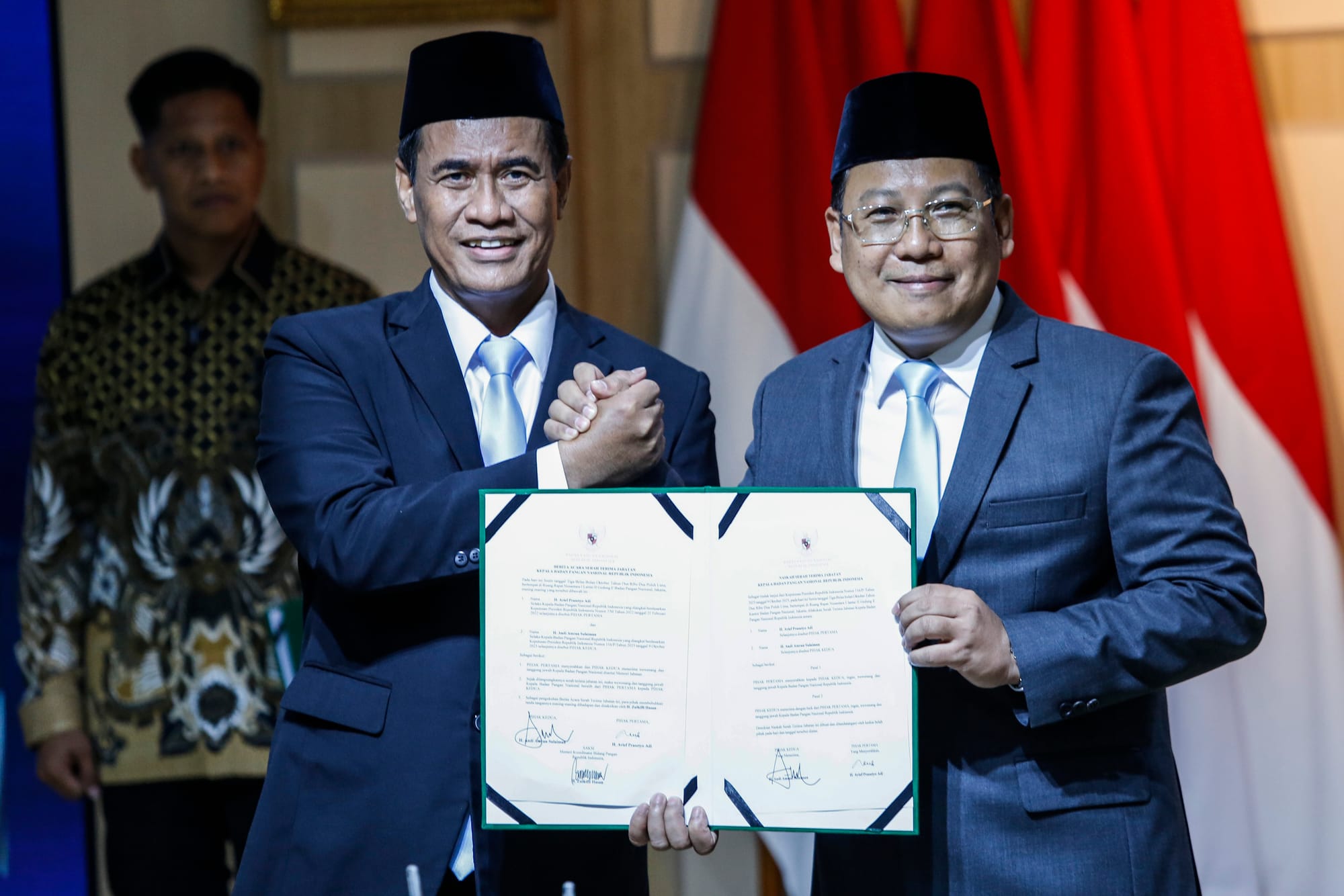
Last weekend, President Prabowo Subianto made another cabinet change by removing Arief Prasetyo Adi from his position as head of the National Food Agency.
As his replacement, Prabowo appointed Agriculture Minister Andi Amran Sulaiman as his successor.
"To respectfully dismiss Arief Prasetyo Adi as Head of the National Food Agency, with gratitude for his dedication and services while holding the position," Prabowo said in Presidential Decree No. 116/P of 2025 on the Dismissal and Appointment of the Head of the National Food Agency dated October 9.
Thus, Minister of Agriculture Andi Amran Sulaiman officially doubles as the Head of the National Food Agency (Bapanas).
Amran emphasized his commitment to strengthening cross-institutional cooperation in accelerating the realization of national food self-sufficiency.
"We only have one vision, which is food self-sufficiency. So, God willing, if there are no obstacles, in the next two-three months the President's big idea of self-sufficiency can become a reality. We can accelerate the four-year target to one year. This is the work of all of us without exception," he said during the handover ceremony held at the Bapanas Office in Jakarta, Monday (13/10),
Amran emphasized that the Ministry of Agriculture and Bapanas have the same vision in implementing President Prabowo Subianto's directive to realize food self-sufficiency.
Kementan ensures that the acceleration measures will focus on strategic programs such as strengthening production, stabilizing stocks, and controlling prices at the national level.
According to Amran, the positive achievements of the food sector in the past year need to be maintained with concrete work and continuous coordination.
He believes that the synergy between the Ministry of Agriculture under the coordination of the Coordinating Ministry for Food and Bapanas, Bulog, and other institutions will be the main foundation in maintaining food availability and price stability.
"In addition to maintaining existing achievements, the Ministry of Agriculture will also expand self-sufficiency efforts to various other strategic commodities," he said.
MOA targets to increase production and efficiency in the sectors of corn, sugar, palm oil, vegetable oil, chicken meat, eggs, chili, shallots, coffee, and cocoa so that food independence does not stop at rice, but becomes a national movement across commodities.
Meanwhile, the Coordinating Minister for Food, Zulkifli Hasan, expressed his appreciation to the Minister of Agriculture for the additional mandate he now holds as Head of Bapanas.
"Mr. Mentan, congratulations on your additional duties. I sometimes feel sorry for Mr. Mentan, because his workload is not light. But we know that the President has big thoughts and broad impacts, in accordance with our goal of food independence," Zulhas said.
Zulhas emphasized that the food challenges ahead are not easy, but President Prabowo's policy direction must be the guide for all stakeholders.
He also emphasized the link between food security and renewable energy development that the government is working on.
Focus on the Main Task
IPB Agriculture Analyst Dwi Andreas said the main task of the head of Bapanas is to coordinate, formulate, and set policies in the fields of availability, supply and price stabilization, and food safety.
"Focus on the main task for food safety, do not be affected by other issues," he told SUAR in Jakarta (13/10).
The Head of Bapanas must also stabilize food supply and prices so that they are affordable and stable.
Chairman of the Indonesian Rice Mill and Rice Association (Perpadi) Sutarto Alimoeso hopes that the head of Bapanas can maintain food security well, especially rice.
Bapanas conducts price interventions and market operations to ensure rice prices remain stable and supply is maintained. "Bapanas conducts regular supervision and audits, ensuring that the quality of rice distributed to the community is guaranteed and there is no quality decline," he told SUAR in Jakarta (13/10).
Food self-sufficiency is one of the most crucial issues that Indonesia is facing, such as climate change, land conversion, and the global food crisis.
FAO ranks Indonesia as the country with the second largest increase in food production in the world after Brazil.
Based on data from the Central Statistics Agency (BPS), national rice production this year has reached 33.1 million tons and is expected to reach 34 million tons by the end of the year, an increase of 4 million tons compared to the previous year.
In September 2025, BPS also recorded rice deflation of 0.13 percent, the first time in the last five years in the lean season. Meanwhile, the government's rice reserve stock currently stands at 3.8 million tons.
In addition, the Farmer Exchange Rate (NTP) as an indicator of welfare also increased significantly to 124.36 points, well above the national target of 110 points.
"This condition shows sufficient national rice availability and controlled prices at the consumer level. There is an additional one million tons for market operations. This indicates that our food is safe. Even in excess. Alhamdulillah," Amran explained.