
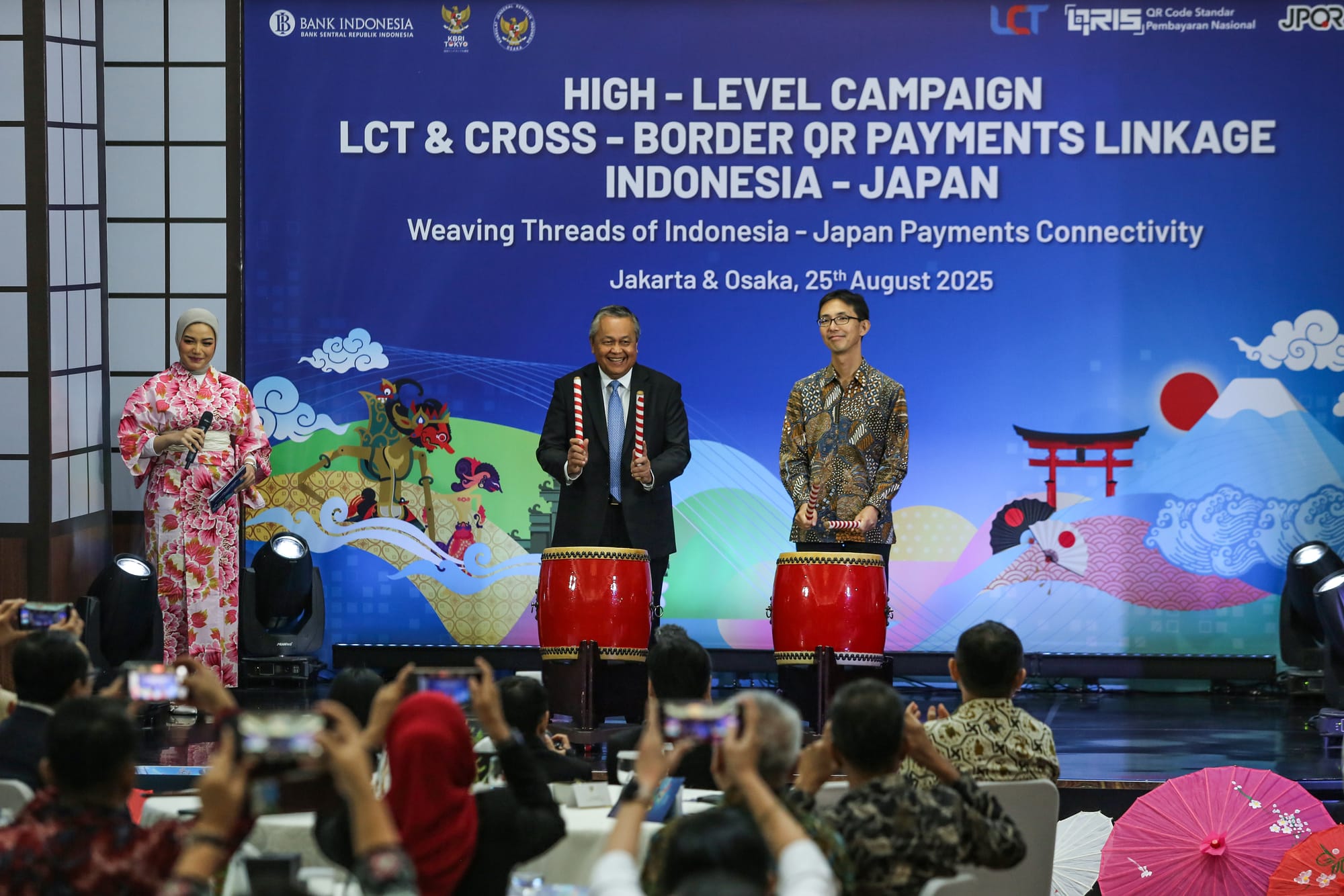
For business people and travelers, it is getting easier to transact digitally in the Land of the Rising Sun. Bank Indonesia (BI) has officially launched the cross-country Quick Response Code Indonesian Standard (QRIS) with Japan, which is effective from August 25, 2025.
The launch of this cross-country QR code-based digital payment system continues the series of QRIS Cross Border expansions. Previously, QRIS could already be used in Malaysia, Thailand, Singapore, Japan, and China.
The use of QRIS Cross Border is greatly felt by Fira Abdurachman, 48 years old, a fan of traveling abroad. According to Fira, the use of QRIS Cross Border is simpler, more convenient and safer when going abroad.
Several large restaurants in Thailand and Supermarkets in Malaysia can already use QRIS from Indonesia and this is very helpful.
“QRIS Cross Border is the best, it helps true travelers to go everywhere,” he said.
“QRIS Cross Border is the best, it helps true travelers to go everywhere,” said Fira Abdurrahman.
This QRIS expansion step was taken as part of a strategy to strengthen economic ties through digital financing connectivity.
The use of QRIS can be done at participating merchants by scanning JPQR Global through a domestic payment application without the need to exchange foreign currencies.
In the initial phase, the use of QRIS applies to 35 merchants in Japan. The reach of merchants will continue to be expanded, making it easier for Indonesian people to transact.
Governor of Bank Indonesia (BI) Perry Warjiyo said that the inauguration of the use of QRIS in Japan is a continuation of cooperation with Malaysia, Singapore and Thailand.
“This collaboration is a form of strong commitment to a shared vision in strengthening economic relations not only physically, but also through digital integration. That way, bilateral transactions in the future will take place more simply and without obstacles,” said Perry at the High Level Campaign LCT and Launching QRIS Cross Border Indonesia-Japan event in Jakarta (25/8).
QRIS or Quick Response Code Indonesian Standard was first introduced on August 17, 2019, and officially used nationally since January 1, 2020. Basically, QRIS is a digital payment standard based on QR codes that makes transactions easier simply by scanning a barcode, without the need for physical cards or cash.
In its development, Bank Indonesia launched cross-border QRIS. Namely, a cross-border payment system that allows Indonesian tourists to transact directly at overseas merchants in rupiah.
The launch of the Indonesia-Japan QRIS implementation is more than just simplifying daily payment transactions, but also reflects the strengthening of Indonesia-Japan economic relations and supports the formation of a more resilient digital payment ecosystem.
The successful implementation of Indonesia-Japan Cross-Border QRIS is the result of close collaboration between Bank Indonesia, the Indonesian Payment System Association (ASPI), the Ministry of Economy, Trade, and Industry (METI) of Japan, the Payment Japan Association (PJA), Netstars, and financial institutions from both countries.
According to Bank Indonesia data released in mid-July, the volume of digital payment transactions through QRIS in the second quarter of 2025 grew 148.50% year on year (YoY).
This increase contributed to the total volume of national digital transactions reaching 11.67 billion transactions.
In addition to QRIS, the volume of transactions via mobile applications rose 32.16% YoY, and transactions via internet banking grew 6.95% YoY. The payment system infrastructure is also increasingly solid: BI-FAST processed 1.12 billion transactions with a value of IDR 2,788 trillion, while BI-RTGS recorded transactions worth IDR 47,481 trillion.
Meanwhile, as of June 2025, the implementation of Cross-Border QRIS has shown significant results. Cross-Border QRIS cooperation with Thailand was recorded at 994,890 transactions with a nominal value of IDR 437.54 billion since it was launched in August 2022.
The volume of Indonesia-Malaysia Cross-Border QRIS transactions reached 4.31 million transactions with a nominal value of IDR 1.15 trillion since it was launched in May 2023. Cross-Border QRIS with Singapore, which was launched on November 17, 2023, has also recorded 238,216 transactions with a nominal value of IDR 77.06 billion.
High commitment
Chief of Economist of Bank Central Asia (BCA) David Sumual explained that the implementation of Indonesia-Japan Cross Border QR is a real form of Indonesia and Japan's commitment to supporting digital payments.
The need for a cross-country payment system is very necessary along with the increase in transactions and the influence of globalization.
“Many Indonesian people like to travel to Japan, with the enactment of this Cross Border QR it makes payments easier,” he told SUAR in Jakarta (25/8).
He said that the implementation of this cross-country QRIS not only makes transactions easier, but also builds an inclusive digital economy – especially for tourists.
Provide comfort for Indonesian tourists
Meanwhile, the Chairman of the Indonesian Payment System Association (ASPI) Santoso said that the launch of the Indonesia-Japan cross-country QRIS provides convenience for Indonesian tourists who want to vacation in Japan.
Indonesian tourists no longer need to bother exchanging money. They can directly use QRIS in transactions.
“The most tangible impact of this collaboration is the convenience for Indonesian tourists, they are increasingly happy to vacation in Japan,” Santoso told SUAR in Jakarta (25/8/2025).
He explained that with the continued growth of the Asian economy, financial transactions are also increasing rapidly, thus enabling QRIS exchange.
The potential use of QRIS can be seen from the large number of Japanese tourist visits to Indonesia. Citing data from the Central Statistics Agency (BPS), the number of Japanese tourists in June 2025 reached 29,569 people. This figure increased by 13.85% annually. On average, they spend 6.64 days in Indonesia.
Meanwhile, destinations to Japan account for 3.64% of the total visits of Indonesian tourists to foreign countries.
In addition to data on Japanese tourists to Indonesia and vice versa, the great potential of QRIS to Japan can be seen from the rapid trade between the two countries.
Based on data from the Ministry of Trade, total trade between Indonesia and Japan in the January-June 2025 period reached US$ 15.611 million. This consists of an export value of US$ 8.123 million and an import value of US$ 7.487 million.
The details are as follows: the value of oil and gas trade reached US$ 1.014 million, non-oil and gas reached US$ 14.596 million. Oil and gas exports reached US$ 1.000 million and non-oil and gas reached US$ 7.121 million, while oil and gas imports reached US$ 12,000 and non-oil and gas reached US$ 7.47 million.