
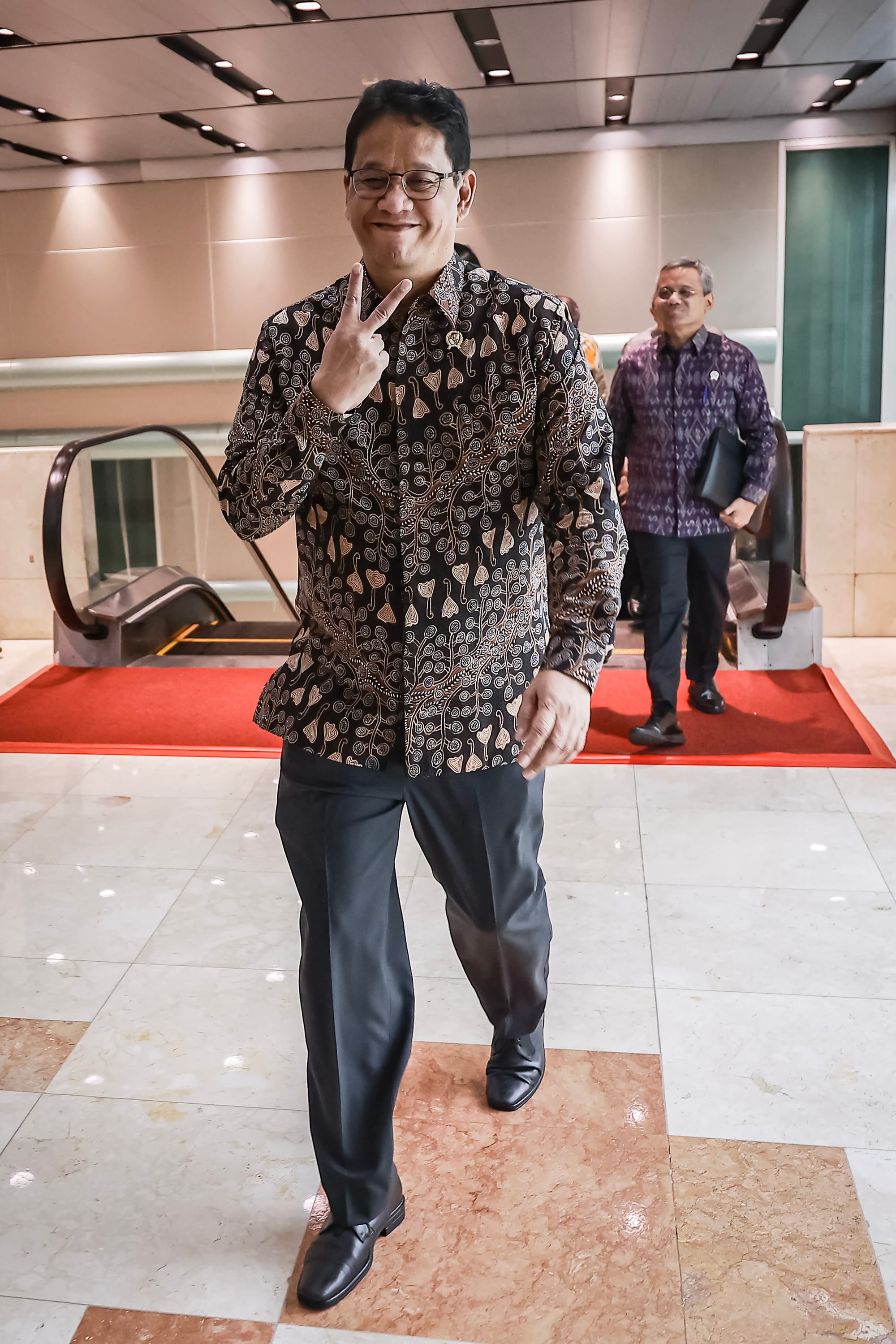
The government is signaling an easing of non-tax state revenue (PNBP) levies. One of them aims to accelerate strategic projects in Papua.
After a limited meeting with President Prabowo Subianto at the Presidential Palace, Jakarta, Friday (19/9/2025) evening, Minister of Finance Purbaya Yudhi Sadewa admitted that he is ready to provide PNBP relaxation for PT Agrinas Pangan, a state-owned company that manages large-scale food programs in Eastern Indonesia.
"In my opinion, it's left pocket, right pocket. If he lacks, he asks me too. I tax him, he asks me too. What for?" said Purbaya.
The relaxation is mainly related to the obligation to pay the cost of land use rights (HGU), which is actually the domain of the Ministry of Agrarian Affairs and Spatial Planning / National Land Agency (ATR / BPN). According to Purbaya, the Agrinas food project needs to be accelerated even though the consequences can reduce state revenue from the PNBP side. "It's land, after all, if you want to make a HGU, you have to pay PNBP first. That is actually not in us, but in ATR/BPN," he said.
This move came after President Prabowo summoned Purbaya to Hambalang the day before. The summons, according to Purbaya, could not be separated from Agrinas' complaint about the slow issuance of the PNBP exemption letter, which is an administrative requirement for HGU management.
"Agrinas has a program where thousands of hectares of land have not been certified. He needs a letter from the Ministry of Finance that it is PNBP-free. He complained to the President, he said the letter had not been processed," he explained.
Purbaya does not want the Ministry of Finance to continue to be a scapegoat. He emphasized that if the letter was only sent in the afternoon, then the Ministry of Finance could immediately issue it the next day. "I told the President, 'Sir, I just sent it this afternoon. Yes, I will issue it tomorrow. But don't claim the Ministry of Finance is late.' Usually we are the punching bag, we are blamed all the time," he said.
PNBP slows below target
Behind the tug-of-war over this strategic project, the condition of PNBP is not encouraging. Until the first semester of 2025, PNBP collected Rp 222.9 trillion or 43.4% of the 2025 State Budget target of Rp 513.8 trillion.
The realization continued the slowing trend since the beginning of the year. As of May 2025, for example, the PNBP achievement had even dropped 24.9% compared to the same period last year to IDR 188.7 trillion.
This condition is worse than the government's projections, which are already low. In the 2026 Draft State Budget, the PNBP target is only set at IDR 455 trillion, lower than the 2025 outlook of IDR 477.2 trillion, as well as far below the 2024 realization of IDR 584.4 trillion.
Sri Mulyani Indrawati, when she was still Minister of Finance, during the House of Representatives' Plenary Session at the end of August, mentioned at least three main factors behind this sharp decline.
First, the weakening of global commodity prices pressured royalties from mining and oil and gas.
Second, since the beginning of 2025, BUMN dividends will no longer go to the state treasury because they are transferred to the Daya Anagata Nusantara Investment Management Agency (Danantara). In fact, dividends have been a big contributor to PNBP.
Third, the raw material export ban policy has cut export duty revenues.
"Strengthening supervision through joint state revenue programs, digitalization steps and simplification of PNBP services are carried out in an integrated manner," Sri Mulyani said at that time. She also inaugurated the Directorate of PNBP Potential and Supervision under the Directorate General of Budget to strengthen non-tax revenue governance.
Expenses increased
While revenue is slowing down, state spending continues to increase. President Prabowo established a number of priority programs with jumbo budget requirements. The Free Nutritious Meal Program (MBG) is estimated to cost more than Rp 400 trillion per year.
The government must also increase Danantara's capital as a sovereign wealth fund, pay energy subsidies, and cover infrastructure, health, and education financing.
Finance Minister Purbaya realizes that fiscal space is getting narrower. He emphasized that he would be more aggressive in supervising ministries and institutions with slow budget absorption. "If there is an unabsorbed budget, I will take it and move it to another program," he said.
It is at this point that the PNBP relaxation policy for strategic projects such as Agrinas becomes paradoxical. On the one hand, the state is trying to close the revenue gap. On the other hand, the government does not hesitate to provide leeway for the acceleration of priority programs.
Middle ground and diversification
A number of economists consider that the PNBP relaxation step for strategic projects is still understandable, as long as it is done selectively. PNBP, is not just a deposit figure, but also a policy instrument. If the HGU relaxation is able to accelerate food projects in Papua, the economic impact can be greater than the short-term revenue lost.
Yusuf Rendy Manilet from CORE emphasized that pragmatically, relaxation has the potential to accelerate food security projects. Especially in Merauke, which is currently developing 200,000 hectares of land for food, water and energy. "The logic of the left pocket to the right makes sense, don't let the HGU fee hamper," he said.
However, he cautioned that the problem lies in momentum. This year, state revenues are under pressure: taxes are declining, PNBP is falling, while the state budget deficit has widened.
Relaxation in these conditions, said Yusuf, risks increasing the fiscal burden. Therefore, its execution must be truly transparent and accountable so that it does not become a field of abuse like the previous food estate project.
Yusuf also emphasized that the fiscal impact needs to be recalculated. If revenue falls, the compensation must be clear. For example, through spending efficiency.
He also reminded that social and environmental aspects in Papua should not be ignored. "If only corporations benefit, conflicts can arise," he said.
According to him, relaxation can be justified as a long-term trade-off . But, without strict guidelines, it risks worsening fiscal imbalances at a time when the economy is fragile.
A bigger challenge was highlighted by Indef economist Eko Listyanto. Eko believes that the government needs to immediately diversify sources of PNBP revenue so that it does not solely depend on BUMN dividends and mining royalties which continue to be depressed. "Many state assets that are still idle, in fact, can be optimized through cooperation with the private sector to open up new sources of revenue," said Eko.
Eko reminded that the decline in PNBP has the potential to reduce the government's fiscal space. As a result, priority programs such as Free Nutritious Meals (MBG) may have to be adjusted according to budget capabilities. "If we refer to the Minister of Finance's solution, the revenue shortfall is likely to be covered through widening the deficit, the Ministry of Finance's outlook is around 2.78% of GDP, and the utilization of excess budget balances (SAL)," he said.
Even so, he emphasized, the MBG challenge is not just a matter of funds. The ability to absorb the budget, good governance, and regional readiness will be very decisive. "Without careful preparation, vulnerable programs will only become a budget burden without having an optimal impact on society," said Eko.
In the midst of the dilemma of slowing revenue and swelling expenditure, the government is required to find a middle way, namely maintaining the pace of development without sacrificing fiscal discipline. The relaxation of PNBP for Agrinas may provide short-term wiggle room, but in the long run, revenue diversification and strengthening governance remain the key to a robust state budget that supports the Prabowo administration's grand ambitions.
Tax burden, private role, and distribution
On the other hand, the business community considers that the weakening of non-tax state revenue (PNBP) will add pressure to the business world. Chairman of the Manpower Division of the Indonesian Employers Association (Apindo) Bob Azam said that the current economic conditions are indeed facing serious challenges.
"Our economy is slowing down. Almost all indicators are negative, including PMI and state revenue. If the economy is weak, state revenue will automatically weaken," he said.
However, according to him, the government's move that tends to cover the weakening of revenue by increasing tax rates can actually backfire.
"Because revenue is not as expected, the government ends up raising tax rates and others. In fact, it can actually hit the business world even more. What is needed is a policy that reverses the situation, relaxation that encourages the economy to move, so that state revenues can increase," he added.
He emphasized the importance of government projects involving the private sector. Such schemes are considered healthier because they open up profit opportunities for companies, while creating additional revenue for the state.
"The government needs projects that involve the private sector. Not only are they involved, but they can also generate profits for the company as well as income for the country," said Bob.
Furthermore, Bob also highlighted the government's tendency to be misguided in organizing the business ecosystem. He gave an example of a policy that marginalizes the role of distributors or middlemen, even though they are an important part of the distribution chain.
"The private sector should not be antagonized, let alone middlemen. They are part of the market mechanism, the backbone of distribution. If distribution is eliminated, prices will become more expensive. The problem is not with middlemen, but with monopolies. What must be eradicated is the monopoly, not the distribution players who actually maintain the market ecosystem," he said.