

Although there are still two months left before the end of 2025, a number of institutions have already issued estimates of economic growth next year. The economic growth in 2026 is estimated to range from 4.9%-5%.
The Institute for Economic and Community Research of the Faculty of Economics and Business, University of Indonesia (LPEM FEB UI) projects Indonesia's economic growth in 2026 to be in the range of 4.9-5.0%.
In a report entitled Indonesia Economic Outlook 2026, LPEM assesses that the growth rate has not reflected significant structural improvements. Growth that appears stable is actually described as growth with suboptimal quality.
LPEM noted that in 2025, the new government launched a number of populist programs such as Makan Bergizi Gratis (MBG) and Koperasi Merah Putih, which had a major impact on the state budget. The programs increased the spending burden and forced the government to make cuts to various budget items, including transfers to the regions. LPEM assesses that the combination of rising debt interest payments, stagnant revenue, and large expenditure expansion has the potential to disrupt fiscal sustainability.
In the report, LPEM noted that household consumption grew 4.97% on an annualized basis in the second quarter of 2025, slightly higher than 4.95% in the previous quarter. This increase was mainly due to seasonal factors such as long holidays, Eid celebrations, and the provision of holiday allowances, rather than a sustained increase in purchasing power.
"GDP growth in Q2 2025 exhibited a number of mismatches and anomalies when compared to broader macro- and microeconomic indicators," the report states.
LPEM also noted a decline in the Consumer Confidence Index as well as a drop in tax revenue, with VAT decreasing by 19.69% and income tax decreasing by 11.35% compared to the same period last year.
On the monetary side, LPEM highlighted Bank Indonesia's move to lower its benchmark interest rate by 100 basis points since the beginning of 2025 to 4.75% in October, despite the rupiah exchange rate weakening to IDR 16,660 per USD. Bank Indonesia also purchased IDR217.1 trillion worth of government bonds in the secondary market until mid-September 2025. The easing policy was carried out amid acapital outflow of USD0.79 billion and a decline in foreign exchange reserves to USD148.7 billion.
In its report, LPEM highlighted the risks to Bank Indonesia's independence as fiscal and monetary boundaries blur. The placement of around Rp200 trillion of government funds in state-owned banks, the reduction of interest rates, and the reactivation of the burden-sharing scheme are considered to increase the potential for fiscal dominance over monetary policy.
"Recent developments, including the surprise interest rate cut and the reactivation of the burden-sharing scheme to fund the President's program, have raised concerns among analysts about the potential erosion of Bank Indonesia's independence and increased political influence on monetary policy," the report said.
Previously, a number of international organizations had also released predictions of Indonesia's economic growth in 2026. According to the Organization for Economic Co-operation and Development (OECD) , Indonesia's economic growth in 2026 is estimated at 4.9%.
The Asian Development Bank (ADB) assesses Indonesia's economic growth projection to reach 5.0%. This ranks third after Vietnam with a projection of 6.7% for this year and 6.0% in 2026; and the Philippines with a projection of 5.6% for this year and 5.7% in 2026.
Read also:
 Benedictus Krisna Yogatama
Bank Indonesia (BI) Governor Perry Warjiyo said that overall economic growth in 2025 is slightly above the midpoint of the 4.6-5.4% range and increases in 2026.
Quite differently, a very optimistic view was expressed by Finance Minister Purbaya Yudhi Sadewa, who said that Indonesia's economic growth in 2026 could reach 6%. According to him, economic conditions in the second semester of 2025 will be the basis for the Indonesian economy to accelerate next year.
Brittle foundation
Economic researcher at the Center of Reform on Economics (CORE) Indonesia, Yusuf Rendy Manilet, believes that LPEM FEB UI's projections show an economy that continues to grow, but with a fragile foundation.
The household consumption structure, which is the main pillar of GDP, is facing pressure due to the shrinking middle class and the lack of stimulus directed at them. "When the middle class holds back spending because their income is declining and there is no specific stimulus, economic growth also weakens," Yusuf said.
According to him, another challenge comes from the uneven composition of investment. Most investment in recent years has been concentrated in the downstream mining sector, while labor-intensive sectors that have a large multiplier effect have not been maximally absorbed.
This condition makes investment growth only strong in numbers, but limited in job creation. Yusuf called this homework that needs to be addressed immediately so that investment does not only accumulate in long-term and export-oriented projects.
On the fiscal side, Yusuf assessed that the government is facing increasingly narrow spending space because various government flagship programs such as MBG and Koperasi Merah Putih require large budgets.
The policy of reallocating funds to finance the program is considered to pose a risk to fiscal sustainability, including the ability to transfer to the regions.
The cut in regional funds has left a number of local governments without a source of financing and forced them to raise taxes abruptly. "Moreover, this populist program has not been tested for its impact on economic growth," he said.
Yusuf also highlighted the loose monetary policy amid external pressures. The decline in the BI benchmark interest rate to 4.75% when the rupiah weakened to Rp16,660 per dollar was considered too fast and actually increased the potential for capital outflows. He reminded that the purchase of Rp217 trillion worth of government bonds and the placement of Rp200 trillion in funds in state-owned banks strengthened the perception that the monetary authority was getting involved in fiscal financing. "We have not yet reached the condition of fiscal dominance, but the symptoms are there," Yusuf said.
Thus, Yusuf emphasized the importance of maintaining monetary policy communication so that the public and market players continue to believe in BI's independence. According to him, fiscal and monetary coordination is still needed, but it must be within clear limits. Yusuf cited a number of countries such as Turkey and Argentina that lost market confidence because the independence of their monetary authorities was eroded by political pressure.
"For growth to be more inclusive, the key is fiscal policy. This includes stimulus for society and industry as well as job creation. That will ensure that government spending can be felt by the lower and middle groups, not just the top. The key word is in a comprehensive fiscal policy design," he said.
The business world needs certainty
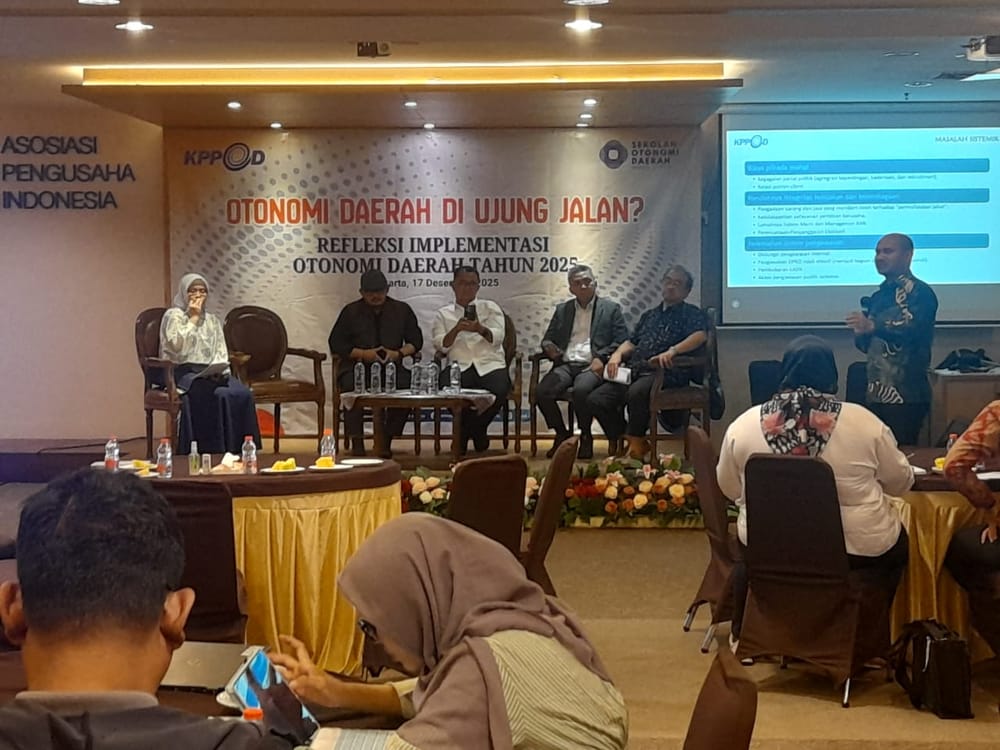
The business community believes that the fundamental problem still rests on the effectiveness of bureaucracy and regulatory certainty. Previously, Deputy Chairman of the Indonesian Employers Association (Apindo), Sanny Iskandar, said that many investments were held back at the basic licensing stage due to overlapping authority between ministries. Obstacles like this, he said, make government policies not automatically translate into real economic activities on the ground.
Sanny pointed out that a number of projects that had obtained location permits and met administrative requirements were hampered due to differences in interpretation between agencies regarding spatial planning and land use. "The concept of one map policy has not been fully implemented until now, so that one area can be claimed by two ministries with different functions," he said.
Sanny emphasized the importance of structural reforms so that government policies really have an impact on investment and job creation. According to him, without regulatory certainty and quick completion in the field, various development programs will be difficult for businesses to feel. "The business world needs certainty and quick resolution, not a pile of new regulations," he said.