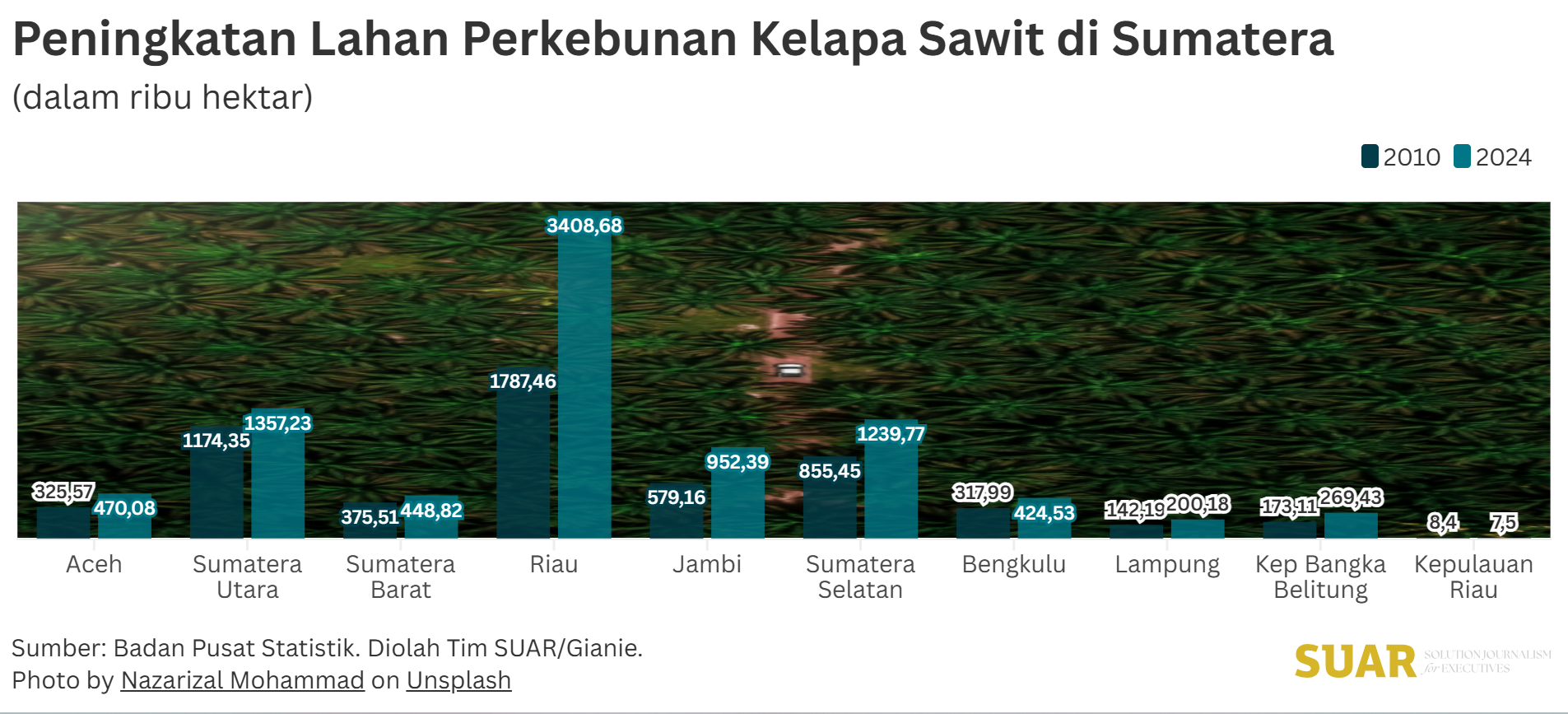
Over the past 1.5 decades, data from the Central Statistics Agency (BPS) shows that the area of Indonesian palm oil plantations has increased from 9 million hectares in 2010 to 16 million hectares in 2024. With this 76% increase in area, production has reached 47 million tons, making Indonesia the world's leading producer of palm oil.
More than half, or around 55%, of the plantation area is located on the island of Sumatra. It currently covers around 8.7 million hectares, an increase of 53% over the last 1.5 decades.
On the island of Sumatra, the province with the largest oil palm plantation area is Riau Province. In 2024, it will cover an area of 3.4 million hectares, accounting for around 39% of the total oil palm plantation area in Sumatra or 21% of the total national oil palm plantation area. North Sumatra Province is the province with the second largest oil palm plantation area in Sumatra, covering 1.35 million hectares or 15.5% of the total oil palm plantation area in Sumatra.
In the context of the three provinces in Sumatra, namely Aceh, North Sumatra, and West Sumatra, which were hit by flash floods and landslides at the end of November, the cumulative area of oil palm plantations in these three provinces is still below that of Riau Province. With an area of 470,000 hectares in Aceh, 1.35 million hectares in North Sumatra, and 448,000 hectares in West Sumatra, the cumulative area of oil palm plantations in the three provinces is only 26% of the total area of oil palm plantations in Sumatra. This percentage is smaller than the area in Riau.
Although the share of oil palm land in the three provinces is smaller than that of Riau, the increase over the last 1.5 decades is quite large. Oil palm land in Aceh has increased by 44.4%, in North Sumatra by 15.6%, and in West Sumatra by 19.5%. Oil palm production in these three provinces contributes 15.3% to national production.
The significant increase in oil palm plantation land, both nationally and among major producers in Sumatra, has actually been attempted to be curbed through a moratorium. The palm oil moratorium policy was issued on September 19, 2018, through Presidential Instruction (Inpres) No. 18 of 2018 concerning the Postponement and Evaluation of Palm Oil Plantation Licensing and the Improvement of Palm Oil Plantation Productivity.
The purpose of the moratorium is to increase palm oil productivity through plantation intensification, without expansion. The Presidential Instruction is addressed to central and regional government agencies to evaluate land release permits and postpone the opening of new palm oil plantations for three years. The moratorium period ends on September 18, 2021.
Unfortunately, the goal of the moratorium was not achieved. Expansion is still happening, meaning that permits to open or expand new oil palm plantations continue to take place.
BPS data shows that during the 2018-2021 period, there was an increase in the area of oil palm plantations by 2.4% or an additional 337,300 hectares, from 14.32 million hectares in 2018 to 14.66 million hectares in 2021.
With the increase in area, palm oil production has also increased. Increased production cannot be done without expanding land. This increase in the area of oil palm plantations has worsened Indonesia's image internationally due to widespread deforestation.