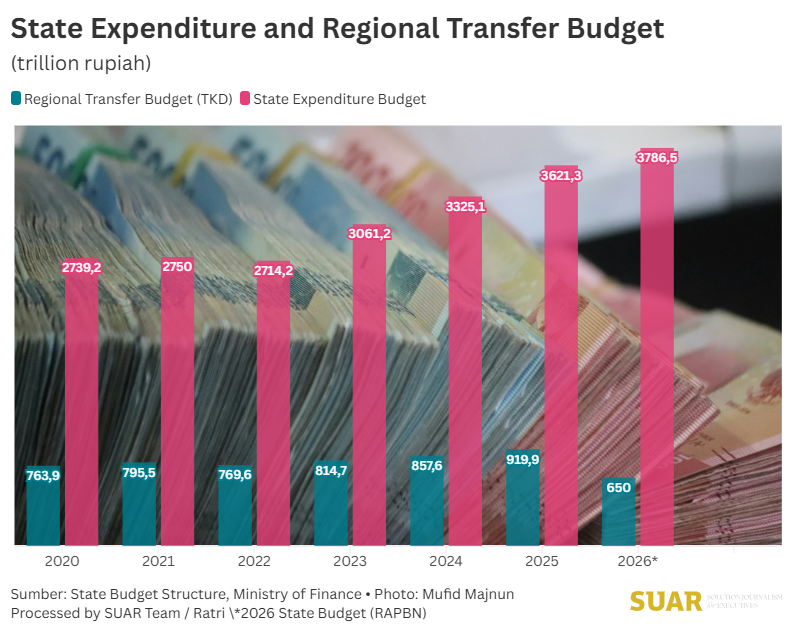
The government has increased the allocation for the food security budget in the 2026 State Budget Draft (RAPBN) by 5.9% to IDR 164.41 trillion. This reflects the government’s strong commitment to achieving food self-sufficiency, particularly in rice and corn.
Food security is one of the eight priority agendas of President Prabowo Subianto. The increase in the food security budget is not only aimed at boosting production but also at stabilizing prices and improving the welfare of farmers and fishermen.
Naturally, this large budget allocation requires effective implementation and strong cross-agency coordination to ensure that the goals of food security are achieved, especially the optimization of key commodities such as rice and corn.
It should be noted that Indonesia’s agricultural sector is facing challenges in the form of declining production and a shrinking number of farmers. Data from Statistics Indonesia (BPS) shows that rice production, which once reached 54.9 million tons in 2022, fell to 53.1 million tons in 2024.
A similar trend occurred with corn. Its production also dropped from 16.5 million tons in 2022 to 15.1 million tons in 2024. This trend indicates that Indonesia still struggles to maintain consistent production of staple food crops that are crucial for food security.
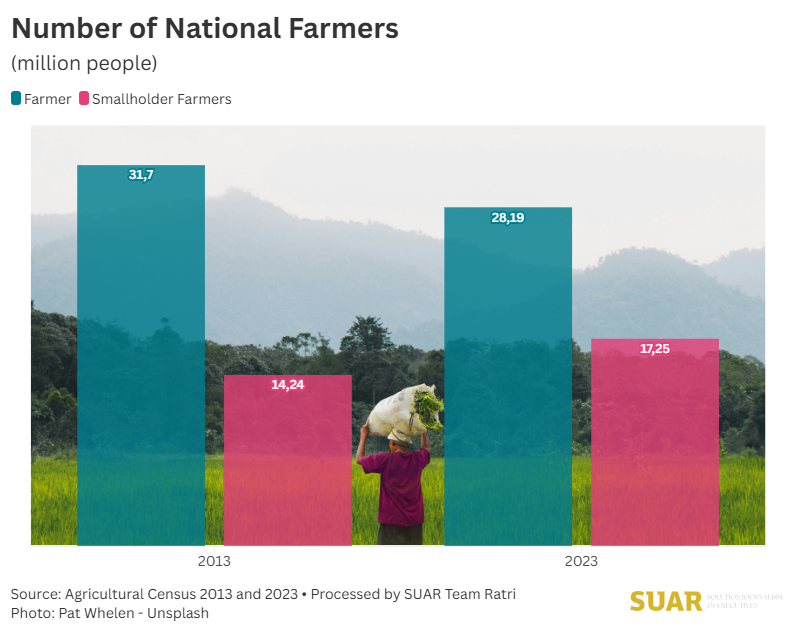
The workforce in the food sector, particularly farmers, has also declined. The 2023 Agricultural Census by BPS recorded 28.19 million farmers, down from 31.7 million farmers in the 2013 census. Meanwhile, the number of smallholder farmers increased from 14.24 million (2013) to 17.25 million (2023).
The increase in the number of farmers with agricultural land of less than 0.5 hectares, or smallholder farmers, indicates that they are also facing the threat of land shrinkage. In addition, from an age perspective, around 61.35% of main farmers are over 45 years old, while only 10.6% are under 35. This shows the lack of regeneration in the agricultural sector.
The additional allocation of the food security budget demonstrates the government’s strong commitment to addressing these challenges. This budget is not only allocated for subsidies but also for strategic investments.
The development of agricultural infrastructure, such as irrigation and dams, is expected to restore and optimize underproductive farmland. Furthermore, investment in modern technology and agricultural machinery is expected to attract younger generations to enter the food sector.