
Bank Indonesia (BI) estimates 2026 economic growth in the range of 4.9%-5.7%. This is supported by 2025 economic growth in the range of 4.7%-5.5%. Indonesia's economic growth in 2027 is expected to continue to accelerate in the range of 5.1%-5.9%.
At the Bank Indonesia Annual Meeting, at Graha Bhaskara Icchana Bank Indonesia, Jakarta, Friday (28/11/2025), BI Governor Perry Warjiyo said that the 2026 economy will be supported by strong public consumption supported by the Free Nutritious Meal (MBG) program and social assistance. Meanwhile, investment is also expected to strengthen from the entry of investment in Special Economic Zones (KEK) and Industrial Zones (KI) as well as various Danantara investment actions.
Meanwhile, inflation in 2026 is expected to remain under control in the range of 1.5%-3.5%. This continues the controlled inflation in 2025 and continues in 2027 at the same estimated range of 1.5%-2.5%.
Perry Warjiyo revealed five characteristics of the 2026 world economy.
- The sustainability of the United States' protectionist tariff policy.
- Slowing economic growth in the US and China.
- The high government debt and fiscal burden of developed countries.
- The high vulnerability and risk of the world financial system due to derivative product transactions that depress the exchange rate of developing countries.
- The rise of cryptocurrency and stablecoin transactions.
To address the situation, Perry emphasized the importance of synergy to ensure better economic performance, characterized by higher growth, increased consumption and investment, maintained inflation, stable rupiah exchange rate, sufficient foreign exchange reserves, increased credit, maintained financial system stability, and high-growth digital financial economy (EKD) access.
"Going forward, let us further strengthen the synergy of transforming the national economic structure to encourage growth based on natural resources and the people's economy through synergies in five important areas: strengthening stability and driving demand; downstream and industrialization; financing and financial markets; accelerating EKD; and international cooperation," Perry said.
With synergies to support downstream financing and industrialization of strategic commodities, BI positions the policy mix to remain pro-stability and pro-growth. The monetary policy mix will keep an eye on the room for interest rate cuts, while seeking exchange rate stabilization through foreign exchange intervention, expansion of pro-market monetary liquidity, and maintaining adequate foreign exchange reserves.
Meanwhile, the macroprudential policy mix through liquidity policy incentives worth Rp423 trillion for banks that encourage the acceleration of credit to priority sectors and accelerate the decline in bank interest rates is carried out simultaneously with the coordination of the Financial System Stability Committee (KSSK) to overcome special rates on large depositors and strengthen the surveillance system.
In an effort to encourage the growth of EKD, the establishment of an integrated digital center supported by artificial intelligence capacity will be the foundation of an interconnected digital payment system infrastructure, followed by QRIS innovation which is targeted to reach 60 million users, with 45 million of them being UMKM players. The digital rupiah experiment is being prepared to become the only legal digital payment instrument in the territory of the Republic of Indonesia.
"With relentless transformation, thank God, BI received 10 international awards throughout 2025. BI's commitment to maintain accountability with performance reports to the President of public transparency and continue to synergize with various parties. With synergy, Indonesia will achieve higher growth and resilience," Perry concluded.
Presidential mandate
The resilience of the Indonesian economy that has managed to find spaces for growth amid the turmoil of global uncertainty is proof that the synergy of all economic stakeholders has taken the right path. Going forward, economic acceleration should not only spur growth according to the set target, but also ensure that all people enjoy the economic cake, including those in remote areas of the country.
The mandate was emphasized by President Prabowo Subianto when giving a speech at the same event.
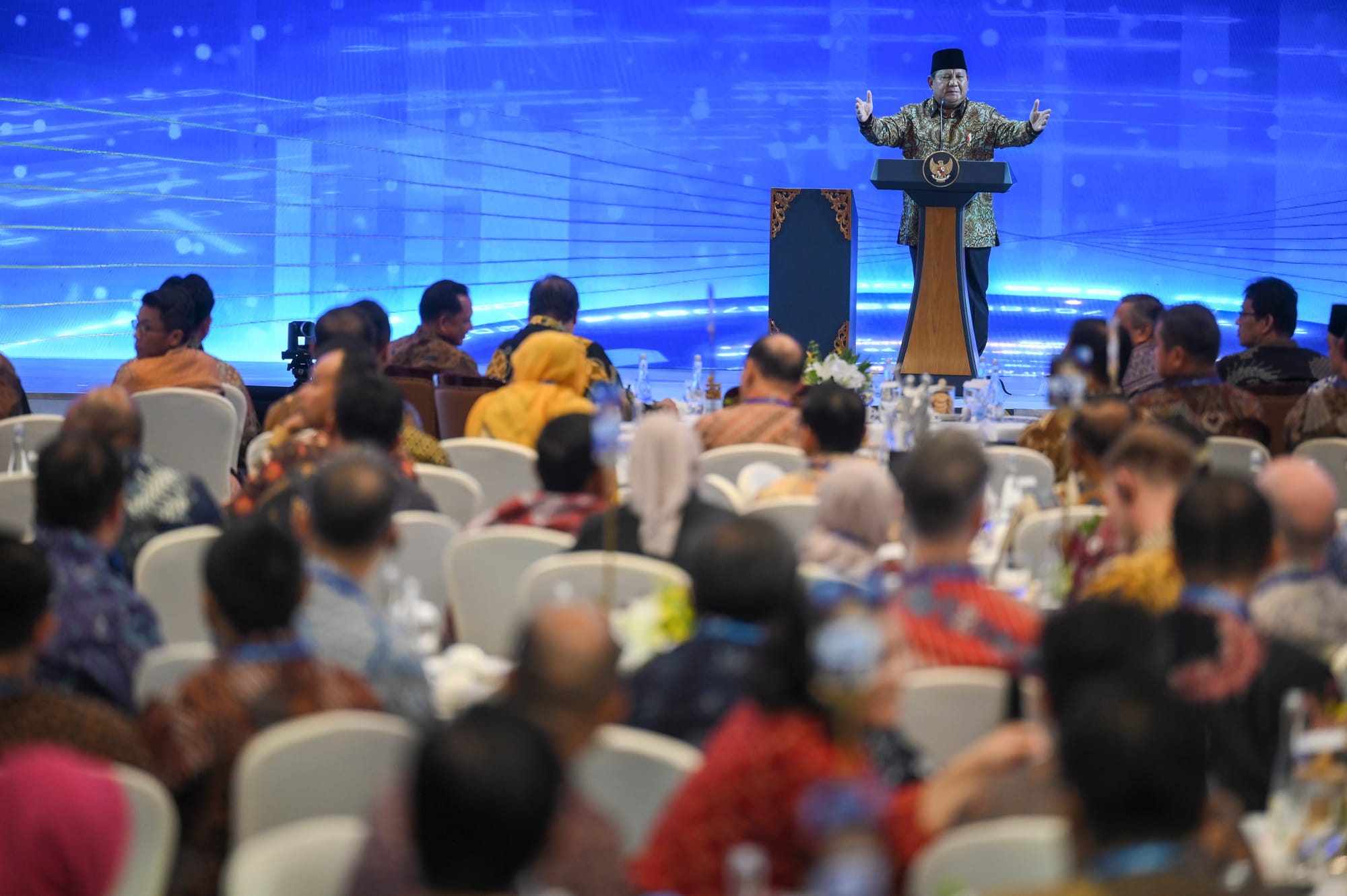
The Head of State stated that during his one year in office, the economic achievements that remain stable provide a calming picture, especially in the midst of trade wars and global hegemony competition. The cooperation between the ministers managing the economy is one of the drivers of this success, and the President expressed his gratitude for the hard work of his aides in the cabinet.
"We stand with our heads held high that we are able to control the economy with prudence, with sincerity, and the intention of a clean government, a fair government, free of fraud and corruption. This is our determination and tonight we see the evidence," Prabowo said.
Apart from the economic record that deserves appreciation, in front of hundreds of guests, Prabowo showed a short video clip about school children in Nias, North Sumatra and other remote areas who have to cross the river to get to school. Through the short clip, the President reminded that the economic map and plans that have been good need to be considered for implementation.
"Our poorest people cannot wait. While we are here, there are still children risking their lives to go to school. The growth figures are good, but our people, our children go to school every day, sit in class, and come home wet. They are screaming, and the state must answer," he said.
On top of the established economic foundation, Prabowo directed that the goal of accelerating the economy in 2026 needs to be followed up with a blueprint for the distribution of the economic cake, especially for people in remote areas and far from the growth centers.
"We are on the right track. Complement each other, help each other. Synergy, unity, reconciliation. Once we are united, all elements, all parties, all tribes, all religions, all stakeholders, the private sector and the government unite and work to overcome the suffering of the people towards a Golden Indonesia," Prabowo concluded.
Expert view
Center of Reform on Economics (CORE) Indonesia Executive Director Mohammad Faisal warned that the room for BI-Rate cuts is increasingly limited, while liquidity expansion policies have not been fully effective. Therefore, instead of encouraging credit, future BI-Rate cuts risk weakening the rupiah amid market pressures, while the impact flows directly to the real sector.
"The surge in primary money growth since September was largely due to the injection of liquidity and the placement of part of the government's current account at BI into the banking sector. Meanwhile, money supply growth has slowed down. The slower decline in deposit rates is a signal that monetary easing has not been fully effective in reducing the cost of funds for banks, so that lending to the real sector has not strengthened," Faisal explained at the launch of the CORE Economic Outlook 2026, Wednesday (26/11/2025).
Sharing Faisal's view, LPEM FEB UI Macroeconomics and Financial Markets Researcher Teuku Riefky assessed that BI faces three challenges in maintaining its independence when the temptation of "coordination" of fiscal-monetary authorities and the commitment to synergy are peddled so easily.
First, reducing government bond holdings without creating financial volatility. Second, ensuring government debt continues without dependence on the central bank. Third, maintaining market confidence in the management of capital flows and exchange rate pressures.
"BI needs to establish an institutional framework that allows coordination to remain effective while maintaining its independence," Riefky said in an analysis of Indonesia Economic Outlook 2026. There are three aspects of the institutional framework that are important for BI to consider in synergizing. First, legal restrictions on central bank lending to the government, ensuring coordination is only carried out in crisis periods, along with guarantees of transparency and accountability.
Second, well-defined institutional arrangements on how central bank losses are covered, how profits are distributed, and under what conditions the central bank can provide fiscal support. These rules help prevent political disputes while allowing the central bank to work alongside the Ministry of Finance without compromising its autonomy.
Third, the Ministry of Finance remains focused on government financial matters, such as strengthening the tax base, rationalizing spending, improving debt management, and increasing fiscal transparency, instead of engaging in monetary or quasimonetary operations such as forging liquidity injection funds into banks or directing loans through state-owned banks.
"Maintaining clear boundaries is crucial to prevent policy conflicts and maintain institutional credibility. Instead, fiscal policy should stimulate demand through targeted public investment and structural reforms, while liquidity management and price stability remain the exclusive domain of the central bank," concluded Riefky.