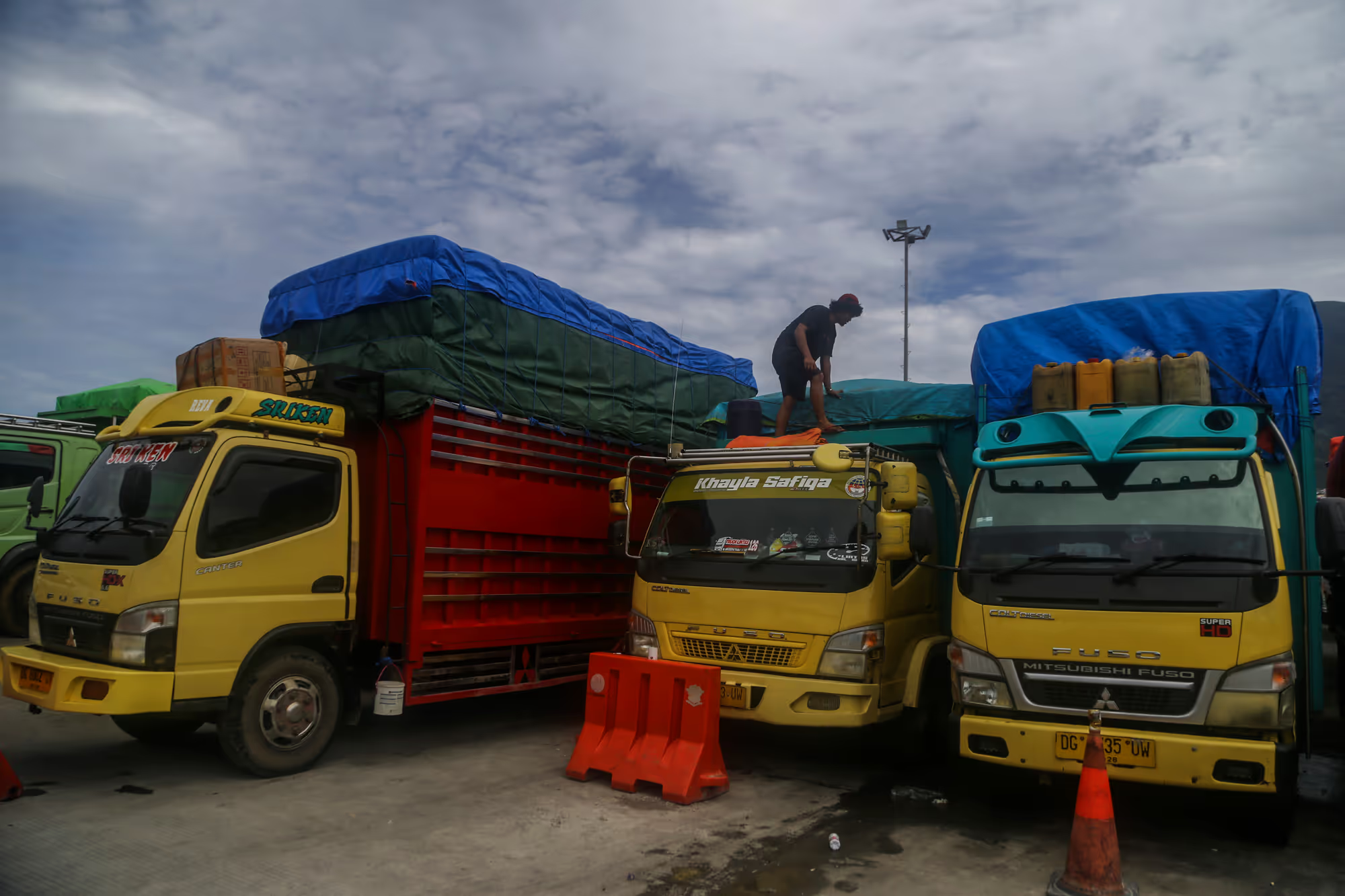
After years of debate, Indonesia is edging closer to implementing a “zero over-dimension and overloading” (ODOL) truck policy, though uncertainty remains over how and when full enforcement will begin.
Transportation Minister Dudy Purwagandhi has urged immediate action, warning that oversized and overloaded trucks cause disproportionate harm—from fatal accidents and road damage to air pollution. Ministry of Transportation data show that more than 60% of freight vehicles fell into the ODOL category in 2024, with annual state losses from road damage and accident costs estimated at Rp43 trillion.
Freight operators say they back the plan but insist that it must be underpinned by a sustainable roadmap.
“Good policies like zero ODOL should be supported. The key is consistency and fairness for all parties,” logistics company Siba Surya owner Steffanus Suryaatmadja told SUAR in Jakarta, Wednesday (August 6, 2025).
“Good policies like zero ODOL should be supported. The key is consistency and fairness for all parties,” he reiterated.
He added that zero ODOL could enhance national economic competitiveness by lowering logistics costs.
To ensure durability, Steffanus urged the government to form a dedicated monitoring and enforcement team, describing it as a long-term solution that would make oversight easier.
Drive Down Logistics Costs
Logistics players stress that zero ODOL must be part of wider efforts to overhaul the sector. Yukki Nugrahawan, Chair of the ALFI Institute, urged the government to reduce logistics costs.
“Reforming the national logistics system is crucial to enhance Indonesia’s competitiveness, particularly by reducing logistics costs,” Yukki said.
ALFI outlined five policy recommendations:
- Expand the availability of logistics infrastructure across land, sea, and air.
- Improve fiscal governance and trade/logistics administration to be simple, efficient, and optimized.
- Harmonize regulations and streamline bureaucracy to avoid complexity.
- Promote fleet revitalization to strengthen logistics operational performance.
- Build the capacity of logistics and supply-chain businesses and the workforce, especially in digitalization and the management of land, sea, and air logistics systems.
Joint Technical Team Formed to Draft Zero-ODOL Policy
In a meeting at the House of Representatives (DPR) on August 5, the Government, DPR RI, and the Independent Drivers Alliance (API) agreed to establish a joint technical team to design Indonesia’s Zero Over Dimension Over Loading (ODOL) policy.
The policy is slated for implementation in 2027—pushed back from the previous 2026 target.
Deputy Speaker of the DPR RI Sufmi Dasco Ahmad said the team aims to capture input from all stakeholders and map out a phased, measurable rollout of zero ODOL.
“This is essential to ensure road safety and protect infrastructure from damage caused by excessive loads. We are working to make sure no party is disadvantaged,” Sufmi said in a DPR release received by SUAR.
The technical team is expected to begin work in the fourth quarter of 2025, with the following timeline:
- 2025–2026: Draft technical regulations, conduct public outreach, and run pilot programs on major logistics corridors.
- 2026: Limited implementation in priority sectors such as mining haulage, construction materials, and heavy goods.
- 2027: Full zero-ODOL enforcement across the national road network.
Transportation Minister Dudy Purwagandhi added that the joint team will assess vehicle capacity, freight standards, licensing regulations, and education and outreach for transport industry stakeholders.
“We agree on the need for a shared commitment to implement zero ODOL. Several key issues will be followed up promptly,” he said.
Ministry of Transportation data show that more than 60% of freight vehicles in Indonesia fell into the ODOL category in 2024. Each year, damage to national roads caused by ODOL vehicles leads to state losses of up to Rp43 trillion, including infrastructure maintenance and the social costs of traffic accidents.
Each year, damage to national roads caused by ODOL vehicles leads to state losses of up to Rp43 trillion, including infrastructure maintenance and the social costs of traffic accidents.
ODOL vehicles also contribute to high traffic accident rates. According to Korlantas Polri, there were more than 1,200 traffic accidents involving over-dimension and overloaded vehicles in 2023, mostly along key logistics routes on Java and Sumatra.
Drivers Seek Protection
The chair of the Independent Drivers Alliance (API), Suroso, said logistics drivers are fully ready to support the Zero Over Dimension Over Loading (ODOL) policy for the sake of legal certainty and road safety.
“We will monitor the rollout of Zero ODOL in 2027. We want legal certainty, protection, and education so this transition doesn’t become a one-sided burden,” Suroso said. “We want legal certainty, protection, and education so this transition doesn’t become a one-sided burden,” he reiterated.
“We want legal certainty, protection, and education so this transition doesn’t become a one-sided burden,” said Suroso, chair of the Independent Drivers Alliance (API).
Responding to this, transportation expert Djoko Setijowarno of the Indonesian Transportation Society (MTI) warned that implementing zero ODOL without a clear roadmap would be toothless—especially if the government fails to fix weigh stations.
“The main control instrument for over-dimension and overloading trucks—vehicle weigh stations, or UPPKB—virtually has no bite,” Djoko told SUAR on August 5, 2025.
He noted that oversight tools like weigh stations are not operating optimally in the field.
Many regional weigh stations have yet to operate fully, and some are even abandoned. As of 2021, only about 88 of the 134 weigh stations were functioning. This condition, he said, discourages truck drivers from entering weigh stations.
Djoko urged the government to quickly devise a clear roadmap for the 2027 zero-ODOL implementation and to prioritize repairs to weigh stations.