
The government is targeting the full restoration of health services in the three disaster-affected provinces of Aceh, North Sumatra, and West Sumatra by the end of March 2026.
On Wednesday (7/1), the Ministry of Health reported that disaster response in the health sector has now entered the phase of restoring health services after the government ensured that all affected hospitals are back in operation and the majority of community health centers have resumed serving the public.
Health Minister Budi Gunadi Sadikin said that until early January 2026, recovery will be carried out in stages, involving thousands of volunteers and cross-institutional support to maintain access to health services for hundreds of thousands of survivors.
"When this disaster occurred, the President ordered me to ensure that health services in the affected provinces of Sumatra could be restored immediately," Budi said at a National Disaster Management Agency (BNPB) conference on Wednesday (7/1/2026).
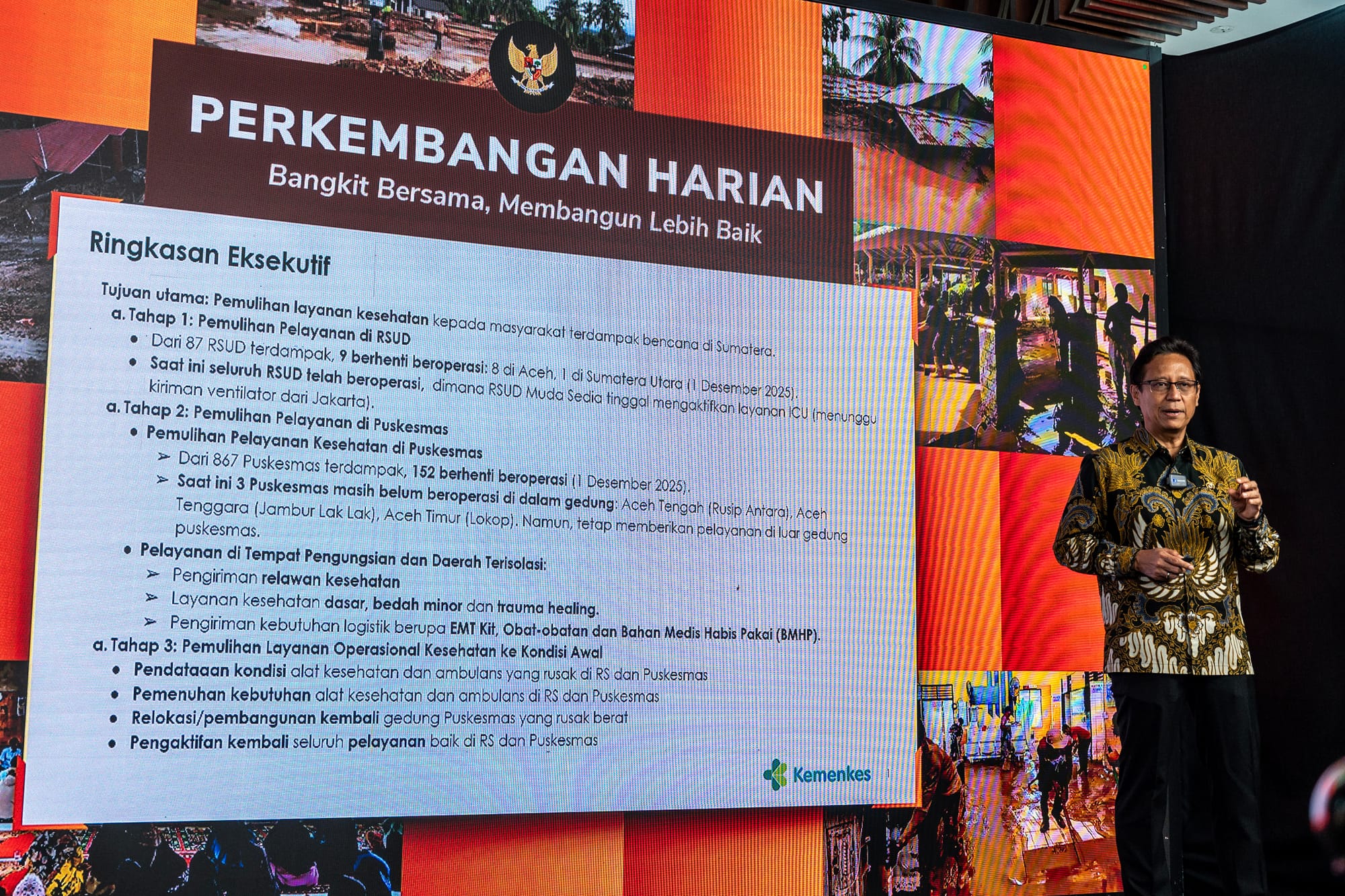
The initial phase of recovery focused on hospitals as critical and life-saving services. Of the total 130 hospitals in the affected areas, 87 experienced operational disruptions due to flooding and landslides. Nine of them were completely shut down, consisting of one hospital in North Sumatra and eight in Aceh.
Through the establishment of the Health Emergency Operations Center (HEOC) on December 1, 2025, the Ministry of Health, together with the Indonesian National Armed Forces, the Indonesian National Police, the National Disaster Management Agency, and local governments, mapped the damage and gradually restored services.
"Within two weeks, we managed to reopen these nine hospitals to serve patients," said Budi. Although they are not yet fully functional due to damage to equipment and residual flooding, all of these hospitals are now accepting patients again.
Entering the second phase in mid-December, the focus of recovery shifted to primary health care facilities. Of the 867 community health centers affected, 152 were temporarily closed due to severe flooding. As of early January 2026, three community health centers in Aceh remain inoperable and are scheduled to be rebuilt due to severe damage.
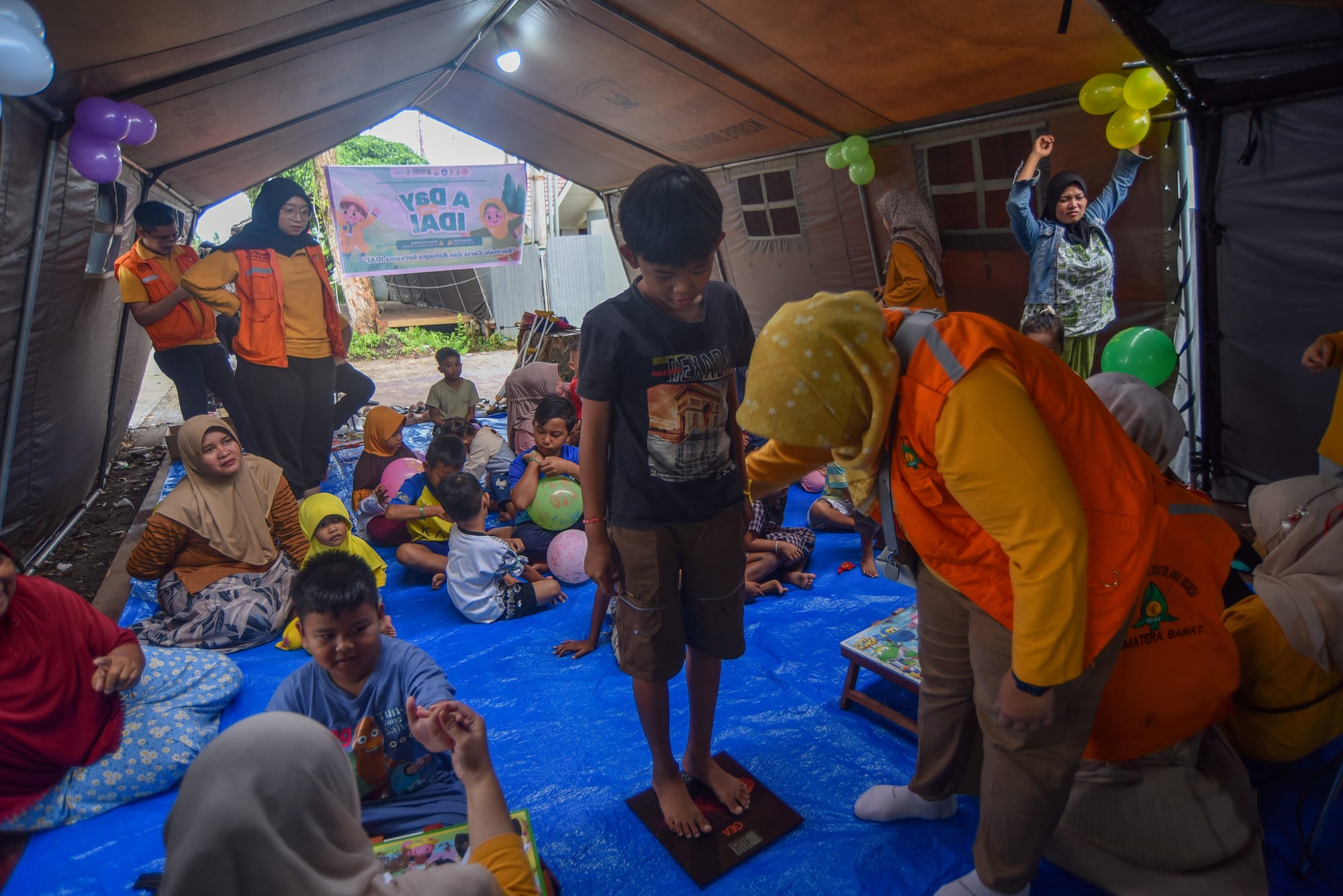
Community health centers are crucial because, in addition to serving local residents, these facilities support health services at around a thousand evacuation sites. BNPB data shows that the number of evacuees, which initially reached around 300,000 people, has now decreased to around 200,000.
To reach survivors, the Ministry of Health deployed around 4,000 health volunteers from various government institutions, universities, professional organizations, and international humanitarian agencies, with a rotation system every two to three weeks.
Currently, Budi said, the response has entered its third phase, which is recovery towards normal conditions. The focus is on repairing medical equipment, laboratories, ambulances, and restoring mental health services. The government aims to have all affected health facilities fully operational by the end of March 2026 at the latest, in line with the ongoing physical rehabilitation and cross-sectoral support in the disaster-affected areas of Sumatra.
His party has proposed a budget of Rp 500 billion for this continued recovery plan. According to the plan, the funds will be used to replace damaged medical equipment such as ambulances, CT scan machines, MRI machines, and damaged physical health facilities.
"We have compiled the data, and approximately Rp 500 billion will be prepared for phase 3 of the recovery," he said.
The National Disaster Management Agency (BNPB) recorded that as of December 6, at least 1,178 people had died, while 163 others were reported missing in cyclones and flash floods in three provinces: Aceh, West Sumatra, and North Sumatra.
The post-disaster conditions affecting a number of areas in Sumatra are showing signs of improvement. Head of the BNPB Disaster Data, Information, and Communication Center, Abdul Muhari, noted a significant decrease in the number of residents remaining in evacuation centers as the emergency situation subsided.
The province of Aceh remains the region with the highest concentration of refugees, reaching 217,780 people. In detail, the heaviest refugee burden is in Aceh Tamiang Regency with 74,735 people, followed by North Aceh with 67,876 people, and Gayo Lues with 19,906 people.
Although this figure is relatively high, Abdul said that the number of refugees has actually continued to decline compared to the peak that occurred on December 8.
"The number of refugees continues to decline. Along with the improvement in search and rescue (SAR) operations, the number of reported missing victims has also decreased," said Abdul in a press statement at the BNPB Office in East Jakarta on Tuesday (12/6/2025).
Can put pressure on fiscal policy
Post-disaster recovery in a number of affected areas is putting increasing pressure on the fiscal capacity of the central and regional governments, as the budgetary requirements for the rehabilitation and reconstruction of basic infrastructure rise.
The National Disaster Management Agency (BNPB) emphasized that effective recovery spending is key to preventing prolonged fiscal pressure and ensuring that regional economic activity can resume immediately.
BNPB Director of Emergency Resource Support Agus Riyanto explained that natural disasters not only cause physical damage, but also economic consequences that must be addressed in a relatively short period of time.
Local government budgets that were originally allocated for routine development are often forced to be diverted for emergency response, rehabilitation, and reconstruction. This situation has the potential to disrupt regional fiscal sustainability if it is not managed in a disciplined and measured manner.
Agus believes that the recovery process requires coordination between ministries and local governments to ensure that state and regional spending remains on track. Without proper management, recovery spending risks being duplicated, misdirected, or even slowing down the economic recovery of the affected regions.
Therefore, BNPB encourages the use of rehabilitation and reconstruction planning mechanisms based on damage and loss data to ensure more effective budgeting.
From a fiscal perspective, the burden of recovery also has the potential to erode local governments' productive spending. When budgets are focused on improving basic infrastructure and public services, regional economic development programs, including support for UMKM risky investments, are put on hold.
"If recovery takes too long, local economic growth could be suppressed and prolong the economic impact of the disaster," Agus said.
To maintain fiscal sustainability, BNPB emphasizes the importance of funding synergy between the state budget, regional budgets, and other legitimate sources of financing, including support from the business world and non-governmental organizations.
"The effectiveness and transparency of recovery budget management are also considered important to maintain the trust of stakeholders, especially business actors, in the stability of the regional economy after the disaster," said Agus.
In a broader context, BNPB emphasized that disaster management must be an integral part of investment planning and national economic growth. BNPB Deputy for Systems and Strategy Agus Riyanto warned that economic growth could be corrected if it was not balanced with disaster risk management.
"Economic growth that we talk about all the time, every moment. It must grow, grow, and grow," he said.
However, he emphasized that disasters are often sudden obstacles.
According to Agus, most disasters, especially those that occur gradually, can actually be managed from the outset.
"Actually, there are two types of disasters: slow onset and fast onset. This means that we can manage slow onset disasters. We can predict them and reduce them," he said.
He cited the floods in the Pantura region, which occur almost every year and have a major impact on the national economy.
"The coastal areas, especially in Central Java, have been crippled or affected economically," Agus explained.
Agus also reminded business actors to include disaster risk analysis in every investment decision.
"This applies to everything, including business and entrepreneurship. Of course, we need to pay attention to the risk analysis aspects involved," he said.
BNPB has also provided the Indonesian Disaster Risk Index (IRBI) as a reference for investors. This is because disaster risk reduction investments are considered important for protecting long-term investment value.
"So we have actually provided that platform," said Agus.