Good morning, Chief,
Here’s today’s curated briefing on key developments shaping the business ecosystem, prepared by the SUAR Team:

2026 Free Nutritious Meals Budget Jumps 400% - Big Opportunities for MSME
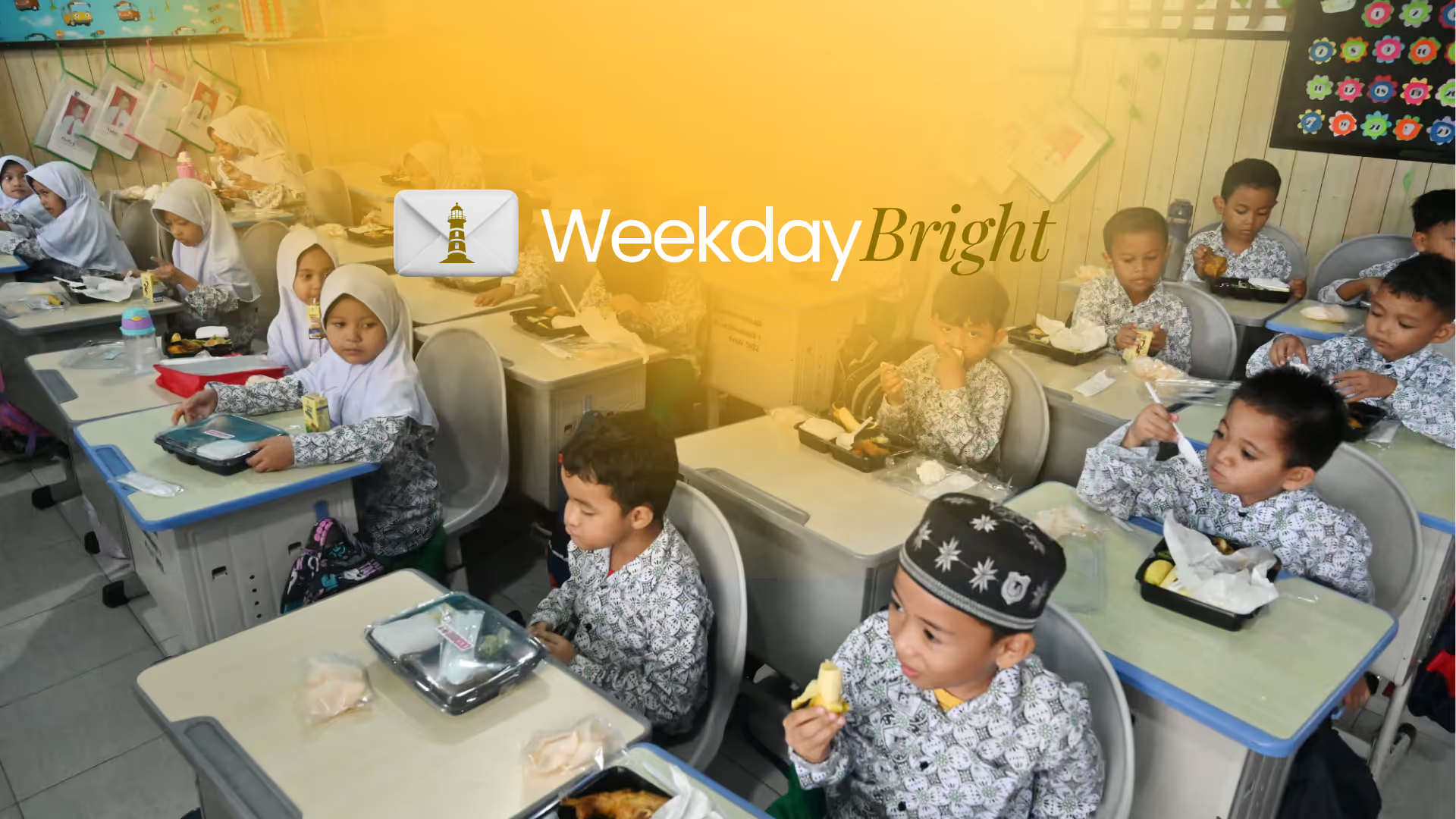
- In the 2026 State Budget Draft (APBN), the Free Nutritious Meals (MBG) program budget will increase to IDR 355 trillion, soaring 400% compared to the 2025 budget of only IDR 71 trillion. This presents both opportunities and challenges for the business sector.
- In 2026, the MBG program will reach 82.9 million people. With this many recipients, the program is estimated to spend around IDR 1.2 trillion daily. Each nutrition service unit (SPPG) will manage approximately IDR 10 billion per year, with 85% of it used to purchase raw materials, 95% of which come from agricultural products.
- Of the total MBG budget, 85% is allocated for the procurement of kitchen raw materials, ranging from vegetables, livestock products, and fishery products to plantation crops. This presents a significant opportunity for 29 million food-sector MSMEs, especially those in rural areas, to grow and develop.
Read more here.

Regional Transfer Budget Reduced, Local Governments Need to Be Creative and Innovative
- The 2026 State Budget Draft (RAPBN) allocates IDR 650 trillion for regional transfers (TKD). This figure represents a significant decrease of IDR 214.1 trillion, or 24.8%, compared to the 2025 APBN outlook of IDR 864.1 trillion.
- The government’s decision to cut regional transfer funds has drawn mixed reactions from various local government leaders. They warned that the reduction could burden regional finances and hinder local development. Meanwhile, experts have advised local leaders to be more creative in exploring new sources of regional revenue (PAD) to cover the deficit caused by the reduced transfers from the central government.
Read more here.
BI Rate Cut Boosts Growth as Fed Rate Is Also Expected to Fall
- At the Bank Indonesia (BI) Board of Governors Meeting (RDG) on Wednesday, August 20, 2025, it was decided to cut the benchmark interest rate (BI Rate) by 25 basis points to 5.00%, the Deposit Facility rate to 4.25%, and the Lending Facility rate to 5.75%. This marks the second consecutive BI Rate cut. Previously, at the July RDG, BI also lowered the BI Rate by 25 bps. Throughout this year, BI has reduced interest rates three times, totaling 75 bps.
- The Board of Governors made this decision to meet domestic economic needs while considering global conditions. Inflation levels and the rupiah exchange rate remain within target ranges. From an external perspective, various data indicate that the U.S. central bank, The Federal Reserve (The Fed), is likely to cut its benchmark interest rate.
- The BI Rate cut can stimulate economic growth, partly through lower bank lending rates. Banking players will gradually adjust both deposit and loan rates to be more accommodative.
Read more here.
Boost the Tax Ratio to Accelerate Tax Revenue Growth
- The tax revenue target in the 2026 Draft State Budget (RAPBN) is IDR 2,357.7 trillion, an increase of 13.5% compared to the 2025 tax revenue outlook of IDR 2,076.9 trillion. Creative and innovative efforts are needed to achieve this target, one of which is by increasing the share of tax revenue relative to gross domestic product (GDP), or the tax ratio. OECD data states that Indonesia’s tax ratio in 2023 stood at 12%.
- Efforts that can be undertaken include improving the tax database and optimizing collections. In addition, system improvements should be made to encourage the public to comply with tax payments.
Read more here.

Increase in Budget to Support Food Self-Sufficiency
- The government is increasing the food security budget allocation in the 2026 State Budget (RAPBN) by 5.9% to IDR 164.41 trillion. This demonstrates the government’s serious commitment to achieving food self-sufficiency, particularly in rice and corn.
- Indonesia’s agricultural sector faces challenges such as declining production and a decreasing number of farmers. Data from the Central Statistics Agency (BPS) shows that rice production, which reached 54.9 million tons in 2022, dropped to 53.1 million tons in 2024. A similar trend occurred with corn, whose production fell from 16.5 million tons in 2022 to 15.1 million tons in 2024. This trend indicates that Indonesia still struggles to maintain consistent production of staple crops that are crucial for food security.
Read more here.

International Licensing Conference: This conference on licensed businesses will be held on Thursday, August 21, 2025, at JIExpo, Jakarta. The conference will feature presentations under the theme, “Prospects and Trends in the Global Licensing Industry 2025.” Speakers at the event include Tani Wong, Managing Director of Greater China & Southeast Asia Licensing International; Susanty Widjaya, Chairwoman of the Indonesia Licensing Association (ASENSI); and the Vice President and General Manager of Disney Consumer Products South Asia Pacific, The Walt Disney Company.
Road to G20 Summit: F20’s Call for Just Transition and Climate Justice: Multi-stakeholder Dialogue: As part of the Road to G20 Summit, this event presents the theme “F20’s Call for Just Transition and Climate Justice” and is organized by The Habibie Center with support from the Ford Foundation and the Ministry of Home Affairs of the Republic of Indonesia. The forum is a strategic discussion platform hosted by F20 (Foundations Platform) as part of the series of events leading up to the G20 Summit. The event aims to discuss critical issues related to a just energy transition and climate justice by involving multiple stakeholders, including representatives from philanthropic organizations, government, private sector, and civil society. The dialogue can be attended online via live stream on The Habibie Center’s YouTube channel on August 21, 2025, at 12:00 WIB.

“The key to investing is not to assess how much an industry will impact society, or how large its growth will be, but rather to determine the competitive advantage of a particular company and, most importantly, the durability of that advantage.” (Warren Buffet – Entrepreneur)
Have a productive day, Chief.
The SUAR Team