In the 2026 Draft State Budget Bill (RUU APBN 2026), the government allocated IDR 37.5 trillion for the development of new renewable energy (EBT). This EBT development budget is part of a total IDR 402.4 trillion allocation to strengthen energy resilience, which is one of next year’s priority programs.
“There is a fairly significant budget for EBT, IDR 37.5 trillion,” said Finance Minister Sri Mulyani Indrawati at the 2026 Budget Structure press conference at the Ministry of Finance, Friday (August 15, 2025).
According to Fabby Tumiwa, Executive Director of the Institute for Essential Services Reform (IESR), this figure is still relatively small, only about one-tenth of the real funding needed to drive Indonesia’s energy transition.
“Based on IESR calculations, annual budget requirements for the energy transition reach US$30 billion by 2030. So this 2026 RAPBN EBT budget may be less than one-tenth of the funding needed for the energy transition,” he told SUAR on September 19, 2025.
Fabby added that the government’s limited budget is not intended to fund all projects but to act as a catalyst to mobilize funding from other sectors to reach US$30 billion. He emphasized that this strategy is important to meet the large investment needs for the energy transition.
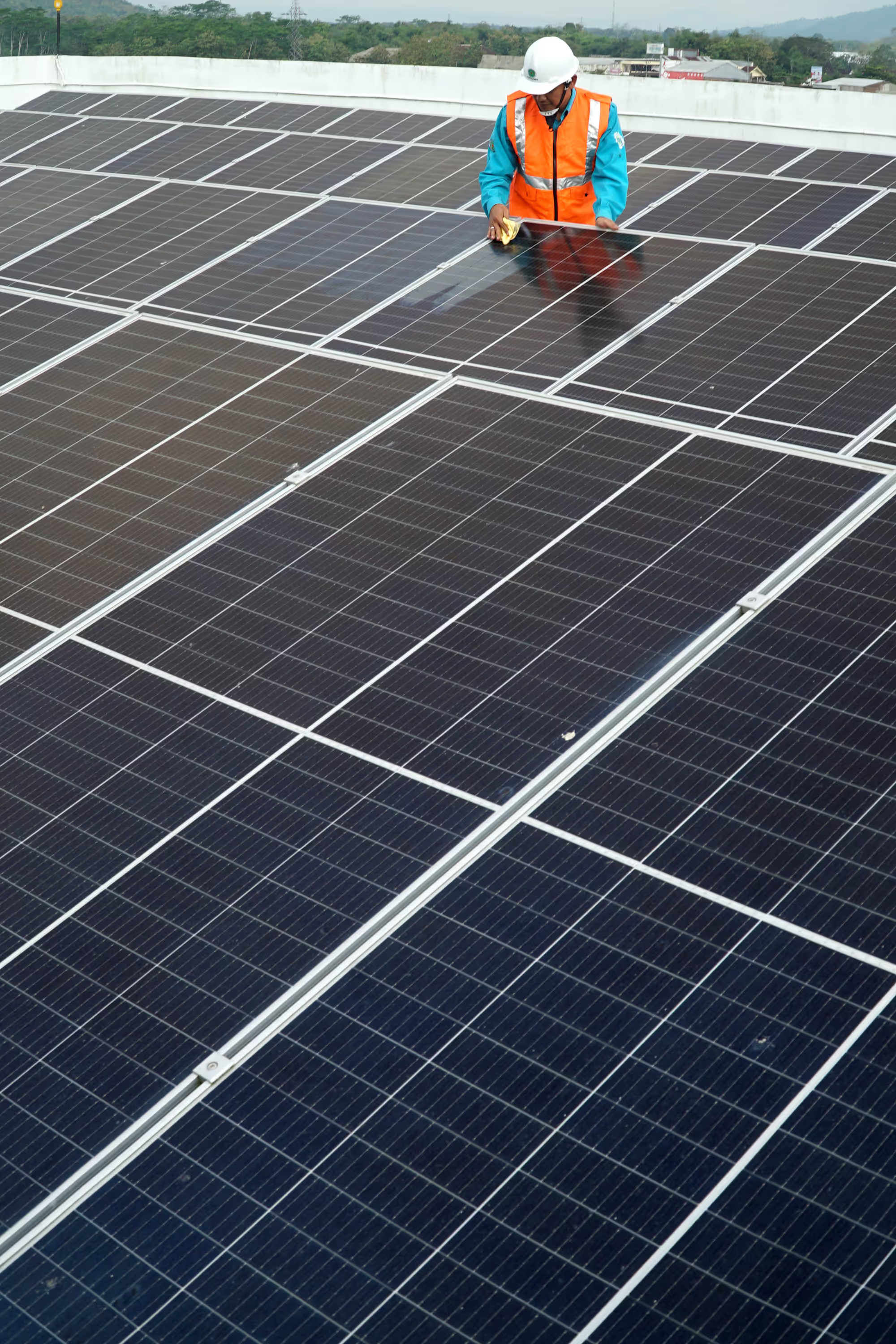
Government funding can be used to build electricity access in rural areas, such as constructing communal solar power plants (PLTS) in villages, he said. IESR studies show that Indonesia has solar energy potential ranging from 3.3 TWp to 20 TWp, spread from Sabang to Merauke.
Fabby explained that this potential could be utilized to provide reliable electricity for 5,500 villages without adequate access, optimize the potential 655 GW of rooftop solar PV on houses across Indonesia, and utilize 300 GW of floating solar potential in national waters.
Regarding village PLTS programs, Fabby sees a great opportunity for the private sector to collaborate with the government, although detailed plans are still in preparation. He suggested that the government open project tenders competitively.
“The government can provide the market, but let companies compete to offer the best prices,” he explained.
The role of the private sector is not limited to supplying components but also includes training skilled workers. Fabby estimates that one PLTS project requires 50–60 workers for 6–9 months from construction to operation. Additionally, he added that the private sector can provide materials and components that meet standards, such as “tier 1” solar modules with 40% local content (TKDN).
Meanwhile, larger and bankable energy transition projects listed in PLN’s Electricity Supply Business Plan (RUPTL) can involve the private sector. Fabby noted that the funding requirement for projects in PLN’s RUPTL through 2034 could reach US$80 billion, with 60% of the funding allocated for power plants, allowing a greater role for private sector involvement.
“Large and bankable investments are the ones that can attract private investors. They will participate if the project offers an adequate rate of return,” Fabby emphasized.
According to Fabby, over the next 10 years for executing the RUPTL, the private sector will provide 80% of the funding for renewable energy power generation, with private sector financing needs reaching US$70 billion–US$80 billion.
He identified three renewable energy sectors with the highest growth potential in the next 1–3 years:
- Solar energy (PLTS): Indonesia has very large solar potential, reaching 3,300–3,400 gigawatts. This technology is easy to install, scalable, and available across the country.
- Bioenergy from biomass: Biomass potential from agricultural waste (especially palm oil) and urban waste is significant and can be utilized for power generation.
- Small-scale micro-hydro power projects (PLTMH): These can be rapidly developed in various locations.
Additionally, he noted that wind energy also has potential for development within three years in several locations.
Zulfan Zahar, President of the Indonesian Renewable Energy Society (METI), emphasized the importance of the private sector’s role. He highlighted METI’s commitment to accelerating renewable energy project tenders, especially those managed by PLN.
“Renewable energy investment potential could reach US$200 billion, equivalent to IDR 3,000 trillion. If renewable energy tenders are opened more widely and the process accelerated, economic opportunities for Indonesia will grow significantly,” Zulfan said in an official statement (August 16, 2025).
Zulfan added that METI will focus on collaboration and overcoming bureaucratic obstacles to make the investment process more efficient and attractive to investors.