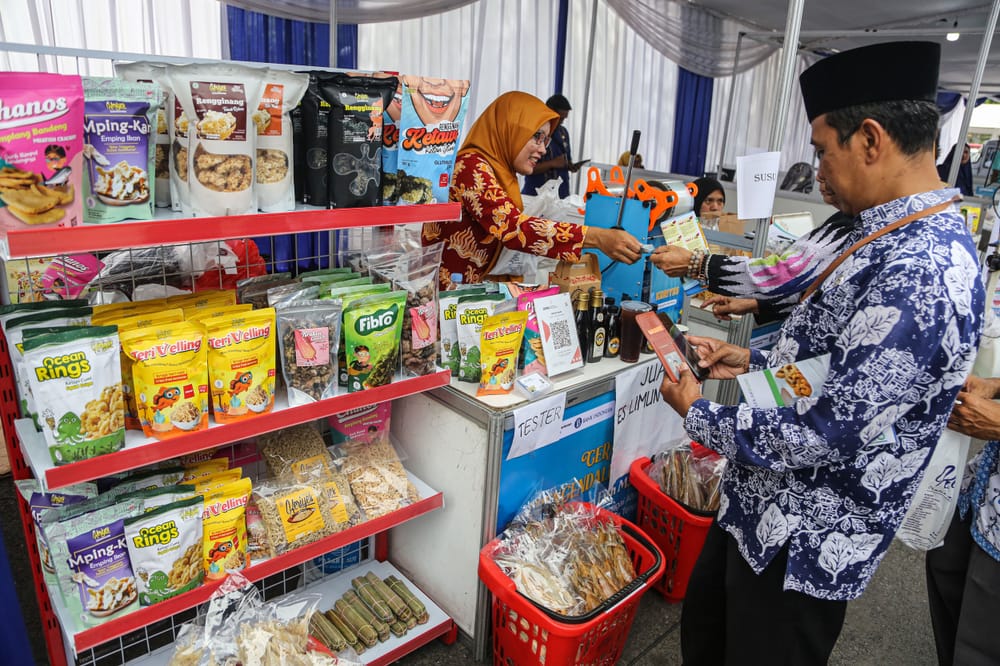



Fikri, a micro, small and medium enterpriseUMKM) brand owner, has been worried for several months because the government has imposed a final income tax rate of 0.5 percent on online sales turnover in order to expand state revenue.
The owner of the Muslim fashion brand 'Zenitha' admitted that so far the costs that must be borne by business actors in every transaction in e-commerce are not small.
"If calculated, the capital and advertising costs can be greater than the selling price, plus the platform administration costs," he told SUAR at the launch of the Shopee Jagoan UMKM Naik Kelas event on Monday (29/09/2025).
However, Fikri's worries instantly disappeared when last weekend Finance Minister Purbaya Yudhi Sadewa postponed the implementation of the e-commerce tax. Purbaya said he postponed this policy because he wanted to maintain people's purchasing power amid the national economic recovery.
Fikri said he was happy with the postponement of this policy. According to Fikri, without additional tax deductions, business actors will be freer to design financial balance.
This delay, in his assessment, not only impacts profits, but also employee welfare. Business owners can give bonuses and increase the welfare of their workers.
Fikri emphasized that when employees are more prosperous, public consumption will also increase.
"With that, employees can shop, so more money is circulating ," he said.
He believes that the circulation of money in the community will be greater if business actors are given space without additional levies. According to him, the government should not rush to seek revenue from the small entrepreneurial sector.
When asked whether it is better to postpone tax collection or not have it at all, "no," Fikri replied with a laugh.
Not only Fikri, on the same occasion, Michael Kwok, owner of the badminton bag business Maritim Bag Indonesia, also positively welcomed the postponement of the tax collection policy.
Michael believes that this step shows the government's favor to UMKM.
"When this regulation was first published, we were confused. Will we be deducted directly by the marketplace or will we pay ourselves?" said the former Grobogan-born teacher.
Michael considers the decision to postpone as a safer middle ground for business actors. If the tax collection policy is implemented, Michael hopes that there will be no other levies that will burden UMKM players.
Previously, PMK Number 37 Year 2025 was signed by Sri Mulyani Indrawati when she was still Minister of Finance on June 11, 2025 and promulgated on July 14, 2025. The regulation regulates the appointment of other parties, including marketplace platforms, as collectors of Income Tax Article (ITA) 22 from domestic traders who transact electronically.
Under the regulation, the tax rate is set at 0.5% of annual gross turnover. Merchants with turnover below IDR 500 million per year are exempted from the collection obligation, provided that they submit a declaration to the platform where they sell. The collection mechanism is designed to be carried out directly by the marketplace, so that merchants do not need to make independent deposits.
Purbaya said that technically the collection system is ready to run. However, the implementation was postponed because the government wanted to wait for the condition of people's purchasing power to improve. In addition, the government is also channeling fiscal stimulus of around Rp200 trillion to banks and wants to see the impact on the economy before adding a new tax burden on the digital sector.
Effective without being burdensome
Secretary General of the Indonesia E-commerce Association (idEA), Budi Primawan, said he appreciated Minister Purbaya's decision to postpone the implementation of Income Tax Article 22 on e-commerce transactions.
According to him, this step shows the government's commitment to hear input from business actors and ensure that tax policies run effectively without causing excessive burdens, especially for those who still need room to adapt.
Budi emphasized the importance of designing fiscal policies that complement each other. He said the policy should be able to encourage public consumption while maintaining state revenue, while still paying attention to the right implementation momentum.
Going forward, according to Budi, the process of formulating the implementation of this policy will continue. He hopes that the government will continue to open space for dialog with business actors so that the resulting tax policy can be more proportional, equitable, and support digital UMKM as the backbone of Indonesia's digital economic growth.
In response, Shopee Indonesia's Head of Corporate Affairs, Satrya Pinandita, chose not to comment much on the postponement of the e-commerce tax collection policy.
Be fair
Nailul Huda, Director of Digital Economy at the Center of Economic and Law Studies, affirmed his support for the implementation of e-commerce tax for merchants who have qualified as taxpayers.
He believes that the obligation to pay taxes should be fair, both for online and offline merchants.
"I personally support the implementation of a 0.5% tax on gross turnover for e-commerce merchants who are eligible and categorized as taxpayers," he said.
According to his calculations, the potential state revenue from this policy is only around Rp500 billion to Rp1.5 trillion. Although small, the regulation is crucial for equality among sellers.
Huda also estimates that the majority of e-commerce merchants, around 90%, have turnover below Rp500 million, so they will not be subject to the levy.
He sees that this policy delay can be motivated by two things. First, the government is trying to attract public sympathy by postponing a policy that is relatively small in value but gives a positive image. Second, the tax collection system is not ready because it still depends on the turnover statement from business actors.
"This means that this is a self-assessment and will depend on the awareness of business actors," he said.
As a solution, Huda emphasized the need for more complete data collection. He said that cross-marketplace transaction data can be utilized to prevent business owners from splitting their turnover to various stores to avoid taxes.
The inclusion of identity such as NIK in each store account, Huda pointed out, could be an important step to strengthen taxation policies in e-commerce in the future.
Huda believes that the delay will not have a major impact on the digital ecosystem or UMKM exports. According to him, the factor that determines competitiveness is not only taxation, but also the certainty of rules that ensure transactions and investments in the e-commerce sector can be carried out clearly and safely.
Chris Wibisana contributed to this article