
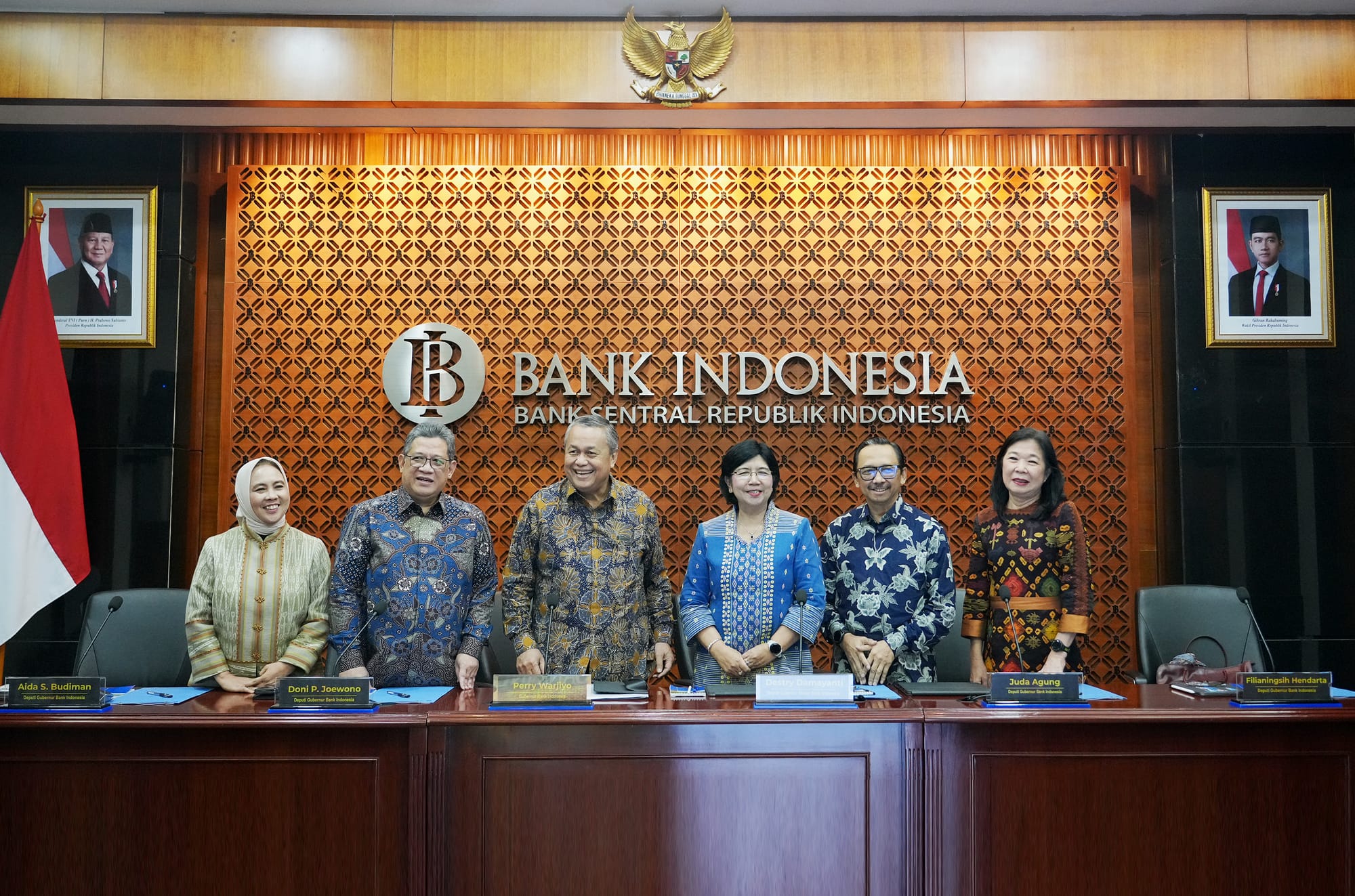
The July 2025 Bank Indonesia (BI) Board of Governors Meeting (RDG) on Wednesday (16/7/2025) decided to lower the benchmark interest rate (BI Rate) by 25 basis points to 5.25 percent. This decision indicates that BI wants to blow fresh air to boost economic growth amid sluggish conditions.
This is the second time BI has lowered the benchmark interest rate. In January 2025 the benchmark interest rate was at 5.75 percent. The first benchmark rate cut was 25 basis points in May 2025.
BI Governor Perry Warjiyo explained that this decision was taken to encourage economic growth. With the inflation rate still under control, his party sees room to reduce interest rates so as to provide a stimulus to economic growth.
Citing BI data, the inflation rate in June 2025 was 1.87 percent on an annual basis. This figure is still within BI's target range of 1.5 percent - 3.5 percent.
"Domestically, Indonesia's economic growth needs to continue to be encouraged amid the weakening global economic outlook," said BI Governor Perry Warjiyo.
BI estimates that Indonesia's economic growth in 2025 will be in the range of 4.6 percent to 5.4 percent supported by improved domestic demand and positive export performance after tariff negotiations with the US government. As for the first quarter of 2025, economic growth was at 4.87 percent on an annualized basis.
Going forward, BI will continue to look at the room for rate cuts to boost economic growth while maintaining the stability of the Rupiah exchange rate and achieving inflation targets in accordance with the dynamics that occur in the global and domestic economy.
One of BI's efforts to boost the pace of economic growth is through macroprudential policies to encourage credit growth.
Economic stimulus
Indonesian Employers Association (Apindo) Economic Policy Analyst Ajib Hamdani welcomed BI's decision to lower the benchmark interest rate. Cutting the benchmark interest rate will encourage more liquidity to rotate and people's purchasing power will be well maintained.
"Hopefully, the consumption sector will strengthen and become a momentum to maintain economic growth to reach 5 percent in the third quarter of 2025," Ajib said on Wednesday (16/7/2025).
Bank Permata Chief Economist Josua Pardede, assessed that the BI Rate reduction will have a significant impact in reducing the cost of capital for the business world. "Theoretically, the 25 bps reduction in the BI Rate will push bank lending rates down, thereby reducing borrowing costs for companies in funding their investment and business expansion activities," he told Suar, (16/7/2025).

He added that sectors that are highly sensitive to capital costs, such as manufacturing, construction, property, and automotive, will feel a greater impact.
According to Josua, this reduction in the cost of capital can improve the company's cash flow and the profitability of new projects, as well as provide incentives for companies to realize previously delayed investments. However, he cautioned that investment decisions still depend on demand expectations and overall business prospects.
He also sees that BI's move indicates a higher priority on economic growth, while maintaining stable inflation and rupiah exchange rate.
Josua expects Indonesia's economic growth to moderate at around 4.8 percent until the end of 2025, driven by recovering business optimism following the trade agreement between Indonesia and the US and easing global geopolitical tensions.
"BI still has room to cut interest rates further by 25-50 basis points until the end of the year," he said, referring to manageable domestic inflation and a relatively stable rupiah. Nevertheless, BI's future moves will remain cautious, depending on the dynamics of the Fed's monetary policy and foreign capital flows.
Senior Economist & Associate Faculty of the Indonesian Banking Development Institute (LPPI) Ryan Kiryanto said that the lower interest rate will be a stimulus for the real sector.
BI, according to Ryan, supports economic recovery and strengthening when weakening signals are felt or seen. These signals include the June Purchasing Managers Index (PMI) of 46.9 percent. An index below 50 indicates that the manufacturing business is contracting, while above 50 indicates the opposite.
Ryan added that the stable position of the rupiah exchange rate is also an additional consideration for BI because the valuation of the rupiah against the US dollar is priced-in with the development of global and domestic factors. So the decline in the BI rate is expected to be a stimulus for banks to adjust lending rates in line with the BI Rate so as to encourage credit demand.
"Hopefully BI's dovish steps, which are pro economic growth and still pro stability , will be followed by banks to lower deposit and lending rates in a measured manner to encourage credit demand so that the real sector will be more vibrant to boost economic growth in the next period," Ryan said.

The decision to reduce the BI Rate was welcomed by banking industry players. PT Bank Mandiri (Persero) Tbk. expressed full support for BI's move.
Bank Mandiri Corporate Secretary M. Ashidiq Iswara said that BI's decision was an accommodative step amidst inflation conditions that remained under control and exchange rate stability that was maintained.
"This policy is a strong signal to encourage national economic growth amid ongoing global uncertainty," he told Suar, (16/7/2025).
As a follow-up, Bank Mandiri is committed to strengthening its intermediary function by channeling healthy and selective financing to strategic sectors. Iswara added, "Adjustments to lending and deposit rates will be made in a measured manner, taking into account business strategies, internal liquidity conditions, and market dynamics," said Ashidiq.