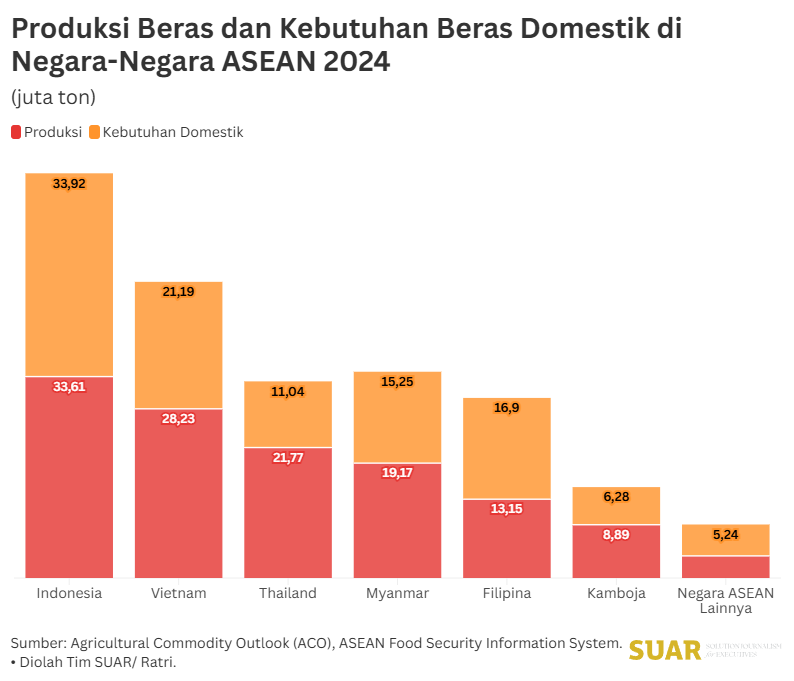
Compared to its fellow rice-producing countries in ASEAN, Indonesia is not yet fully self-sufficient. However, the trend of rice production is starting to increase, so it is expected that food self-sufficiency (rice) can be achieved soon.
The December 2024 Agricultural Commodity Outlook (ACO) shows that of all ASEAN members, Indonesia's food self-sufficiency ratio (SSR) reached 99.11%. The SSR is expected to increase in 2025 to reach 99.8%. Not only does this bring optimism, it is also a challenge to continue improving the performance of national rice production.
Among ASEAN countries, Indonesia has a dominant position as the largest rice producer. In 2023, Indonesia's rice production reached 34.33 million tons, far surpassing other countries such as Vietnam (28.27 million tons) and Thailand (21.86 million tons). Despite a drop of 600,000 tons in 2024, Indonesia's rice production is predicted to increase again in 2025.
However, the data also shows that Indonesia still faces major challenges in meeting domestic demand. By 2023, Indonesia's domestic demand will reach 36.97 million tons, leaving a negative gap of 2.64 million tons. This gap between production and demand must be closed by importing 3 million tons of rice. This amount is to meet the aggregate needs of domestic needs, exports, and final stock needs.
The food self-sufficiency ratio (SSR) provides a clearer picture of Indonesia's position. Despite Indonesia's huge rice production, its self-sufficiency ratio is still around 99% in 2024. This means that Indonesia's rice production is only able to fulfill 99% of the total domestic demand.
In 2023, Indonesia's SSR stood at 92.85%, lower than net-exporter countries such as Thailand (199.26%), Vietnam (133.84%) and Cambodia (125.28%). The year 2024 and predictions for 2025 show improvements in SSR rising to 99.11% and 99.8%, close to the 100% target.
Data projections for 2025 bring optimism for achieving food (rice) self-sufficiency. The negative gap between production and domestic demand is expected to narrow significantly. In 2024, the gap is projected to be -0.30 million tons, and in 2025, to -0.07 million tons. This positive trend needs to be maintained to create food self-sufficiency like Thailand, Vietnam and Cambodia.
The challenges facing rice farming in Indonesia are not small, as one of the factors is the shrinking land area. In addition, the issue of the sustainability of agricultural cultivation and the welfare of farmers also looms large in this sector. By looking at the positive trends, the hope of achieving food self-sufficiency is great.
This positive trend in rice production and food self-sufficiency ratio (SSR) brings great hope for Indonesia to achieve food self-sufficiency.
If food self-sufficiency is achieved, it will be a fundamental transformation for Indonesia's agricultural sector. Indonesia's status will change from an importing country to a country that is able to fulfill its own needs.
Tangible steps including further investment in modern agricultural technology, efficient irrigation systems, the development of high-yielding seeds, and financial and mentoring support for farmers can be critical to this transformation.