
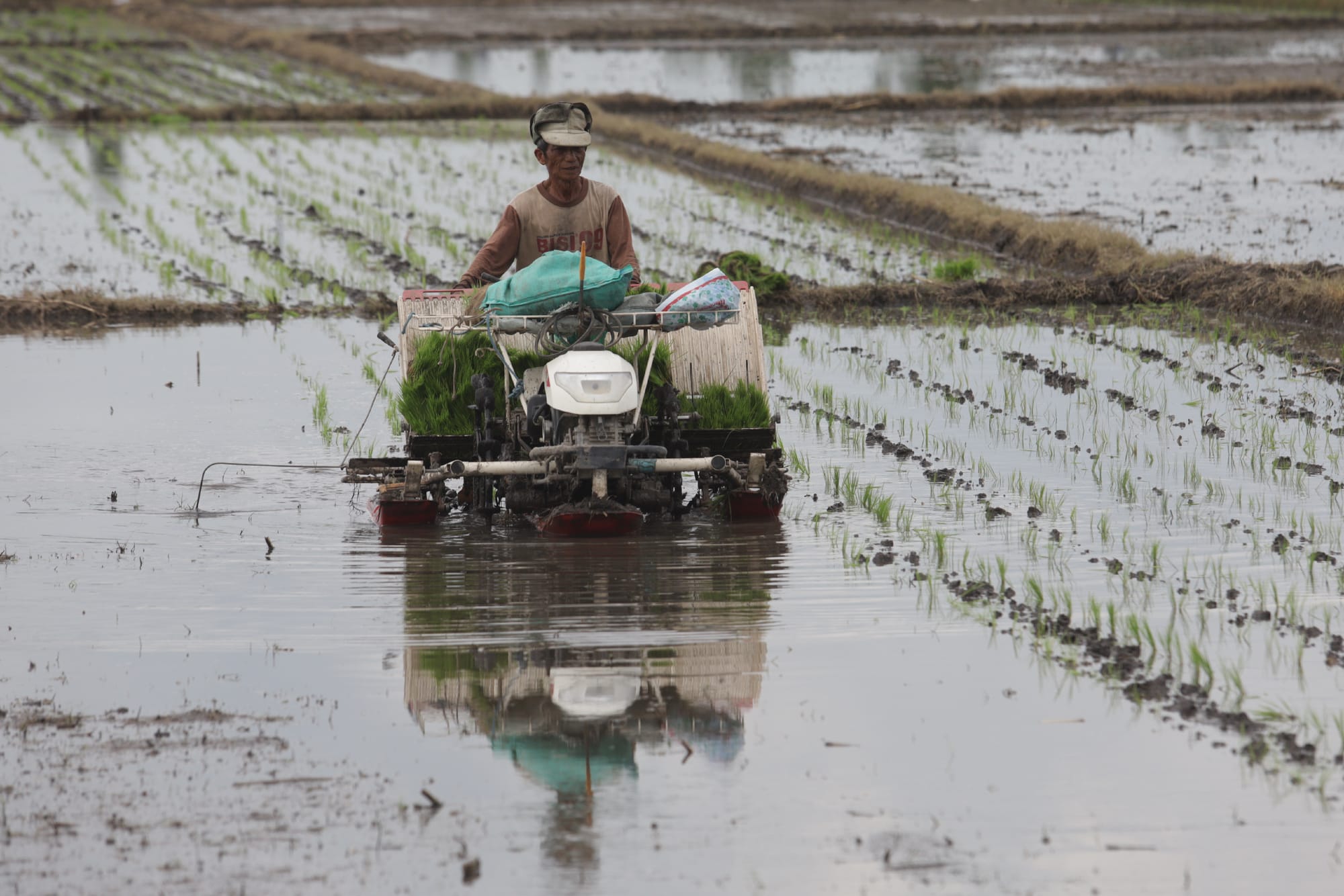
Farmers need high-quality seeds to increase productivity. This is done in an effort to promote a high farmer exchange rate (NTP).
The Central Statistics Agency (BPS) recorded that the Farmer Exchange Rate (NTP) in December 2025 rose 1.05% to 125.35, or an increase of 1.05 percent compared to November 2025. This achievement confirms the improving welfare of agricultural households throughout Indonesia.
Chairman of the Indonesian Rice Millers Association (Perpadi) Sutarto Alimoeso said farmers could implement a number of measures to increase productivity.
"One of them is by using high-quality seeds, appropriate fertilizers, and supported by agricultural technology and advanced machinery," said Sutarto when contacted by SUAR Jakarta on Tuesday (January 6, 2025).
In addition, farmers can also grow commodities with high demand so that their yields can have high added value. "That will clearly encourage sustainable NTP," he said.
According to him, the increase in the NTP means that farmers have higher incomes, with the surplus from the higher selling price of products compared to the production costs of fertilizers and seeds increasing farmers' net income.
"Increased income has a direct impact on the quality of life of farming families, providing a sense of security and confidence," he said.
Deputy Head of Distribution and Services Statistics at the Central Statistics Agency (BPS), Pudji Ismartini, explained that this increase in NTP occurred because the Farmer Price Index (It) jumped by 2.08 percent, much higher than the increase in the Farmer Price Index (Ib), which was only 1.02 percent.
"This situation shows that farmers' bargaining position is getting stronger and farming is becoming more profitable," said Pudji.
The surge in the NTP in December 2025 was mainly driven by the impressive performance of the horticulture sub-sector, which recorded a very significant increase in the NTP of 14.48 percent. In addition, other commodities also contributed to the increase, ranging from grain, cayenne pepper, cocoa, and broiler chickens.
In addition, cumulatively, throughout January–December 2025, the national NTP reached 123.26, an increase of 3.04 percent compared to the same period in 2024.
The increase in the NTP in December 2025 was influenced by the rise in the NTP in three agricultural subsectors, namely the Horticulture Subsector by 14.48 percent, the Livestock Subsector by 0.77 percent, and the Fisheries Subsector by 0.42 percent.
In his official statement, Minister of Agriculture Andi Amran Sulaiman said that this figure reflects the increased purchasing power of farmers, along with improved agricultural prices and controlled production and household consumption costs.
"Food self-sufficiency is no longer interpreted solely as sufficient stock, but as a path to greater prosperity for farmers," he said.
Regionally, positive NTP growth was widespread. A total of 22 out of 38 provinces recorded an increase in NTP, with Gorontalo Province recording the highest increase nationally, rising 5.60 percent in December.
This achievement shows that the strengthening of the agricultural sector is not only happening at the national level, but is also being felt at the regional level. Overall, the surge in NTP in December 2025 is clear evidence that Indonesia's agricultural sector is becoming more resilient, productive, and profitable.
Key indicators
In response to this, IPB Agricultural Observer Dwi Andreas said that the main benefit of the Farmer Exchange Rate (NTP) is as an indicator of farmers' welfare and purchasing power, measuring farmers' ability to exchange their harvest for production and consumption needs.
An NTP above 100 means an increase in welfare surplus, while a deficit below 100 means a decline in welfare.
"NTP is also a tool for measuring the success of agricultural development, measuring product competitiveness, and providing important data for the formulation of national food security policies," he told SUAR Jakarta (6/1).
The government uses NTP data to evaluate the success of agricultural development and formulate targeted policies, such as subsidies or strengthening programs.
Regarding rice prices, BPS reported that the average price of rice at mills in December 2025 rose by 1.26 percentmonth-to-month and 6.38 percentyear-on-year.
When broken down by rice quality at the mill, the price of premium rice rose 2.62 percent month-to-month and 6.92 percent year-on-year. Meanwhile, medium-quality rice rose 0.67 percent month-to-month and 6.72 percent year-on-year.
Furthermore, for rice inflation at the wholesale and retail levels in December 2025, at the wholesale level, there was rice inflation of 0.22 percent month-to-month, and there was also rice inflation of 5.00 percent year-on-year. Meanwhile, at the retail level, rice inflation was 0.18 percent month-to-month and 3.64 percent year-on-year.