

On Tuesday (12/23/2025), the Indonesian government announced that it had agreed on the substance of the reciprocal negotiations or the Agreement on Reciprocal Trade (ART) between the two countries, which is targeted to be completed and signed by the end of January 2025.
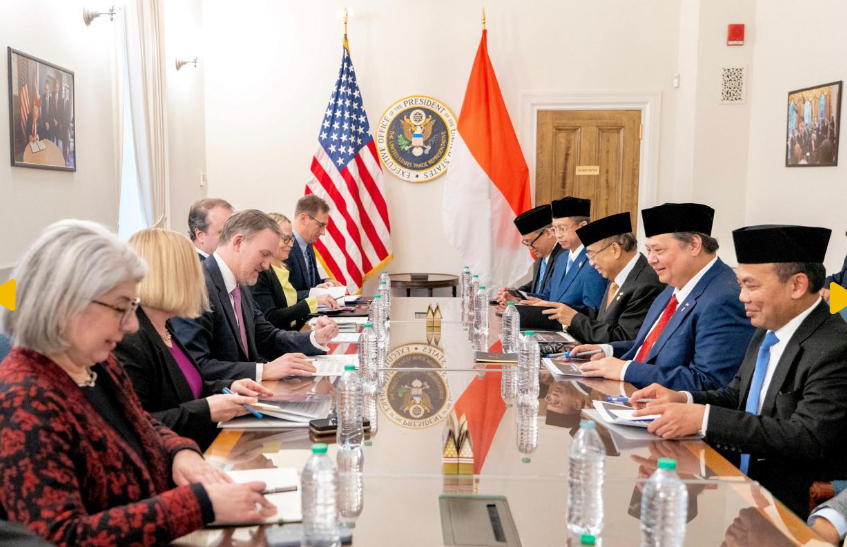
This was conveyed by Coordinating Minister for Economic Affairs Airlangga Hartarto, accompanied by Indonesian Ambassador to the United States Indroyono Soesilo, after meeting with United States Trade Representative Ambassador Jamieson Greer in Washington DC on Monday (12/22) local time.
The meeting was held again from December 17 to 22 local time in Washington D.C. with United States Trade Representative (USTR) Ambassador Jamieson Greer to discuss key and technical issues of the agreement in order to accelerate the completion of the ART document.
Indonesia and the US have also agreed on a timetable for the substance of the ART agreement, whereby technical teams from both countries will meet again in mid-January 2026.
"Once all technical processes have been completed, it is expected that by the end of January, documents will be prepared for official signing by President Prabowo and US President Donald Trump. The US is currently arranging a suitable time for a meeting between the two leaders," Airlangga said in an online press conference.
In addition, the US also grants tariff exemptions on Indonesia's leading export products such as cocoa, palm oil, coffee, and so on. Meanwhile, the United States is eager to gain access to critical minerals.
Indonesia is known as the world's largest exporter of palm oil and a major supplier of robusta coffee beans.
Previously, on July 22, 2025, based on the published Joint Statement, Indonesia received a reciprocal tariff reduction from 32% to 19%.
The meeting took place following a report by Reuters news agency that the negotiations reached in July could potentially collapse because Indonesia had withdrawn several commitments made as part of the agreement.
"This agreement is a continuation of the agreement reached on July 22 between the two leaders, whereby Indonesia's tariffs were reduced from 32% to 19%. Indonesia also received special tariff exemptions for its leading export products," said Airlangga.
Airlangga confirmed that the signing will take place and that there are no longer any factors that could hinder the signing of the ART, as both countries have already reached an agreement.
"The deadline is the time we agreed upon together. Regarding the content or material discussed from the 17th to the 22nd of this month, everything has been discussed and agreed upon by both parties. So, there are no more factors that could hinder the signing of this ART," he said.
Airlangga also emphasized that this agreement is good news for Indonesia. With this agreement, market access for both countries will be wide open, thereby boosting Indonesia's economy.
"This is certainly good news, especially for Indonesian industries that are directly affected by tariff policies, where the sectors affected by these tariffs are mainly labor-intensive, employing 5 million workers, and this is certainly very strategic for Indonesia," he said.
Competitiveness
In response to this, Chairwoman of the Indonesian Employers Association (Apindo) Shinta Widjaja Kamdani said that the reduction in reciprocal tariffs was a success for Indonesia's economic diplomacy in maintaining mutual economic interests with the US. The tariff reduction is said to improve the cost competitiveness of Indonesian products in the US market amid fierce global competition.
"For the business world, this is a positive signal of predictability and policy certainty in bilateral trade relations. This is important to encourage investment decisions, long-term contracts, and deeper integration of Indonesia into global value chains," Shinta explained to SUAR Jakarta on Tuesday (12/23).
Business actors, especially in labor-intensive and commodity sectors, are also said to be ready to respond to this opportunity in the near future. Moreover, many Indonesian exporters have continued to maintain their US market despite reciprocal tariff dynamics. The government is also expected to encourage further steps to maximize the opportunities from this agreement.
"However, this readiness is not entirely uniform. Large companies are relatively more prepared in terms of compliance, standardization, and supply reliability, while UMKM new exporters still need assistance, especially in relation to technical standards, certification, and logistical readiness," he continued.
Shinta believes that the list of products exempted from US tariffs is appropriate because it targets sectors with comparative advantages and a high impact on job creation for Indonesia.
Apindo also encourages the gradual expansion of this product's coverage in the future, thereby further strengthening domestic economic and industrial growth.
"We encourage the gradual expansion of product coverage, especially for value-added manufactured products, with the aim that this agreement will not only strengthen commodity exports, but also encourage industrial upgrading and export diversification," he said.
Although reciprocal tariffs have been lowered and a number of Indonesia's leading export products have been granted exemptions, Indonesian businesses still face a number of challenges in penetrating the US market.
Meanwhile, domestically, businesses also face challenges related to logistics efficiency, raw material supply, and the speed of licensing. Therefore, Shinta believes that structural reforms and continuous deregulation are necessary so that the business world can truly convert the opportunities presented by this tariff agreement into real trade gains.
"The main challenges still lie in Non-Tariff Measures ( NTMs), especially technical standards, sustainability requirements, and increasingly strict environmental regulations in the US market. In addition, issues of traceability, ESG compliance, and product liability are determining factors in competitiveness," said Shinta.
Appreciated
Similarly, Permata Bank Chief Economist Josua Pardede believes that this tariff reduction is also positive news because it reduces uncertainty in trade policy, which ultimately helps maintain production and employment in export-oriented sectors.
However, imports from the US into Indonesia also have the potential to increase, meaning that domestic industries face tougher competition.
"The net benefits will still depend on the content of the accompanying agreement, because Indonesia is also committed to expanding market access for US products and removing non-tariff barriers to trade, including technology-based trade issues and other cooperation," Josua said.
The increase in export potential to the US is most evident in commodities that receive tariff exemptions due to falling prices and new contract opportunities that can open up more quickly for goods whose supply cannot be met by the US. For other products, price competitiveness will improve and export volume opportunities are expected to increase in the near future, as the tariff burden on import prices will be lower than in the previous scenario.
This reciprocal tariff reduction does not automatically increase the competitiveness of Indonesian export products in the US market. There are still a number of other factors that need to be considered by the business world.
"The increase will not automatically rise, because the 19% tariff is considered to be roughly on par with many competing countries, so Indonesia's relative advantage is not that great. Factors such as quality, supply certainty, and delivery accuracy will be more decisive in determining who wins the orders," he explained.
Therefore, in order to maximize the benefits of this opportunity, according to Josua, there are a number of steps that need to be taken by the government and other relevant parties to increase competitiveness in the US market.
"Indonesia needs to ensure that the agreement is implemented smoothly and consistently so as not to give rise to new disputes, accelerate the removal of non-tariff trade barriers, and provide certainty regarding export licensing services," Josua continued.