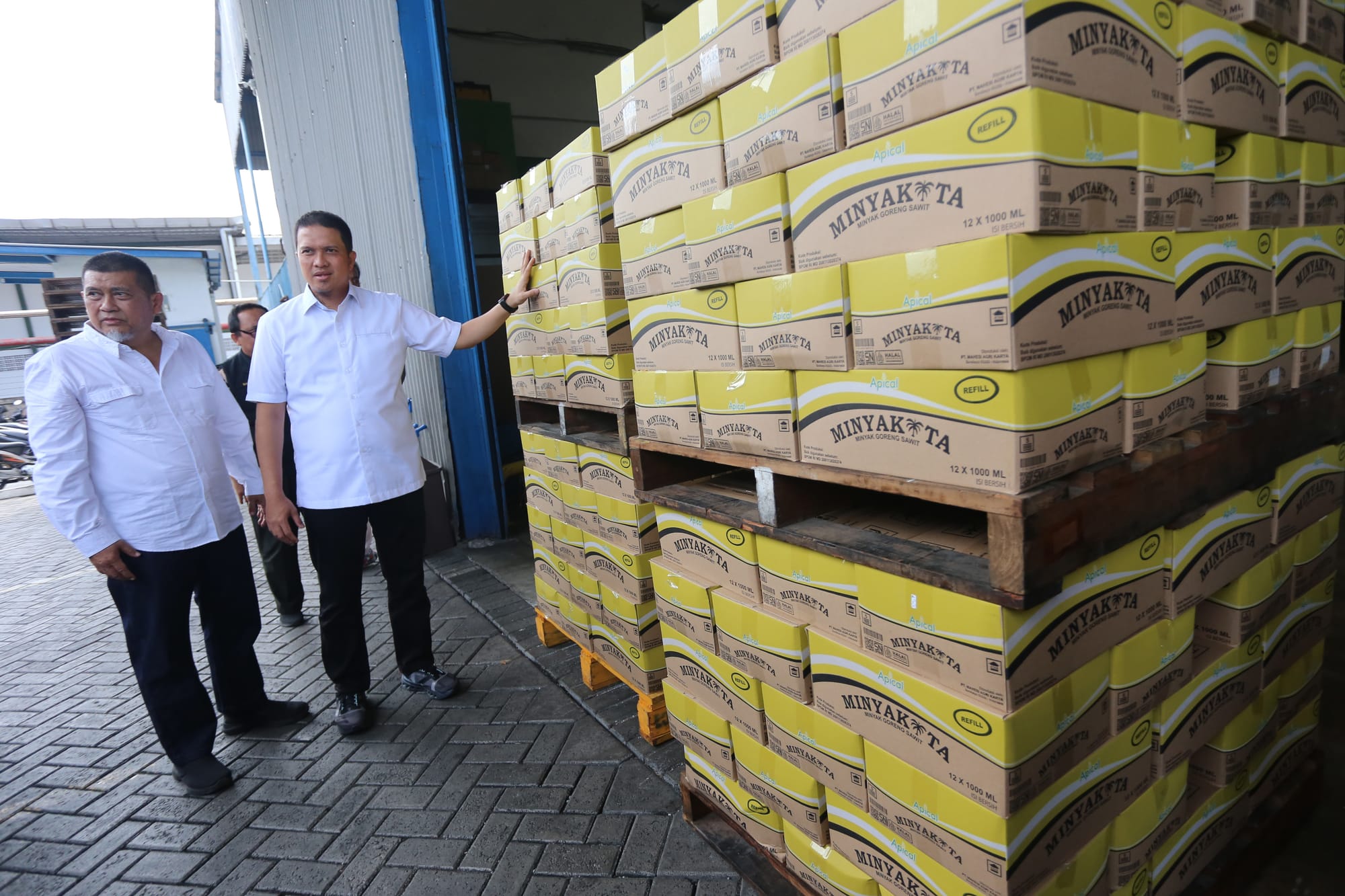
The price of Minyakita cooking oil will follow the Maximum Retail Price (HET) of Rp 15,700 per liter starting in January 2026. This policy is stipulated in the Minister of Trade Regulation (Permendag) Number 43 of 2025 concerning Packaged Palm Cooking Oil and the Management of Cooking Oil for the People.
Director General of Domestic Trade (PDN) at the Ministry of Trade, Iqbal Shoffan Shofwan, said that Permendag 43/2025 was enacted on December 9, 2025, and promulgated on December 12, 2025, and will come into effect 14 days after its promulgation.
This regulation is expected to improve the management of Minyakita distribution so that consumer prices can immediately return to normal or in line with the maximum retail price (HET) set at Rp15,700 per liter.
This new Minister of Trade Regulation also introduces a number of new rules, such as the mechanism for proposing the use of the Minyakita brand, which is now done electronically through the Ministry of Trade's Inatrade system, whereas previously it was done manually.
The Ministry of Trade also requires producers to distribute at least 35 percent of Minyakita's domestic market obligation (DMO) to Perum Bulog or ID FOOD.
"This regulation is considered very important to accelerate equitable distribution, because Bulog and BUMN Pangan have branch office networks throughout Indonesia," he said when met at the Ministry of Trade office in Jakarta (19/12/2025).
Strengthening the role of Bulog and state-owned food companies is key to reducing price disparities, especially in eastern Indonesia. Currently, the price of Minyakita in the region is still around Rp17,600-Rp18,000 per liter, and in some mountainous areas it can reach Rp20,000 per liter.
Iqbal hopes that once this ministerial regulation takes effect and Minyakita production is distributed through the DMO scheme starting in January, the price of Minyakita will show a significant decline and approach the maximum retail price, especially in Eastern Indonesia.
Ensuring Affordability for the Lower-Middle Class
IPB agricultural observer Dwi Andreas said that the stipulation of palm oil prices in accordance with the maximum retail price provides benefits, especially for the lower-middle class.
Prices in line with the maximum retail price can maintain purchasing power, prevent extreme price fluctuations, and support the government's program to stabilize the prices of basic foodstuffs.
"Producers and traders also benefit from reasonable fixed margins, while consumers enjoy stable and affordable prices, even though distribution challenges sometimes cause prices in the field to deviate from the maximum retail price," he told SUAR Jakarta (19/12).
Dwi said that designated producers and traders already receive adequate profit margins, so there is no reason to sell above the maximum retail price.
The government continues to strive to improve distribution (for example, through state-owned food companies) so that prices in line with the maximum retail price are achieved in all regions.
Strengthening Strategy Through State-Owned Enterprises
Chairperson of the Jakarta Chamber of Commerce and Industry for the 2019-2024 term, Diana Dewi, said that in order for the distribution of minyakita to be in accordance with the HET, it is necessary to strengthen the strategy through state-owned enterprises.
Producers are required to distribute 35% of Minyakita production to Bulog and state-owned food companies to accelerate and equalize distribution, especially outside Java.
"Prioritize traditional markets because they are most accessible to the public and serve as a barometer for national prices and supply," he told SUAR Jakarta (21/12).
The government can tighten supervision in the field and impose administrative sanctions such as freezing export licenses for perpetrators who manipulate prices or supplies.