

Business optimism for 2026 needs to be balanced with early detection of four economic risks this year. These are increased external pressure, mismatched fiscal and monetary policies, widespread educated unemployment, and rising food and energy prices ahead of Ramadan. Without proper mitigation, these four risks have the potential to trigger instability that could hinder the achievement of the set economic growth targets.
Senior Researcher at the Economics Department of the Center for Strategic and International Studies ( CSIS) Deni Friawan explained that currently, economic indicators are quite good. Economic growth is around 5%, inflation is under control, the trade balance is in surplus, and the non-performing loan ratio is below 3%. However, according to Deni, Indonesia still faces silent pressures and risks that could lead to instability.
Externally, in addition to slowing growth engines in the US and China, large budget deficits due to increased debt are adding to inflationary pressures and hampering economic performance. Similar to these two superpowers, the UK and Europe are also facing similar challenges.
The increasing fiscal pressure in developed countries, he continued, is feared to causesudden capital outflows from the bond market, which will put pressure on the rupiah exchange rate and increase the cost of Indonesian government bond borrowing. Deni reminded that even though Indonesia experienced record highs in the Jakarta Composite Index (IHSG) several times last year, capital outflows from the capital and bond markets were also very large.
"Foreign flow was significant lastyear even though the IHSG rose. Our balance of payments was also in deficit and put pressure on foreign exchange reserves. One indicator of this is that last year the rupiah weakened against the US dollar while other currencies in the region strengthened," he said on Wednesday (7/1/2025).
Internal risks
One of the diagnoses of this internal problem lies in the relationship between fiscal and monetary authorities, which is expected to become more synergistic at a time when the fiscal posture is increasingly expansive. Deni emphasized that the expansive posture of the 2026 State Budget risks exceeding the 3% deficit threshold stipulated by law, while the increase in debt due to maturity cannot be restructured because external conditions are also not conducive.
"In the end, we are going nowhere: fiscal policy wants expansion, but monetary policy is contracting in order to maintain stability. Every day, BI buys more and more SBNs and loses its monetary policy influence, so that when interest rates are lowered, the Minimum Reserve Requirement falls, credit still does not grow significantly, remaining at only 7%-8%," said Deni.
Read also:
 Benedictus Krisna Yogatama
From an employment perspective, very loose unemployment criteria mean that the aggregate statistics are not particularly high, even though the Ministry of Manpower recorded at least 79,302 people being laid off throughout 2025. The demographics of unemployment have also changed in terms of education, with an increase in the number of vocational school graduates, bachelor's degree holders, and master's degree holders.
Deni acknowledged that government intervention through stimulus programs such as Paid Internships for bachelor's degree graduates has boosted employment rates. However, the increasingly capital-intensive rather than labor-intensive nature of investment, coupled with the growing opportunities for informal employment, indicates that structural policies that can address this mismatch could drive further change.
"While the unemployed in general tend to be frustrated and lack confidence, educated unemployed people can express themselves on social media and rally the masses, which can lead to riots and damage the economy. If left unchecked, this could become a time bomb that will eventually explode," he said.
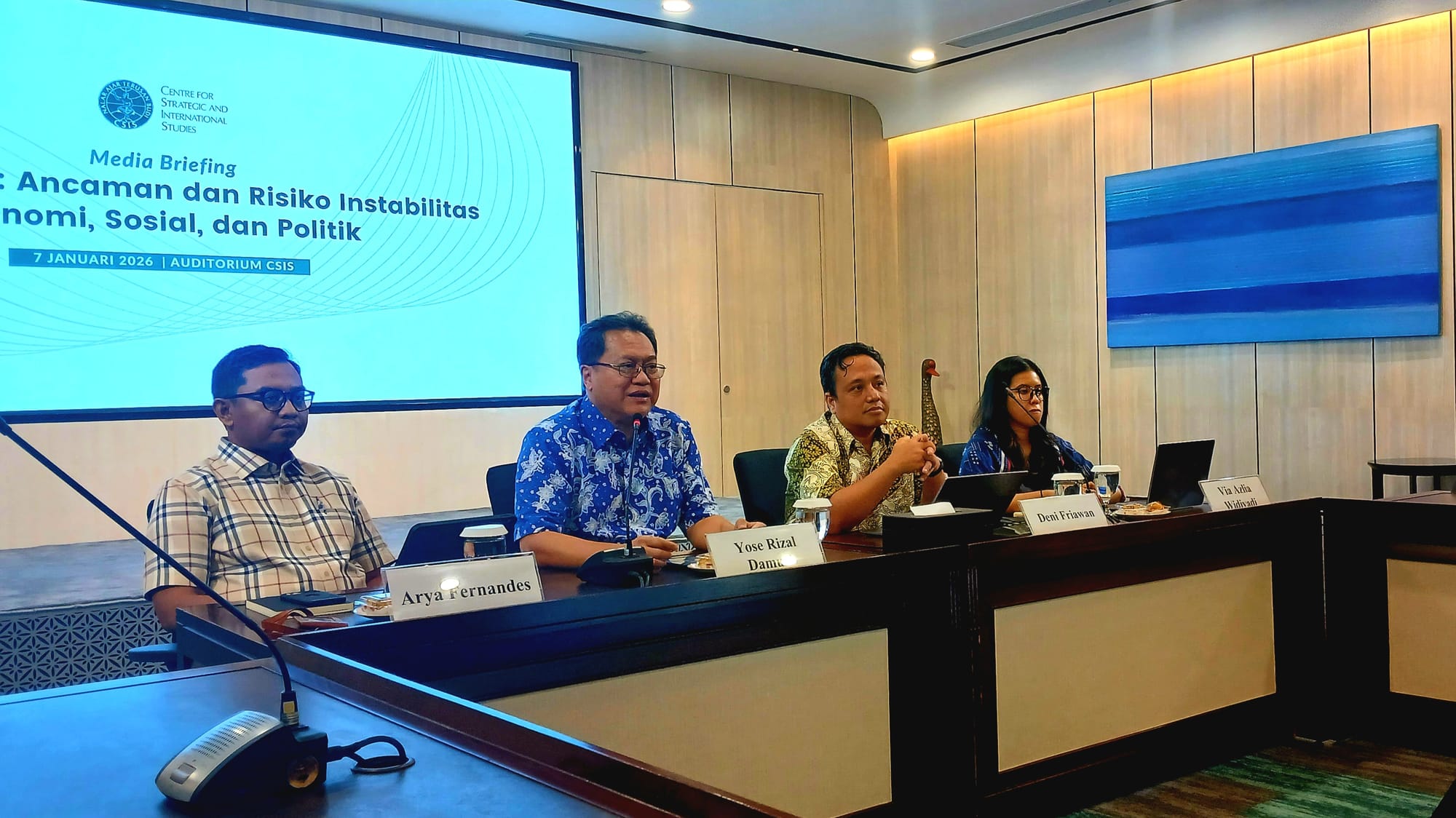
Complementing Deni's explanation, Climate Research Unit CSIS researcher Via Azliya Widiyadi emphasized the impact of climate change, which is predicted to cause losses of Rp 544 trillion between 2020 and 2024, particularly in the agricultural sector due to extreme rainfall and the post-El Niño climate transition.
Via reminds us that ecological disasters in three provinces of Sumatra and deforestation for oil palm plantations, which has exceeded the threshold of 17.67 million hectares, are two pieces of evidence of the declining environmental carrying capacity for extractive economic activities, which have actually increased over the past five years.
"Without good governance, priority national land-based projects have the potential to cause new instability that runs counter to the objectives of the project. Not only risk management, but also consideration of environmental carrying capacity and climate risks must be included in the planning," said Via.
Reflecting on these risks, Deni recommended six priority mitigation measures that policymakers should pay attention to.
- Monetary policy should continue to prioritize inflation control and exchange rate stability to manage expectations and prepare for the risk of capital outflows, rather than supporting expansionary fiscal policy.
- Close the deficit gap by improving revenue and ensuring efficient spending, as well as reducing financing on overly expensive short-term bonds;
- Fiscal-monetary coordination is necessary to ensure that SBN purchases do not become a trap for monetary policy and central bank independence.
- Providing support to sectors experiencing increased layoffs, expanding active labor market programs, and acceleratingreskilling for youth and skilled workers who are vulnerable to unemployment;
- Diversifying imports and building strategic reserves to cope with energy and food price volatility, particularly ahead of Ramadan and increased climate risks;
- Take advantage of falling energy prices to reform subsidies and shift spending to investments that boost productivity and green transition initiatives.
"Economic policy needs to do more than just reach the periphery and generate optimism; it must ensure that the policy has a real impact. If this risk is not addressed, we will remain where we are and get nowhere," Deni concluded.
Stay strong
Responding to a number of economic and environmental risks that are likely to occur in 2026, Director General of Economic and Fiscal Strategy at the Ministry of Finance Febrio Kacaribu emphasized that Indonesia's economy, which showed resilience throughout 2025, would serve as a strong foundation for economic performance in 2026.
Febrio explained that Indonesia's manufacturing activity showed positive performance with a Manufacturing PMI of 51.2 in December 2025, capping five consecutive months of expansion, supported by strong domestic demand, increased employment, and raw material purchasing activity.
"Business optimism has also strengthened and reached its highest level in the last three months, reflecting confidence in the future prospects of manufacturing. Manufacturing activity in major countries, which is generally expansive, is also a positive sign for Indonesia's export demand," said Febrio in a written statement received by Suar.id on Tuesday (06/01/2026).
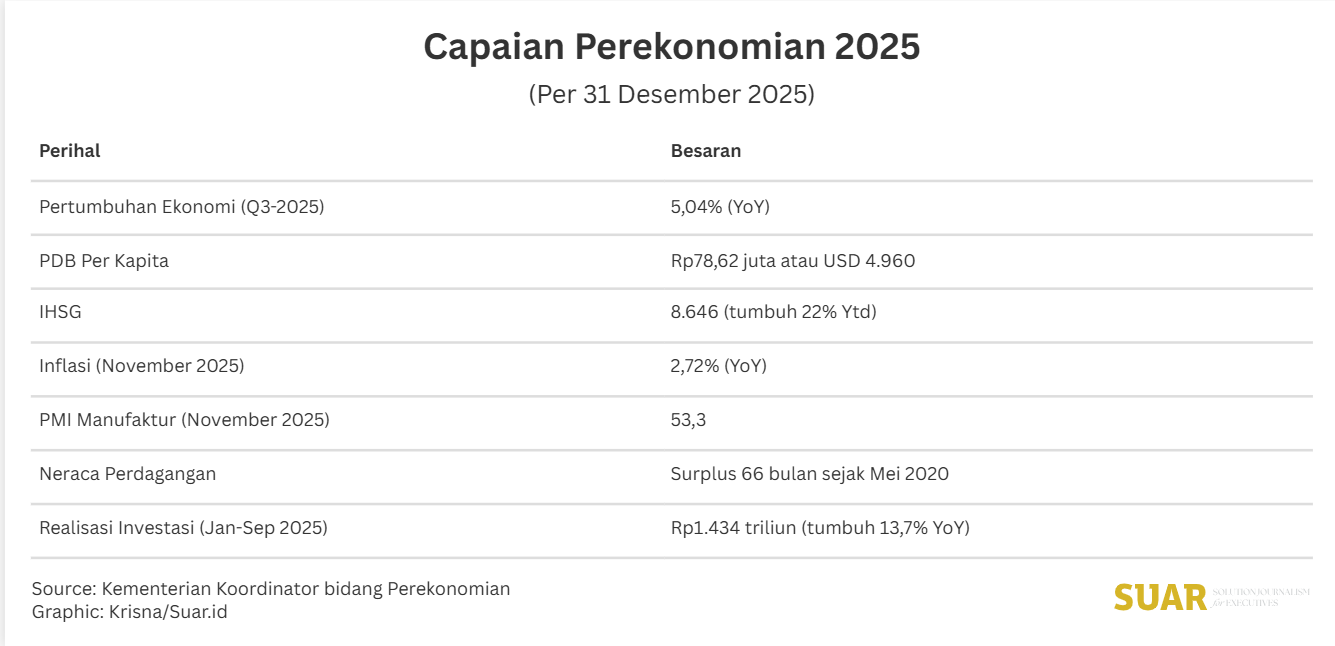
A trade surplus of USD 2.66 billion and an increase in exports contributed by the manufacturing industry with a contribution of 10.41% reflect the increasing added value of national exports. Price stability was maintained, despite inflation rising due to increases in the prices of several food commodities amid core inflation remaining at 2.38%.
With the Consumer Confidence Index strengthening to 124, the Real Sales Index growing 5.94% YoY, and business sector electricity sales increasing 6.2% YoY, Febrio is optimistic that solid domestic economic indicators can mitigate a number of risks that are causing concern.
"The government continues to strive to maintain stability and strengthen economic growth momentum. Fiscal policy is directed at supporting national development to ensure inclusive and sustainable economic growth," he concluded.