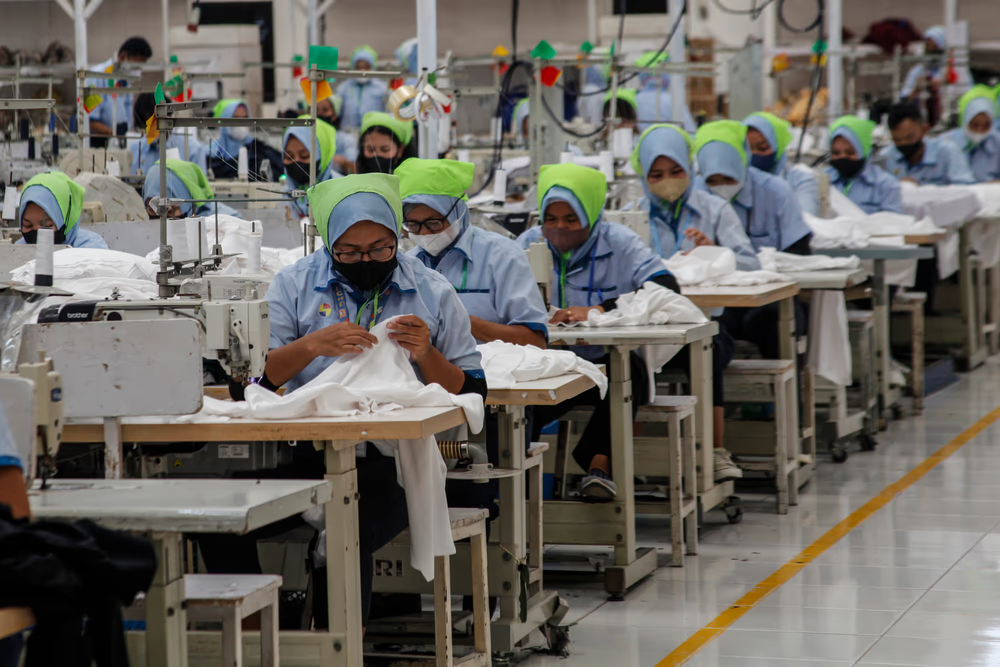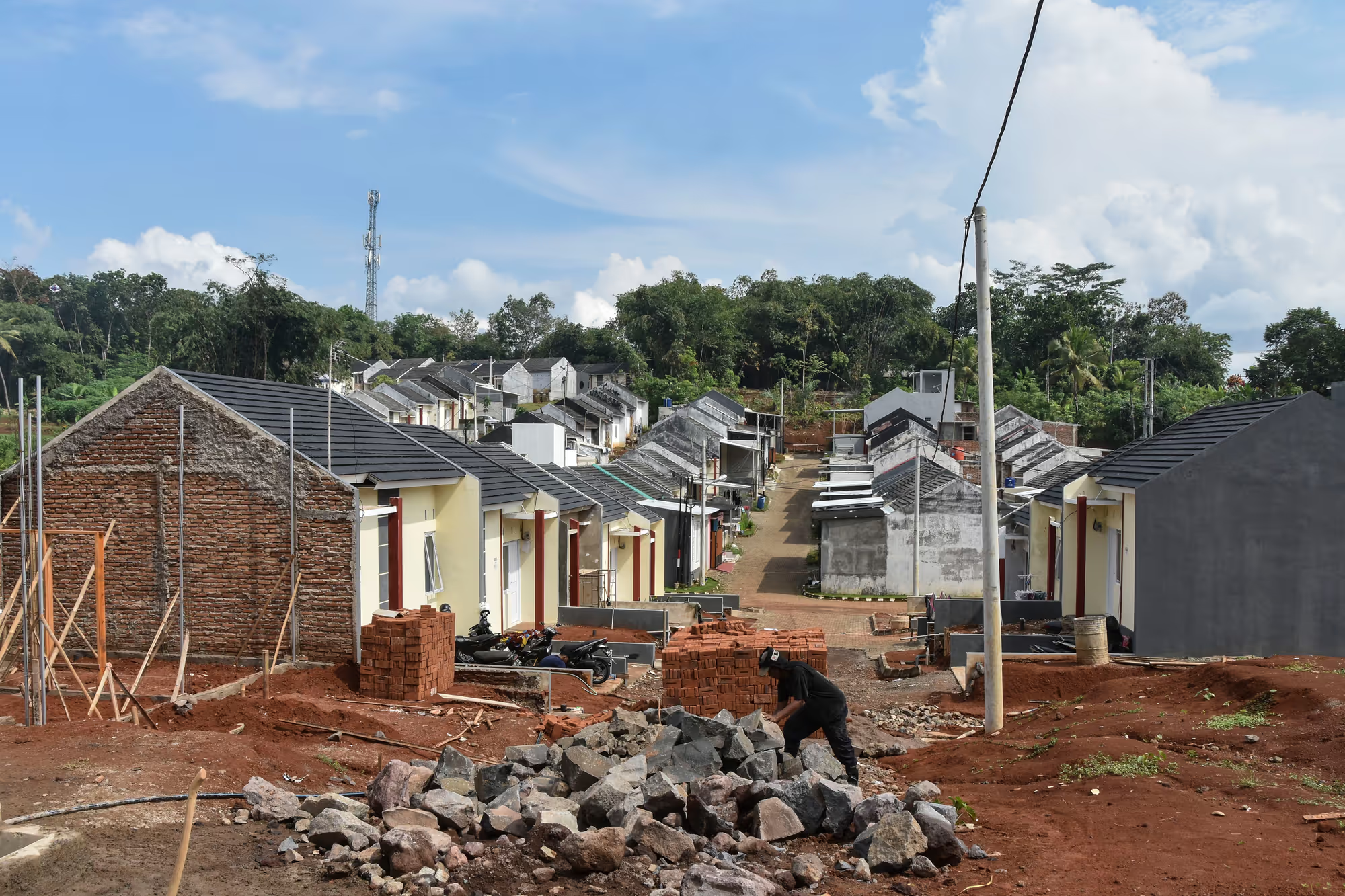
After the Covid-19 pandemic, the Ministry of Finance reexamined incentives that could revive momentum while protecting household purchasing power. Housing was chosen as a priority, seen as a sector with one of the largest multiplier effects on the economy.
“At the time, we were looking for any measures that could soften the impact of the economic slowdown and keep growth around 5%,” Immanuel Bekti, a Policy Analyst at the Fiscal Policy Agency (BKF) of the Ministry of Finance, now reorganized as the Directorate General of Economic and Fiscal Strategy (DJSEF), said in mid-2024.
Today, the same incentive approach is again being applied amid global economic uncertainty. The housing sector is receiving a stimulus known as Value-Added Tax Borne by the Government (VAT DTP). The Ministry of Finance concluded that covering up to 100% of VAT through this incentive could contribute at least 0.1 percentage point to Gross Domestic Product (GDP).

According to DJSEF Director General Febrio Kacaribu, the VAT DTP policy not only strengthens household purchasing power to buy homes, but also spurs growth in the construction sector.
Statistics Indonesia (BPS) data show construction grew above 7% throughout 2024—7.59% in Q1 and 7.29% in Q2 (year on year).
VAT DTP to Spur Home Absorption
The tax incentive borne by the government has been implemented across two periods. In the first period, 100% VAT DTP applied from January through June 2024; it was then reduced to 50% for July–December 2024. VAT DTP for ready-to-occupy homes was announced in November 2023 and formalized in a Ministry of Finance regulation on February 12, 2024.
The government provides the tax incentive for purchases of primary homes priced up to Rp5 billion, with the VAT covered for the portion up to Rp2 billion.
From January to June 2024, the 100% VAT DTP incentive was deemed to have driven average monthly housing absorption of Rp160–Rp170 billion. However, when VAT DTP was cut to 50% in July–August 2024, commercial housing absorption slowed. Realized absorption fell 33% to an average of about Rp100 billion per month. However, when the VAT DTP rate was reduced to 50% in July–August 2024, commercial housing absorption slowed.
However, when VAT DTP was cut to 50% in July–August 2024, commercial housing absorption slowed.
Most of the VAT DTP uptake occurred in commercial homes priced below Rp1 billion per unit, accounting for around 70%. Extending the 100% VAT DTP is expected to reignite the housing market, especially in the sub–Rp1 billion segment.
Previously, VAT incentives for landed houses and apartment units were rolled out in 2021–2022. The government issued Ministry of Finance Regulation (PMK) No. 103/PMK.010/2021 granting 100% VAT DTP for homes priced up to Rp2 billion and 50% VAT DTP for homes priced above Rp2 billion up to Rp5 billion.
Property Sector Must Be Prioritized
The chairman of the Central Executive Board of Real Estate Indonesia (REI), Joko Suranto, stressed that the property sector—one of the backbones of economic growth—needs to be prioritized, noting that every Rp112 trillion invested in property can contribute 0.56 percentage point to national economic growth.
“This sector is also linked to nearly 185 other real-sector industries, which means it has a significant impact on economic activity,” he said.
Joko added that housing has already made a major contribution to the national economy—among them, 14% of national GDP; 9% of state revenue (APBN); 35%–55% of regional revenue (PAD); and employment for 14–17 million people.
“This sector also helps reduce the poverty rate by 8% and curb stunting, as envisioned by President Prabowo Subianto,” he said.
He further noted that housing could open up to nine million job opportunities and foster at least 400,000 new industry players across Indonesia.
Growing public demand for housing makes the sector a primary engine of economic activity. In Indonesia’s economic landscape, housing holds a strategic position alongside sectors such as agriculture, industry, trade, and services.
Its growth carries strong potential to accelerate recovery thanks to powerful backward and forward linkages to other industries.
One reason housing supports broader growth is its capital- and labor-intensive nature, with 90% of construction inputs sourced domestically.
As a labor absorber, the housing construction segment can employ large numbers of workers—around 50,000 for every 100,000 homes built.
Mortgages Remain the Dominant Scheme
Despite various policies, the near-term macro impact remains modest. Bank Indonesia’s Residential Property Price Survey (SHPR) shows that primary market residential prices declined in the first quarter of 2025.
This is reflected in the Residential Property Price Index (IHPR), which grew 1.07% year-on-year in Q1 2025—slower than Q4 2024’s 1.39% year-on-year growth.
The Residential Property Price Index (IHPR) grew 1.07% year-on-year (yoy) in Q1 2025.
“The Q1 2025 price trajectory was influenced by primary market sales that increased—especially for small-type houses—amid declines for medium and large units,” said Bank Indonesia Communications Department official Ramdan Denny Prakoso.
In Q1 2025, sales of small-type houses jumped 21.75% year-on-year, while sales of medium and large units fell 35.76% and 11.69% year-on-year, respectively. Overall, residential property sales grew 0.73% year-on-year—rebounding from a 15.09% year-on-year contraction in the previous quarter.
On the financing side, the survey shows developers still rely primarily on internal funds, which account for 77.28% of residential project financing.
“For consumers, most primary-market home purchases use the Mortgage (KPR) scheme, accounting for 70.68% of total financing,” he added.
Mukhlison