

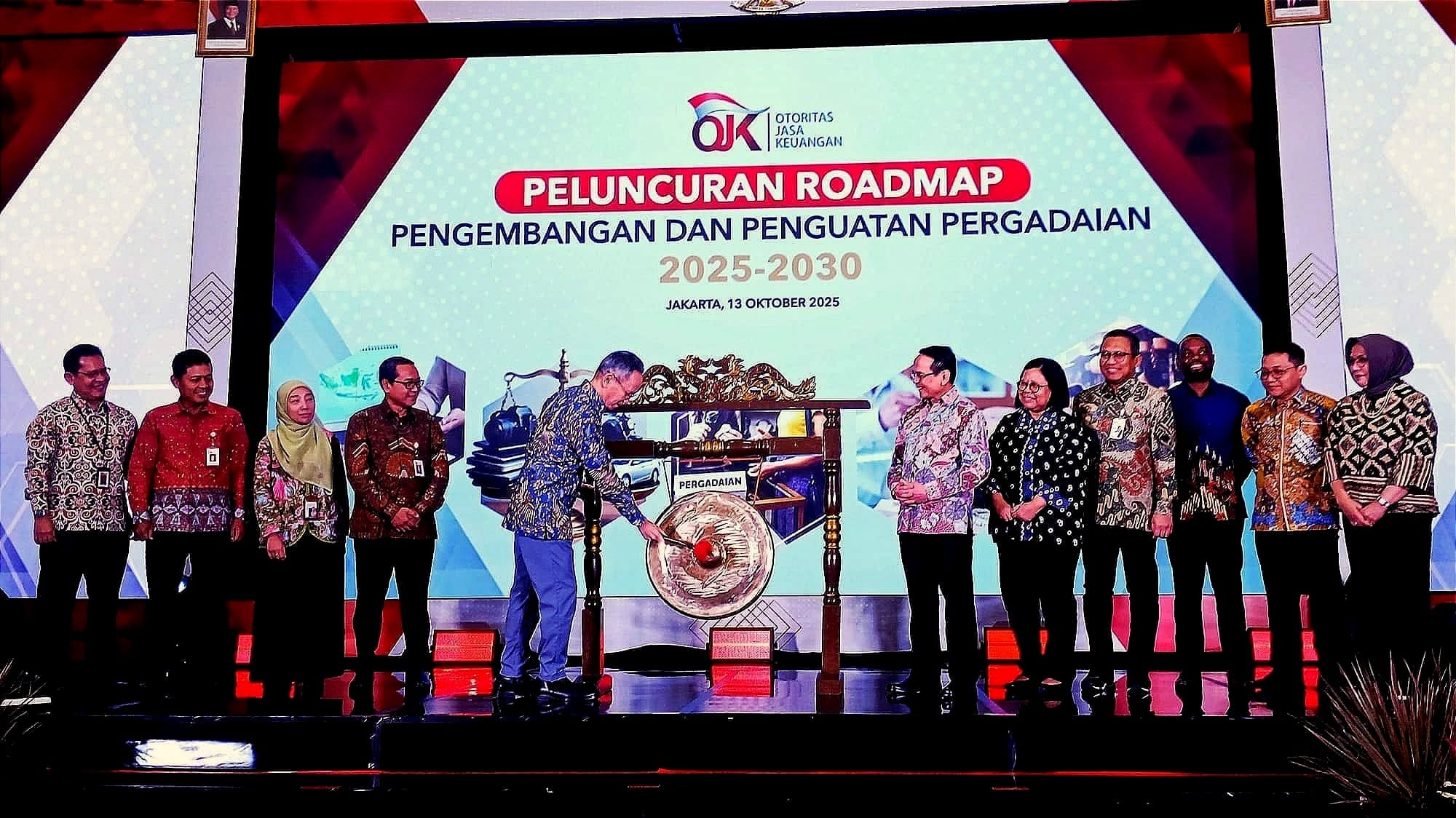
Along with the presence of various innovations in financial services in the digital era, the pawnshop industry also needs to improve in order to remain relevant as the people's choice. Efforts to strengthen and develop the pawnshop industry have been initiated by the Financial Services Authority (OJK) by creating an industry roadmap for 2025-2030.
OJK paved the way for the pawnshop industry to remain relevant and able to survive competition in the digital era. Through this history-making regulation, the pawnshop industry has received government support to improve customer protection, while at the same time becoming an economic empowerment partner that expands financial inclusion for all levels of society.
The commitment to support the pawnshop industry was emphasized by OJK at the launch of the "Pawnshop Development and Strengthening 2025-2030" roadmap in Jakarta, Monday (13/10/2025). Also attending the launch were President Director of PT Pegadaian and Chairman of the Indonesian Pawn Company Association (PPGI) Damar Latri Setiawan, as well as World Bank Financial Sector Specialist Marlon Rolston Rawlins.
OJK Chairman of the Board of Commissioners Mahendra Siregar said the roadmap was a direct derivative of the mandate of Law Number 4 of 2023 on Financial Sector Development and Strengthening (P2SK Law), which gives OJK the full mandate to regulate and strengthen supervision of financial service players, including pawnshops.
"Through the provisions of licensing and risk-based supervision as well as strong governance, this roadmap is expected to become a guideline and joint commitment of all pawnshop business actors in operating optimally and providing protection to the public," he said during his keynote speech.
There are five main strategies that OJK has prepared for the pawnshop industry in this roadmap . First, strengthening capital, governance, risk management, and human resources to build a healthy, stable, and competitive industry foundation. Second, strengthening supervision, regulation, and licensing to ensure a consistent and integrity pawnshop business.
Third, strengthening customer education and protection so that they increasingly understand their rights and obligations and avoid illegal pawn practices. Fourth, strengthening ecosystem elements including the role of pawn associations. Fifth, strengthening service products, markets, and infrastructure. Among the five strategies, supervision and customer protection are the two pillars that OJK emphasizes the most.
"I witnessed that there are still illegal pawn shops in various places, even in one city, this illegal pawn shop is only 2 blocks away from the OJK branch office. I told my friends at OJK, for whatever reason, this pawn business must be included in a good licensing and supervision framework," Mahendra said.
Making history
Member of the Board of Commissioners and Chief Executive of the Supervisor of Financing Institutions, Venture Capital, Microfinance, and Other Financial Services (PVML) OJK Agusman revealed that the pawnshop roadmap is a new history since the VOC's Bank Van Leening established the first pawnshop practice in Sukabumi in 1746.
"After almost three centuries, only now can we think about the future of the pawnshop industry properly, especially through the P2SK Law as the first legal product that explicitly includes the pawnshop industry," Agusman said.
The former head of Bank Indonesia's Internal Audit Department explained that OJK divided the roadmap into three phases that lasted for two years. The consolidation phase will take place in 2025-2026; the momentum creation phase will take place in 2027-2028, and the full implementation phase will take place in 2029-2030.
A number of breakthroughs in this roadmap will evaluate the pawnshop ecosystem, ranging from storage infrastructure to professional certification of appraisers. In addition, through regulations that are still being drafted, OJK will facilitate licensing deregulation, simplification of minimum equity, and minimum capital regulations.

Head of the OJK's Department of Supervision of Financing Institutions and Special Financial Institutions Ahmad Nasrullah underlined that, according to the provisions of the P2SK Law, pawn businesses that have not obtained OJK licenses and are therefore illegal are given the opportunity to apply for licenses until January 12, 2026, or 3 years after the P2SK Law is enacted.
Nasrullah stated that illegal pawn business players have actually wanted to apply for a license for a long time, but often do not know the procedures and are hampered by the minimum capital requirements for pawnshops according to POJK 39/2024, namely IDR 2 billion for district-level pawnshops, IDR 8 billion for provincial levels, and IDR 100 billion for national levels.
"We will relax licensing with a one-day program to make the process easier. In terms of capital, although the nominal cannot be lowered, the fulfillment can be gradual with the reference point of the old regulation, which is Rp500 million," said Nasrullah.
In implementing the roadmap ahead, Nasrullah emphasized that OJK will take a strategic approach and will not rush to arrest illegal pawn business actors after the P2SK Law matures. This is because, even though they are not licensed, the presence of illegal pawnshops often brings the benefits of financial access that are directly felt by the community.
"We have formed a Definitive Task Force consisting of OJK, police, prosecutors, and related ministries/institutions. Enforcement of the rules will be coordinated with the Task Force, but a persuasive approach will be taken by encouraging them to apply for a license by the set deadline," he concluded.
The higher the benefit, the more dignity
OJK's full support for the development and readiness of the pawn industry to navigate the future has received an enthusiastic response from pawn business players. The reason is, not only is it a momentum to upgrade, the OJK roadmap is clear evidence that the pawnshop industry remains relevant as financial preferences change.
President Director of PT Pegadaian Damar Latri Setiawan stated that pawnshop is one of the financial services with the best health in Indonesia. Currently, with a market-share contribution of IDR88 trillion or 10.2% of the total PVML industry contribution of IDR861 trillion, the annual turnover of pawnshops will reach IDR250 trillion by 2024, serving 29 million customers, and managing 120 tons of gold in the form of pawning, savings, gold installments, and bullion.
Not only that, over the past 5 years, the number of pawn business players registered by OJK grew 2.2 times from 94 companies in 2020 to 214 companies in September 2025. YtD lone outstanding growth increased 21.7% from IDR88 trillion in December 2024 to IDR107 trillion in July 2025. Profitability is also promising, with return on assets (ROA) above 6.0% in July 2025.
"These figures prove that pawnshops are relevant and in demand by the public. In order for pawnshops to reach people who want fast and practical services without barriers, digital transformation is a must so that we are not left behind in the dynamic financial industry competition," said Damar.
According to Damar, the pawnshop industry is able to survive the digital era due to its inclusive characteristics, relatively fast and easy process, flexibility, and very low risk. The unique and strong social value of pawnshop makes it very close to UMKM, even becoming the fastest way to get money. "Solving problems without problems" is not just a slogan, it is real and felt.
However, Damar does not deny the existence of illegal pawn businesses, the competence of appraisers who are not uniform, weak capital, non-transparent interest rates, and competition with Islamic banks, multifinance, and fintech are challenges for official pawn businesses.
"Fellow pawnshops are not competitors, but brothers. Our competitors are illegal pinjol and others. The principle is, whoever does the best service, he will be looked at. As fellow members, we are competing to provide better service," he said.
Professor of Banking and Finance at the Faculty of Economics and Business, University of Indonesia (FEB UI) Rofikoh Rokhim validated this commitment. She explained that in the pawnshop industry, which has the nature of monopolistic competition, differences in products, services, and returns will make market players diversified and differentiated by themselves.
Rofikoh added that another challenge for pawnshops is educating customers about the value of assets. According to her, pawnshops need to conduct periodic socialization of valuable assets that can be pawned, because the public is often uninformed about it.
"Theoretically, if someone has a valuable asset, they can pawn it. It's just that these valuable assets evolve. In the past, folding bicycles and love wave trees were extremely expensive, but now they are not. This means that pawnshops must socialize the list of valuable items that can be pawned," Rofikoh explained.
According to him, such socialization can change the pawnshop paradigm to become more dignified. Generally, many people feel embarrassed to pawn goods. In fact, by pawning, the person shows that they actually have valuable assets that can be cashed in.
"People need to be made aware that people who go to pawnshops are rich. Here lies the homework of educating tough appraisers and not only accepting gold, but also other valuables, such as stocks, bonds, diamonds, even securities and mutual funds to be pawned," he said.