

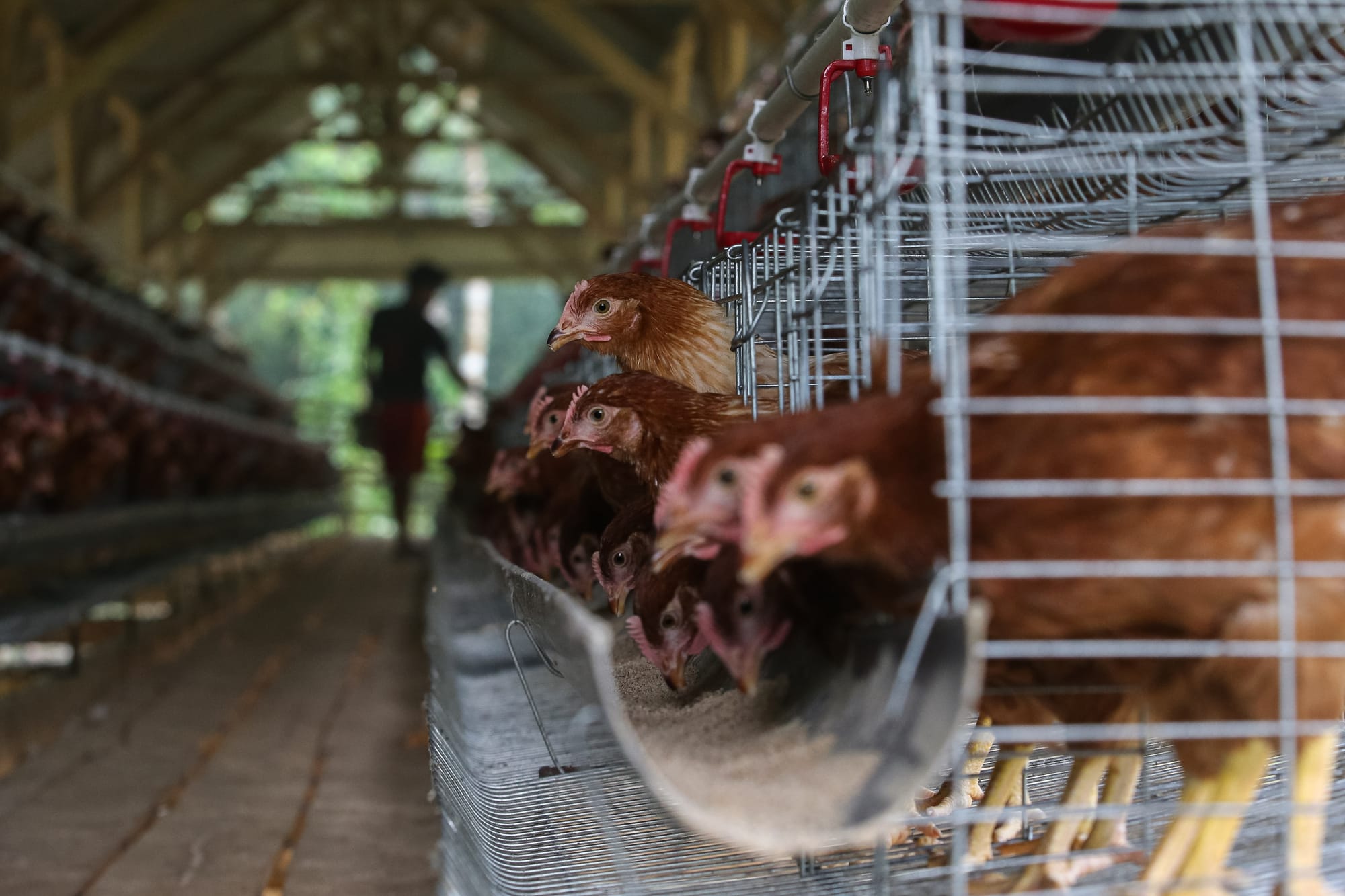
In the midst of the government's efforts to pursue food security and ensure that the Free Nutritious Meal (MBG) program runs without hiccups, a large injection of funds is ready to flow into the livestock sector. The Daya Anagata Nusantara Investment Management Agency (Danantara) is committed to pouring IDR20 trillion to build an integrated chicken farming network starting in 2026.
Minister of Agriculture Andi Amran Sulaiman said the project, which is being worked on with Danantara, is designed to cover the shortage of chicken and egg supplies in various regions. This step is one of the backbones of the national strategy to support the MBG program initiated by President Prabowo Subianto to improve the nutrition of the nation's children towards the Golden Indonesia 2045.
After a meeting to finalize the downstream program with Minister of Investment and Danantara CEO Rosan Perkasa Roeslani, Amran emphasized that the government wants to ensure that animal protein stocks do not falter again.
"The funding is from Danantara and this will be built throughout Indonesia where there is a shortage of chicken and eggs," Amran said after attending the Finalization Meeting of the Plantation and Industrial Hilirization Program with Minister of Investment and Hilirization and CEO of Danantara, Rosan Perkasa Roeslani, on Friday (7/11/2025), as quoted from Antara.
The government is speeding up the planning and feasibility study process so that construction can begin in January 2026, in line with the expected disbursement of IDR 20 trillion from Danantara. With an integrated livestock system, chicken and egg production is expected to increase significantly, keep prices stable, and strengthen long-term food independence.
"We want to make sure there is no shortage in the future. So we prepare from now on," Amran said.
Concerns from the field
Alvino Antonio, Chairman of the Nusantara Livestock Association, follows these developments with honest suspicion. He feels that government programs in the poultry sector often run off the rails.
According to him, the programs that are designed to improve the welfare of farmers appear to be 'budget-busting' projects. "Almost everyone knows who is behind the Minister of Agriculture," Alvino said.
He said the government does not need to participate in business if it really wants to improve the welfare of the people. A more appropriate role is to be a regulator that enforces rules properly and consistently. "If regulations are implemented properly, the ecosystem will be healthy without the need for the state to enter as a player," he said.
Alvino also criticized the plan to use a large budget to meet the needs of the Free Nutritious Meal (MBG) program. He believes that smallholder farmers are actually capable of adjusting the MBG supply needs without the intervention of giant projects, as long as the business environment is improved.
One of Alvino's complaints is the issue of funding business capital because bank interest rates in Indonesia are too high compared to other countries, making it difficult for them to compete.
According to him, the supply needs for MBG are also not as big as described. Therefore, he questioned who would actually enjoy the Rp20 trillion allocation the most.
In addition, Alvino considers the government's communication to be very closed. He admitted that he wrote to the Minister of Agriculture many times to offer input and cooperation, but never received a response. "We want to help the government, but they are busy taking care of their sponsors," he said.
He added that even basic issues such as the price of rice and corn have not been resolved. The production cost of poultry farming is highly dependent on the soaring price of corn. "They say rice and corn are self-sufficient, but how come the prices are still high?" he said.
According to him, the presence of large capital does not necessarily automatically create equitable welfare. Even according to the government's own data, the exchange rate for farmers is currently still in the range of 106-110, a sign that their income tends to stagnate. The Coordinating Minister for Food, Zulkifli Hasan, also admitted that the condition of farmers and fishermen is still poor.
"Fishermen are still poor, their labor value is still 106-110. The same with chicken farmers, egg farmers, they are not yet (prosperous-read)," said Zulhas during a meeting with farmers at Cahaya Tani Fertilizer Kiosk, Tamelang Hamlet, Purwasari, Karawang, West Java, Thursday (6/11).
Two Paths: Vertical or Horizontal Integrator?
At this point, an important solution is offered by Muladno, the innovator of the People's Farm School, former Director General of Livestock at the Ministry of Agriculture, and Professor of the Faculty of Animal Science at IPB. He divides the management of the poultry industry into two models: vertical integrators and horizontal integrators.
Vertical integrators have long dominated the market: one company controls the entire production chain, from grandparent stock, feed, breeding, slaughterhouses, to distribution. Everything belongs to one entity, so management is uniform and easy. Big capital makes them efficient, but the effect on small farmers is marginal.
In contrast, horizontal integrators break down the business chain to many actors, from feed providers to smallholder farmers. Seeds can be owned by A, feed by B, slaughter by C, while the cultivation is done by consolidated smallholders. This model is more egalitarian, with one key: consolidation. Without it, small farmers are on their own and can easily collapse.
According to Muladno, this is where the Rp20 trillion should work. "These funds should be prioritized for horizontal integrators," he said.
It does not need to be big at once. If the first year can only absorb Rp1 trillion for the people, the rest can be given to large industries while slowly expanding.
What is interesting about his idea is the "one sub-district one force" strategy. Farmers should be consolidated for a minimum of four to five months, supervised by the local government and universities. With a regulated harvest schedule and an enlarged scale, one sub-district can run like one big company.
Discussions about the location of development often trigger sensitivities. But Muladno emphasizes that the most important factor is not the region, but the readiness of the people. If farming communities in Papua or Aceh are ready, development can take place there.
He also warned of the risks of relying on a single source of funding. Diversification is important, not only for project stability, but also to prevent budget politics from dominating the direction of development.
Muladno emphasized that consolidation is key. Smallholder farmers should be organized at least at the sub-district level, given 4-5 months to build a solid structure, and assisted by the government and universities. If done right, one sub-district can be managed like a large company, without losing the independence of each farmer. He has been testing this model since 2012 through the People's Farming School.
Therefore, he believes that the Rp20 trillion should be prioritized to strengthen horizontal integrators. But he is realistic: in the early stages, the absorption capacity may be small, for example only Rp1 trillion, before gradually increasing. The government needs to prepare regulations from the sub-district to the provincial level, so that funds really flow to small farmers and support the MBG program.
To ensure the program is effective, Muladno mentioned several indicators that can be monitored by the public. First, chicken and egg prices must be competitive and reasonable, especially since the MBG uses state funds.
Second, coordination between business actors must work, including a scheduled production rhythm. He gave an example of a "check-in" pattern for broilers that can be arranged per village so that the harvest does not pile up at the same time.
Regarding the development of new farms, Muladno believes that the distribution of locations should not be determined by political interests or investors. What is more important is the readiness of human resources (HR). He said Aceh, Lampung, and Papua have the same potential as long as the farming community is ready, including in the provision of feed. Indonesia, he said, has corn fields from west to east.
Although he prioritizes horizontal integrators, he does not close the door to collaboration with vertical integrators. Large companies still have a role, for example in the provision of feed, as long as the cooperation is equal and does not weaken the position of small farmers.
According to Dr. Muladno, strong foundations are always built from the bottom. "If it's from the top, it's fast, but small farmers don't get anything," he said. He hopes that this policy design provides space for small people to grow, not just enlarge established industries.
Inclusive growth
Eliza Mardian, a researcher from CORE Indonesia, warned that an unfair and non-inclusive livestock development model risks excluding small farmers from the economy. "If the scheme only revolves around the same groups, economic equality will not happen," she said. In fact, according to him, the Pancasila economic vision brought by the Prabowo administration requires social justice to be felt as widely as possible.
He emphasized the importance of involving local communities as much as possible and ensuring the double effect of development really flows to them. Do not let state funds only be concentrated on a handful of big actors. For this program to be worthy of being called a national priority, the space for citizen participation and partnership design must be strong.
Eliza gave an example of a partnership scheme that could be implemented. Small farmers can be gathered in groups, and these groups organize a rotating schedule for harvesting eggs or chickens to supply the daily needs of the SPPG (Satuan Pelayanan Pemenuhan Gizi). That way, the supply chain remains stable and small farmers have a stronger position.
He believes that the government's plan to build integrated livestock centers to support the MBG program needs to be appreciated. However, the location must meet ecological requirements, such as stable humidity and temperature, moderate altitude, and feed infrastructure support. "The majority of poultry feed is still corn-based. Don't let farmers have difficulty getting feed because the local supply chain is not built," he said.
Currently, around 63 percent of national egg production is still concentrated in Java. Because MBG also targets the 3T region and areas outside Java, Eliza believes that the government needs to prioritize the development of livestock centers outside Java. The goal is to reduce the disparity in egg and chicken prices, as well as cut distribution costs, which have been inflated because they have to be sent from Java.
According to him, the government needs to cooperate with small farmers so that they can supply MBG directly. If the supply comes from the region itself, distribution costs can be reduced and the region becomes more independent in meeting its food needs.
He emphasized that this program should not be exclusive to large companies. Instead, inclusivity is the key to making MBG truly a driver of the local economy. The involvement of small communities, fulfillment of nutrition, price equality, and the emergence of new jobs in the village agricultural sector must be indicators monitored by the government, not just budget absorption.
"Community participation and how big the multiplier effect is to the local economy should be the main indicators," Eliza said. If the local supply chain is built and the community is part of the production, egg and chicken prices can be more controlled, distribution costs will decrease, and the region will become independent in providing food for the MBG.