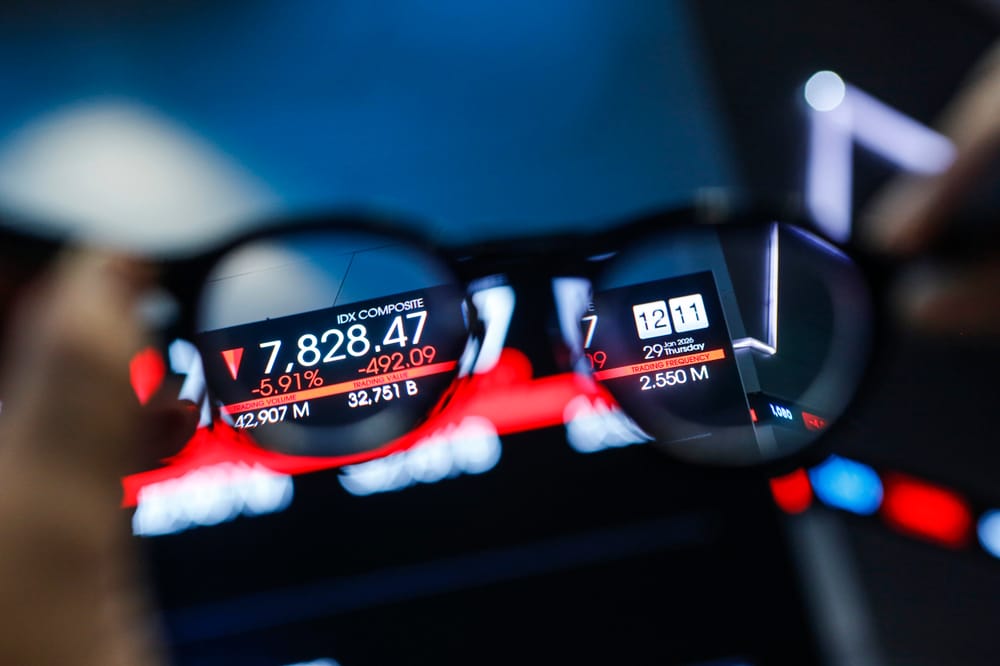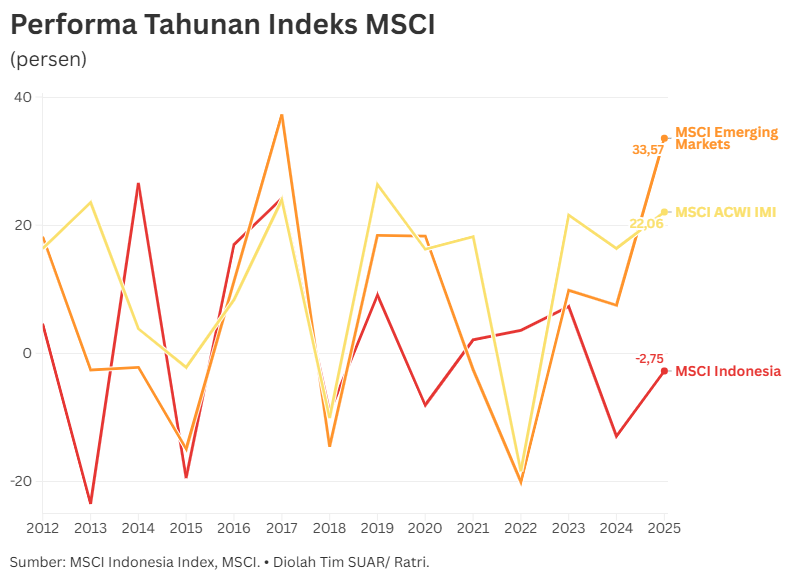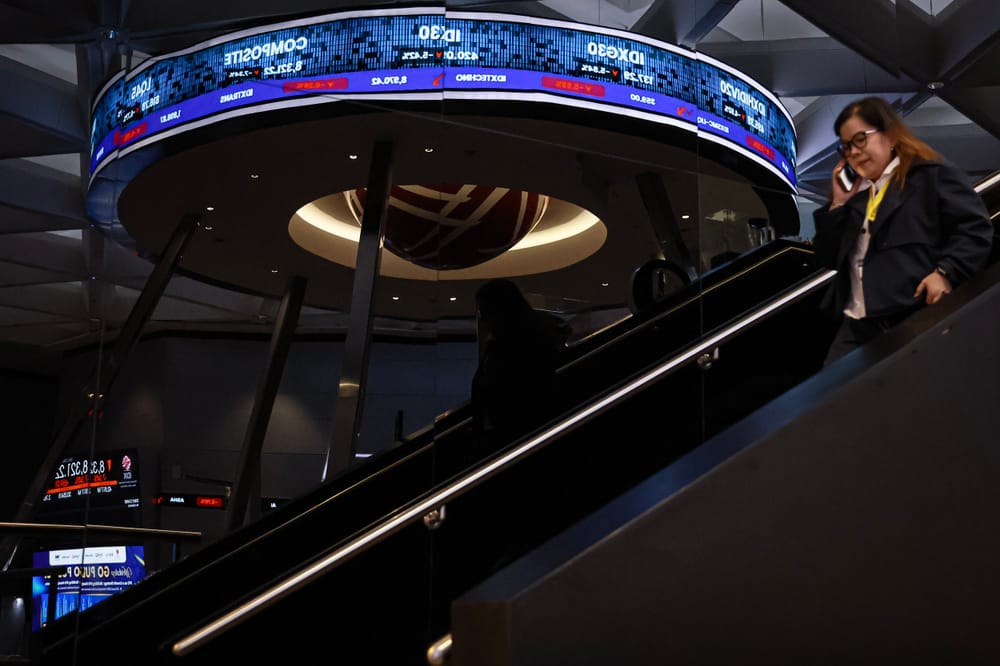


The explosion of retail investor participation was one of the most prominent phenomena in the Indonesian capital market throughout 2025. This surge marked a shift in market structure, where stock exchange activity was increasingly supported by individual investors, especially among the younger generation. However, this needs to be accompanied by caution because investors are prone to getting caught up in stocks that do not perform optimally.
According to data from the Indonesian Central Securities Depository (KSEI), the total number of Single Investor Identification (SID) retail investors in the capital market jumped by 5.25 million in one year. In 2024, the number was 14.87 million, then skyrocketed to 20.12 million on December 19, 2025.
The surge in the number of retail investors has also changed the structure of transactions in the capital market. The Financial Services Authority (OJK) noted that the contribution of retail investors to the average daily value of stock transactions on the Indonesia Stock Exchange (IDX) jumped from 38% at the end of 2024 to around 50% throughout 2025. This means that the transaction value is now evenly divided between retail investors and corporate investors.
OJK Board of Commissioners Chairman Mahendra Siregar revealed that around 70% of Indonesian retail stock investors are from Generation Y and Generation Z. This proportion is relatively large compared to many other countries that are still dominated by institutional investors.
The massive involvement of retail investors has direct implications for market supervision. OJK considers that this dominance increases the urgency of strengthening investor protection, particularly from unfair trading practices and price manipulation.
"This means that there is an increasing urgency to strengthen protection measures, including protecting retail investors from possible stock manipulation, irregular transactions, and other forms of manipulation," said Mahendra.
OJK also emphasizes the importance of more targeted literacy and education. The majority of retail investors are young people, so a change in perspective is needed so that the stock market is not viewed solely as a means of short-term transactions.
"As a result, our retail investors, more than 70% of whom are Gen Y and Gen Z, do not view the stock market as a daily trading transaction that solely pursues short-term wealth," he said.
OJK data as of September 2025 shows that 54.20% of capital market investors are under the age of 30. Although they dominate in terms of numbers, the value of this group's assets is still relatively small, at Rp70.81 trillion, far below the 31-40 age group at Rp293.89 trillion and the 41-50 age group at Rp249.43 trillion. The over-60 age group actually controls the largest assets, worth IDR 1,215.89 trillion, despite only accounting for 2.92% of the total.
OJK Deputy Commissioner Eddy Manindo Harahap considers the dominance of young investors to be a long-term investment. "We hope that the 54.20% share of young investors will decrease, but their assets will grow," said Eddy.
KSEI President Director Samsul Hidayat said that this growth reflects the acceleration of national capital market inclusion. In terms of transactions, retail investors still dominate.
IDX President Director Iman Rachman noted that retail transactions accounted for 47.3% or Rp7.33 trillion of the total transactions of Rp15.5 trillion in September 2025.
In a global context, Indonesia's retail dominance is relatively high. The share of retail orders on the IDX reaches 50%, far above the United States at around 25% and India at 27.37%. In Asia, Indonesia is between the extremes of China, which is dominated by retail at 90%, and Malaysia, which is highly institutional with a retail share of 16.9%.
Faced with an increasingly retail-driven market structure, OJK and IDX are preparing market deepening measures, including strengthening domestic institutional investors and implementing a policy to gradually increase the free float of shares starting in 2026. With the growing dominance of retail investors, the Indonesian capital market is entering a new phase of growth that requires a balance between expansion, investor protection, and long-term stability.
Read also:
 Benedictus Krisna Yogatama
Amidst increasing participation of retail investors in the Indonesia Stock Exchange, President Commissioner of PT Pelayaran Jaya Hidup Baru Tbk (PJHB), Hero Gozali, believes that communication is a key factor in mitigating the risk of excessive speculation. PJHB, he said, consistently strengthens its relationship with investors through various official channels.
The communication strategy implemented includes public exposés, regular disclosure of information, and routine communication with investors and market analysts. This measure is intended to ensure that market participants obtain balanced and accurate information regarding the company's condition.
"The company consistently discloses information, holds public exposés, and communicates regularly with investors and market analysts," Hero told SUAR on Tuesday (January 6, 2026).
Furthermore, the increase in free float is also seen as a strategic opportunity for PJHB to expand its institutional investor base. With improved stock liquidity, the company hopes that PJHB shares will become more attractive to long-term investors.
Hero believes that institutional investors generally pay attention to liquidity, governance, and performance stability. Therefore, increasing free float is considered to open up opportunities for investors with a more measurable risk profile.
Regarding regulatory policy, Hero expressed his view that the Indonesia Stock Exchange (IDX) and the Financial Services Authority (OJK) should adopt an adaptive approach. According to him, the characteristics of the industry and the conditions of each issuer need to be taken into consideration in the application of free float rules.
"PJHB always encourages the implementation of flexible and gradual policies, taking into account the characteristics of the industry and the conditions of each issuer," said Hero.
Overshadowed by Manipulation
The government, together with the Financial Services Authority (OJK), has emphasized that strengthening the integrity of the capital market and cracking down on stock manipulation or hot stock practices is a must, in line with the strengthening of the JCI and the participation of retail investors in the IDX. This statement was made following increased attention to investor protection risks amid market euphoria.
Indonesian Finance Minister Purbaya Yudhi Sadewa stated that the strengthening of the JCI reflects market participants' optimism about the national economic outlook. According to him, this positive sentiment is supported by improvements in economic fundamentals and the synergy between government and Bank Indonesia policies.
"I think there is optimism in the market. Market players see that we will continue to improve going forward," said Purbaya after attending the opening of trading at the IDX.
He added that increasingly solid policy coordination has the potential to drive higher economic growth compared to the previous year. Within this framework, Purbaya believes that the JCI still has room to reach higher levels.
"This year's target of 10,000 is not an impossible number to achieve," he said.
However, Purbaya emphasized that strengthening the index should not neglect market quality and credibility. Responding to the rampant issue of speculative stocks, he referred to the supervisory measures currently being prepared by the OJK.
"Earlier, Mr. Mahendra mentioned several steps that he referred to, he said. I will see, we will continue to observe. Whether he is serious or not," said Purbaya.
He also emphasized that there has been no request for capital market policy incentives for 2026. According to him, incentives are only relevant if they are followed by tangible achievements in law enforcement.
"Not yet. They haven't asked for incentives. If they ask for incentives, I will ask them: What are their achievements? How many people have been arrested?" he said.
A Surge That Could Open Up Opportunities
The surge in retail investors in recent years has changed the face of the Indonesian capital market. Bank Permata economist Josua Pardede said that by the end of November 2025, the number of capital market investors had reached 19.67 million, with retail transactions accounting for nearly 50% of total trading. This phenomenon has expanded the investor base, but at the same time has given rise to the risk of price manipulation or stock speculation.
He explained that the surge in retail investors was driven by three main factors.
"First, easier access through apps and online account opening has caused the number of investors to surge rapidly," Josua said when contacted by SUAR on Tuesday (January 6, 2026).
The second factor is the dominance of young and novice investors who tend to engage in short-term transactions for instant results. Meanwhile, the third factor stems from low returns on savings and deposits, prompting retail funds to seek opportunities in stocks, especially small-cap stocks.
This behavior, said Josua, is reinforced by social media and the existence of financial influencers (finfluencers).
"Brief information and narratives about quick profits spread faster than explanations of risks, so retail trading patterns are increasingly driven by market sentiment rather than the performance of issuers," said Josua.
According to him, retail dominance does make the market feel inclusive, but it does not automatically make it healthy. When there are a large number of novice investors and some stocks have a low free float, the scope for price manipulation widens.
"All it takes is a few small, repeated transactions to drive up the price, and then everyone jumps in for fear of missing out. The combination of novice investors, thinly traded stocks, and short-term transactions does increase the likelihood of the price being manipulated by certain parties," he explained.
Read also:
 Benedictus Krisna Yogatama
Meanwhile, Head of Research at PT NH Korindo Sekuritas Indonesia Ezaridho Ibnutama believes that the surge in retail trading has also been influenced by a shift in interest from cryptocurrency to stocks.
"After crypto declined, stocks began to rise and many financial influencers emerged. This is usually a sign of significant retail interest," said Eza. He added that young investors tend to be aggressive because they see the potential for financial gains more quickly than building a real business.
Regarding the role of retail as a buffer when foreign investors exit, Josua considers it to be situational. "Under normal conditions, retail can withstand pressure. But during sharp corrections, retail is prone to move simultaneously and drive panic selling," he said.
In terms of solutions, Josua emphasized a gradual and risk-based approach. He said that the most realistic policy would be to gradually tighten public share requirements, focus on issuers with too little free float, and quickly strengthen the monitoring of unusual transactions.
"This policy direction is in line with discussions at the OJK and IDX," he added.
University of Indonesia capital market observer Budi Frensidy added that literacy alone is not enough.
"We don't think we've ever heard of anyone being punished for market manipulation. Most of the rumors are about hot stocks," he said.
According to him, the term "gorengan shares" itself is unclear because it does not exist in financial literature. Nevertheless, he encourages clear law enforcement against market manipulation that disturbs investors.
"Without strict law enforcement, speculative stocks will continue to be a topic of discussion," he said.