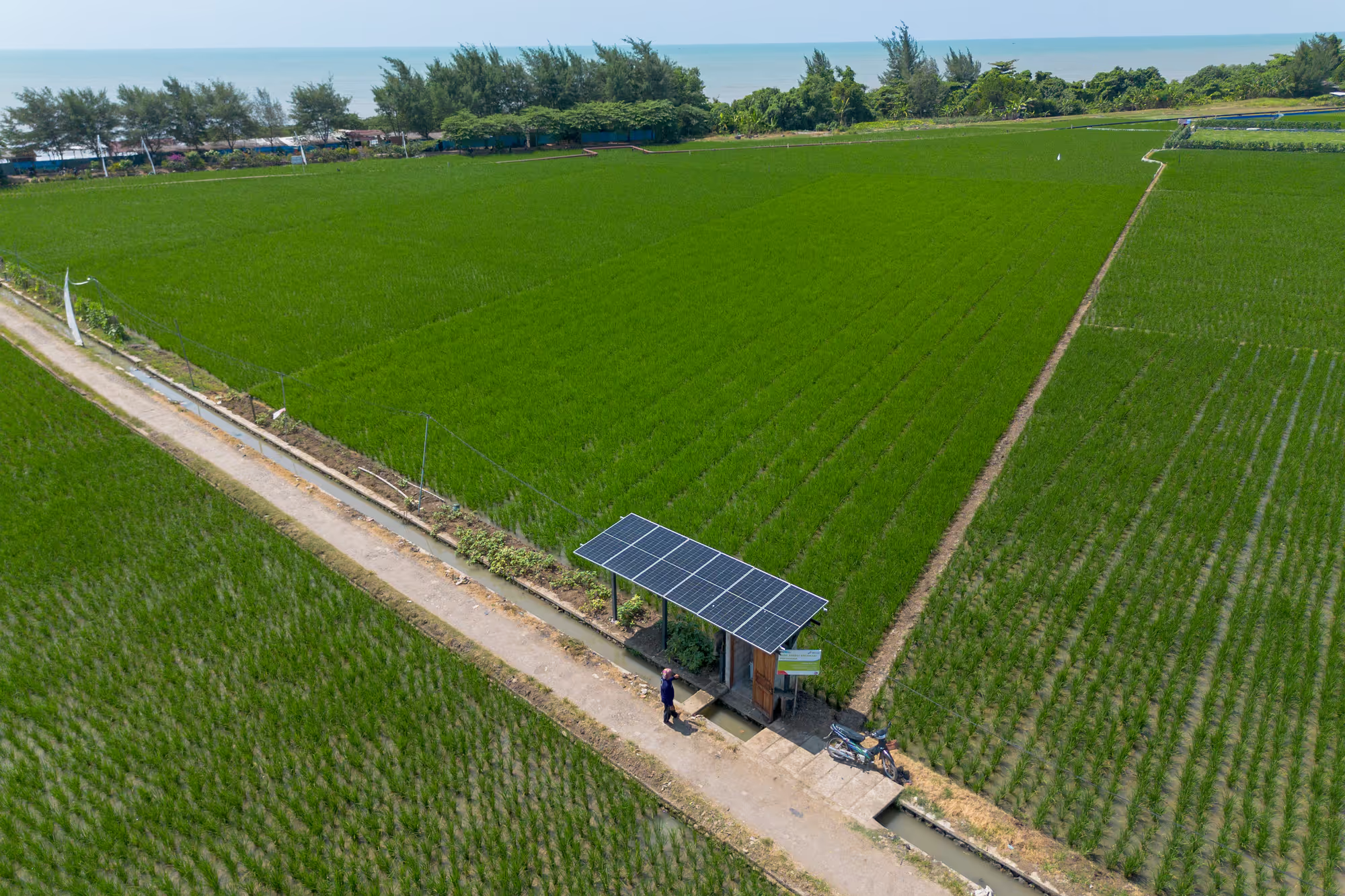
Indonesia has unveiled one of the most ambitious clean-energy projects in the world: building a 1-megawatt solar plant with battery storage in each of the country’s 80,000 villages, under a new “Merah Putih” cooperative framework. If achieved, the program would generate more than 100 gigawatts of new power—catapulting Indonesia into the ranks of the world’s solar leaders.
The government says the initiative will not only decarbonize the grid but also hand control of energy to village cooperatives, a break from the corporate-heavy energy transition model that has dominated so far.
“Following President Prabowo’s directive, we must build new and renewable electricity from solar power. Going forward we will build around 100 GW,” said Bahlil Lahadalia, Indonesia’s Minister of Energy and Mineral Resources (ESDM), on Aug. 5, as quoted by Antara.
For years, Indonesia’s energy transition agenda has been dominated by large corporations. The government is now proposing a new approach: people’s cooperatives. On paper, it promises decentralization and self-reliance.
Yet the project cannot run on its own. Technically, analysts say it is feasible: each village could allocate about one hectare of land; solar technology is relatively inexpensive, modular, and quick to build. But one factor cannot be bought—human-resource readiness.
By the calculation of Fabby Tumiwa, Executive Director of the Institute for Essential Services Reform (IESR), each village would operate its own plant under the local cooperative. That implies the need for more than 35,000 new technical workers annually to ensure the plants are properly built and maintained.
Fabby said the government must swiftly form a special task force or project management unit to handle national-level planning and oversight. Without it, village cooperatives will struggle with technical matters. “Technical design, procurement, and site mapping must be handled at the national level,” Fabby told SUAR on Friday (August 8). The cooperatives, he added, would function like a “village-scale PLN,” managing distribution and day-to-day maintenance.
However, a plan of this magnitude cannot be built on wishful thinking and slide decks alone.
Big Potential, Big Challenges
For Fabby Tumiwa, the biggest hurdles are not technological but managerial, planning, financial, and human resources.
He highlights three critical phases that require serious attention: planning, implementation, and operations. A dedicated body—such as a project management unit (PMU) directly accountable to the President—is essential to manage end-to-end processes, from design to execution. Cooperatives would take over once plants are completed and enter operation.
Workforce is equally crucial. Building one 1 MW village-scale solar plant (PLTS) requires about 30–50 technically skilled workers. With a target of 20,000 PLTS per year, Indonesia will need tens of thousands of trained technicians. Yet this also represents a major opportunity to create green jobs in the regions.
“Especially if supported by training from vocational institutions and partnerships with SMKs or local universities. Young engineering graduates can immediately work as construction technicians or plant operators in their own villages,” Fabby said.
“Imagine engineering graduates working in the village as plant operators—that’s cool,” he added.
Beyond labor, manufacturing capacity matters. If the project proceeds, demand for solar modules will surge. The government should engage domestic industry, encourage tier-1 panel makers to scale production, and lower costs via bulk procurement. This would not only reduce capex but also help build a robust domestic clean-energy industry.
“That’s why we need a bulk procurement mechanism, with relatively uniform pricing,” Fabby said. If executed well, he believes cooperatives can become “village-scale PLNs” that are independent and sustainable.
Still, a program of this size will be extremely capital-intensive. The government estimates total funding needs at US$100 billion. Fabby acknowledges that part will come from the state budget (APBN), but stresses it shouldn’t be borne entirely by the government.
“It will take funding to build, of course. Initially from the APBN, but not all. If managed properly, the government can mobilize other sources,” he noted.
He suggests blended finance: APBN via Danantara or PT SMI, combined with loans from the World Bank, the Asian Development Bank (ADB), and the Eurasian Development Bank (EDB). Equally important, Fabby emphasizes community co-ownership through cooperatives—villagers should be shareholders, not merely beneficiaries.
“Let the community become shareholders. In the end, they’ll earn returns from the operation of these PLTS,” he concluded.
Energy Equity Can’t Be One-Size-Fits-All
Zaky Amali, a researcher at Trend Asia, welcomed the push for solar PV (PLTS) as a pioneer of energy democratization. However, he cautioned that a project of this scale cannot be built with a one-size-fits-all approach. “We can’t assume every village must use PLTS,” he said.
Indonesia is an archipelago with highly diverse topography, climate, and renewable-energy potential. Humid or frequently overcast areas, for instance, may be better suited to micro-hydro than solar. “If everything is standardized to PLTS, that actually runs counter to the spirit of a just transition,” Zaky said.
He also noted that in the government’s own planning documents—such as the RUPTL 2025–2034—the national PLTS development target through 2035 is only 17.1 GW, far from the 100 GW figure recently floated by public officials.
Beyond technicalities, Zaky emphasized the importance of listening to village residents. “Do communities agree with PLTS? If not, what are the alternatives?” he said. The energy transition, he added, must not stop at technology; it has to be fair, participatory, and deliver tangible benefits.
Green—or Just a Label?
Skepticism around the project stems from a long history of “green” initiatives ending in greenwashing. Yuyun Indradi, Executive Director of Trend Asia, posed a more fundamental question: who will actually benefit?
“Wrapping it in ‘village’ and ‘cooperative’ may project a grassroots image, but who controls the upstream?” he said.
If the players remain large industrial actors—from nickel mining, quartz sand, and smelters to component suppliers—what happens is not decentralization but centralization with a new face. According to Yuyun, the project risks becoming a renewable-energy sweetener wrapped in a new centralization.
The core issue is not only technology and funding, but governance. Without strong accountability and public participation, villages could become a new object of exploitation—not by mines, but by “solar potential.”
“If it isn’t properly designed, the solar PV ends up a dead structure,” said Fabby. Many renewable energy (EBT) projects have been abandoned due to poor fit with local needs, weak management, or subpar quality.
Many EBT projects stall because planning is inadequate, management is weak, or quality is poor. Therefore, technical standardization is needed from the outset, including plant designs that are compatible with the state utility PLN grid (on-grid).
Yuyun underscored the importance of building safeguards: protections for the environment and affected communities, including the right to information, consent, and full involvement from design through operations. Therefore, technical standardization is needed from the outset, including plant designs compatible with the PLN grid (on-grid).
Who Holds the Switch?
Mada Ayu Habsari of the Indonesian Solar Energy Association (AESI) welcomed efforts to accelerate power generation. She said solar PV (PLTS) is well-suited to 3T villages (underdeveloped, frontier, outermost). However, she cautioned about potentially “consumptive” behavior once electricity arrives. “Will electricity drive productivity, or instead spur excessive consumption?” she asked.
AESI also underscored the importance of community participation and ability to pay. From the industry side, PLTS together with battery energy storage systems (BESS) can open new markets and attract investors.
Solar Power Takes More Than Just Installing Panels
For Bhima Yudhistira, Executive Director of the Center of Economic and Law Studies (Celios), the idea of promoting village energy self-reliance through cooperatives like Kopdes Merah Putih is fundamentally a progressive step. But big ambition is not enough. A project of this scale requires comprehensive readiness—not only on technology, but on the supporting ecosystem.
“Solar panels can be installed in many places, but what is often forgotten is human resources and ongoing assistance,” Bhima said. Installation is only the first stage. Maintenance, day-to-day operations, and rapid response to disruptions still require technical personnel from the village itself.
Echoing Fabby (Tumiwa), Bhima noted that success will hinge on vocational schools, community-based training, and long-term support. Without these, PLTS (solar PV) risks becoming idle infrastructure—like many previous renewable energy (EBT) projects that failed to operate because no one managed them.
Bhima also underscored the need to build a domestic supply chain. “If all components are still imported, we’re merely shifting dependence from fossil fuels to foreign manufacturing,” he said. Indonesia needs to develop solar panel, battery storage, and other supporting component industries so the project generates real economic impact.
Beyond technology and human resources, land use is another key issue. Large-scale solar requires space—and villages don’t always have idle land. Creative approaches are needed: rooftop installations, dual-use farmland, or agrivoltaic models as in Europe, where panels are installed above while the land below continues to be used for livestock.
“This isn’t new. Overseas, cattle or sheep farming can run side by side with solar PV,” Bhima said. In Indonesia, however, such approaches remain largely untouched in public policy.
Further, Bhima cautioned that the energy transition’s momentum should not be centralized in a single institutional model. “Community-based renewables don’t have to be monopolized by Kopdes Merah Putih,” he said, pointing to many communities that have long developed micro-hydro or biomass on their own.
“Why not support, facilitate, and scale up those initiatives? That could be faster and more effective than building from scratch,” he emphasized.
Who Controls the Money, Who Gets Access?
Financing is a major sticking point. According to Bhima Yudhistira, funding for a project of this kind cannot rely solely on loans from Himbara (the state-owned banks group), given limited lending ceilings and a financial-sector policy environment that is not yet friendly to renewable energy—especially at the community scale.
“Himbara’s share for renewables is still very small. We need banking policy reforms so banks can actively channel loans,” he said. Ideally, village energy cooperatives should also have direct access to international schemes such as the Just Energy Transition Partnership (JETP), rather than always waiting for central intermediaries.
Bhima urged that financing schemes be widened and non-exclusive. “If access is only for newly formed government cooperatives, it isn’t inclusive. All energy communities should be able to tap green finance, both domestic sources and foreign grants,” he said.
Yet, he added, these big ambitions will mean little without changes to the foundational rules. One key barrier is Indonesia’s centralized power system. “Communities cannot sell electricity to neighboring villages because there is no power-wheeling,” Bhima said.
Power wheeling is the mechanism for sharing transmission or selling electricity over the state-owned grid. Without it, community-generated power can only be self-consumed—limiting business potential and economies of scale.
At present, transmission is fully controlled by PLN, and communities have no access to utilize that network. “This is what must be reformed. If we’re serious about advancing community renewables, regulations must favor people, not just large corporations,” Bhima stressed.
