For the business world, the Provincial Minimum Wage (UMP) serves as a guideline for production costs that need to be incurred, affecting the viability of companies. Meanwhile, for workers, this minimum standard serves as a measure of whether they can still afford a decent life.
Workers/laborers must face the bitter reality of life due to the widening gap between the minimum wage and the cost of living. Concerns about declining purchasing power continue to haunt them.
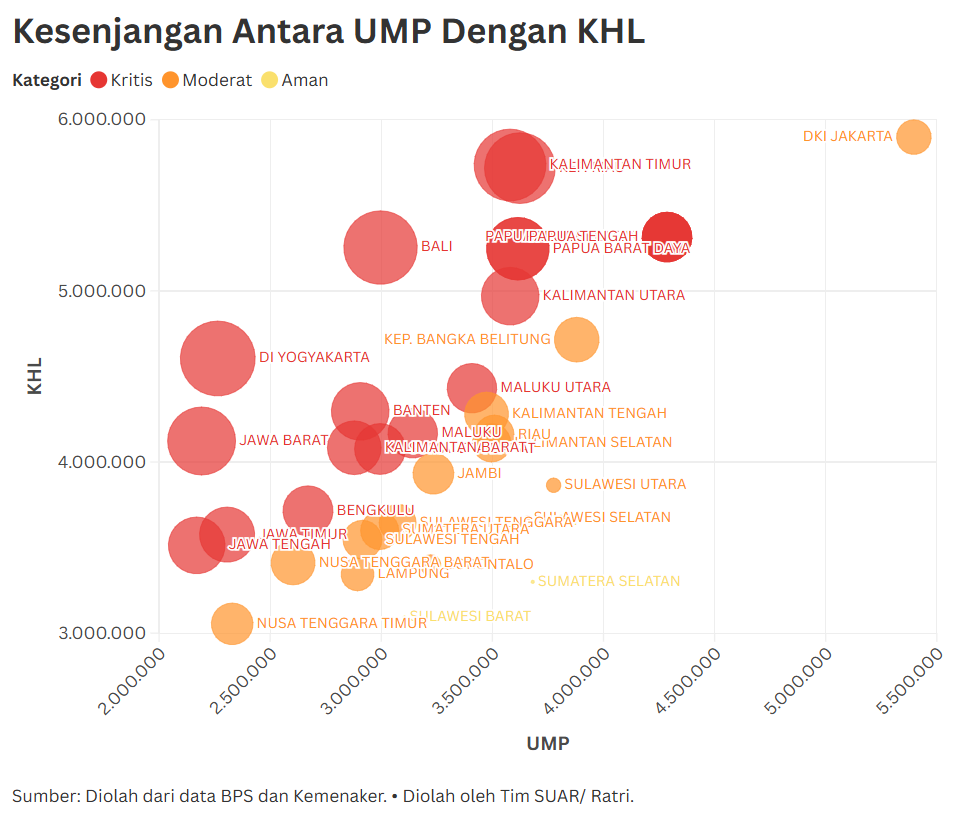
SUAR Team's analysis SUAR the nominal gap between the 2025 UMP and the 2026 KHL shows an uneven picture of worker/labor welfare in Indonesia.
Based on the three categories established (Safe-Moderate-Critical), only three provinces fall into the Safe category with a positive gap, meaning that the UMP is higher than the KHL. These three provinces are West Sulawesi, Aceh, and South Sumatra. This means that only about 7.9% of Indonesia's regions have minimum wages that meet or exceed the standard of living. This shows that the majority of workers in Indonesia are still struggling below the actual cost of living.
The Moderate or Middle category is a negative gap with a higher KHL between Rp 1 and Rp 1 million compared to the UMP, occurring in 39.5% or around 15 provinces in Indonesia. These regions are spread across most of Sulawesi, DKI Jakarta, parts of Sumatra such as Riau and North Sumatra, to the regions of Nusa Tenggara, Maluku, and Papua. Although the gap is not as deep as in the critical category, workers in these regions also face significant economic challenges because their income is not sufficient to cover all basic needs ideally.
In the Critical category, which affects more than half of Indonesia's provinces (52%), there is a negative gap with a higher disparity, namely a higher KHL (above Rp 1 million) compared to the UMP. A total of 20 provinces are in a deep deficit, with D.I. Yogyakarta (minus IDR 2.34 million), Bali (minus IDR 2.26 million), East Kalimantan (minus IDR 2.16 million), and Riau Islands (minus IDR 2.09 million) at the top of the list as the regions with the highest negative gap .
Provinces that are the centers of large industrial areas, such as West Java, Central Java, East Java, and Banten, are also included in this critical category. This indicates that industrial growth has not been directly proportional to the welfare of workers in these areas.
To reduce this gap, the use of the alpha variable in the formula of Government Regulation No. 51 of 2023 is crucial. Based on simulations, provinces included in the Safe Cluster that have a positive gap do not require a high alpha boost, but only need to follow inflation. Examples include South Sumatra, Aceh, West Sulawesi, South Sulawesi, North Sulawesi, and Gorontalo.
Meanwhile, provinces in the Moderate or Middle cluster, such as DKI Jakarta and Lampung, require an alpha value in the range of 0-5.0 to achieve KHL. If efforts are made, this group may still be able to achieve a decent standard of living if regulations provide flexibility above the current alpha limit of 0.30.
However, the biggest challenge lies in Critical Clusters that require an alpha value above 5.0, such as D.I. Yogyakarta (19.5) and West Java (16.6). Such a high alpha value is considered unrealistic in the standard formula because it requires economic growth to be multiplied by dozens of times to reach the KHL figure.
These regional differences send a strong signal to policymakers that without a better formula, the gap between minimum wages and a decent standard of living in these critical regions will cause turmoil that could affect the national economy.
If calculations use the maximum alpha number based on PP No. 51/2023, which is 0.5 - 0.9, then provinces in the Critical category, such as D.I. Yogyakarta, Bali, and Riau Islands, will never be able to meet the KHL standard.
Calculations using alpha values of 0.5-0.9 may be effective enough to prevent workers' purchasing power from declining further. However, these figures are insufficient to reduce the gap between wages and a decent standard of living, which in many regions is already too wide.