
Good morning, Chief...
The following is important information related to the development of the business universe that needs attention today based on the curation of the SUAR Team.

Prabowo Signs Wage Increase Policy, Employers Prepare Countermeasures
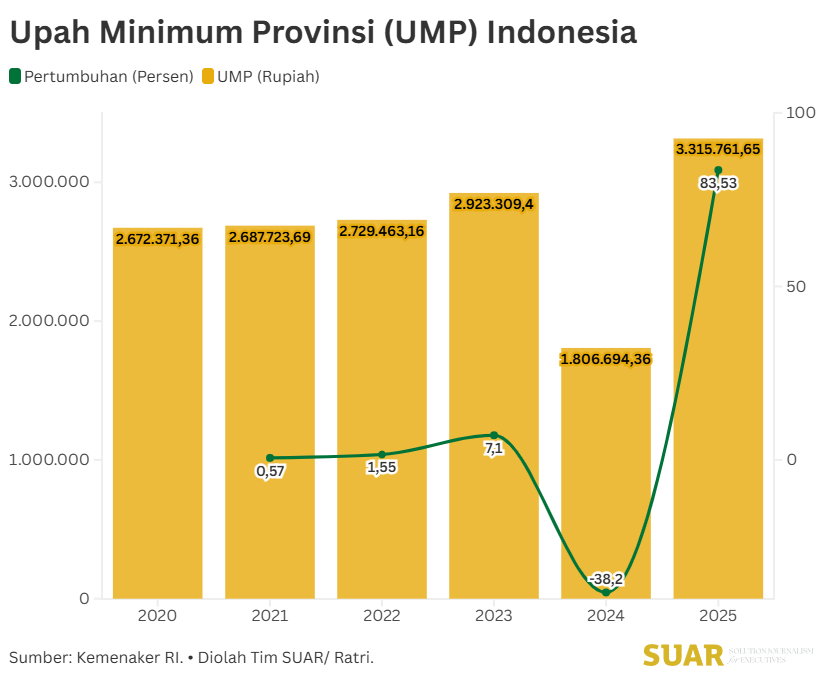
- Business owners are now beginning to prepare a number of anticipatory measures in response to the 2026 wage increase following the ratification of the Government Regulation (PP) on Wages. This has the potential to increase production costs for companies and add to the burden of doing business amid uncertain economic conditions. President Prabowo Subianto has decided on a wage increase formula of Inflation + (Economic Growth x Alpha) with an Alpha range of 0.5 - 0.9.
- Anton Supit, an expert council member of the Indonesian Employers Association (Apindo), said that the increase in the Provincial Minimum Wage (UMP) greatly affects the investment climate in Indonesia. Anton explained that wages have become a major consideration for investors entering Indonesia. If the wage increase is balanced with productivity, it will not be a big problem, but if the increase is not balanced with productivity, investors will suffer huge losses.
Read more here.

Loose Monetary Policy to Remain in Place Until Next Year
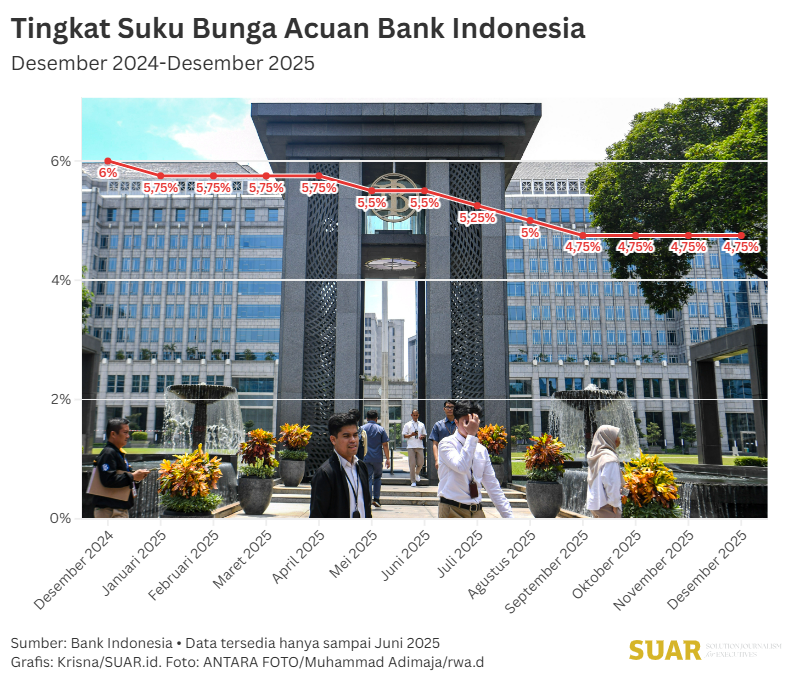
- Bank Indonesia's (BI) decision to hold its benchmark interest rate (BI Rate) at 4.75% at the BI Board of Governors' Meeting (RDG) in December 2025 confirms that the accommodative monetary policy stance will continue into next year. Liquidity expansion strategies and incentives for banks are being prepared to help BI transmit its policies to the real sector more quickly. Throughout this year, the benchmark interest rate has been lowered by 125 basis points (bps), followed by monetary liquidity expansion.
Read the full story here.
Many Ways for Local Governments to Create Ideal Fiscal Conditions
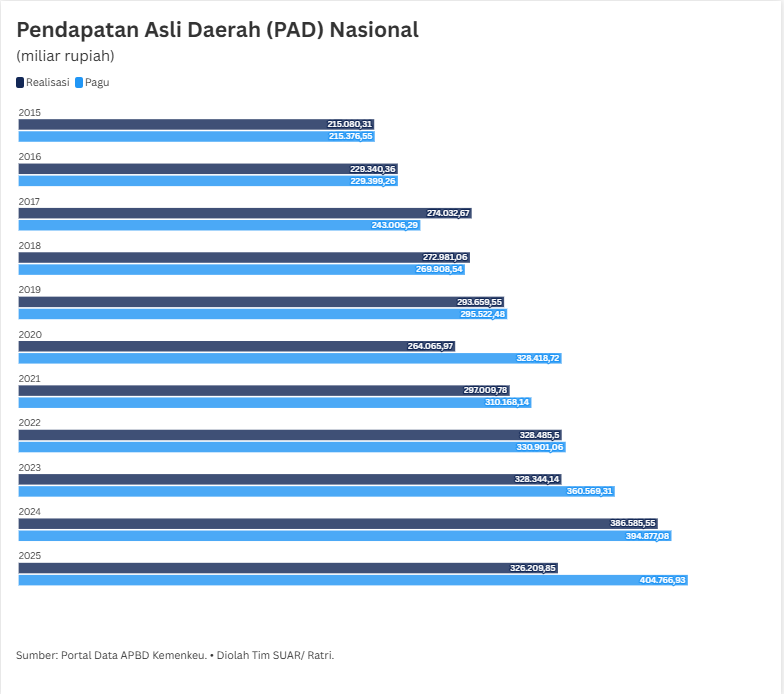
- Fiscal constraints or regional budgets can be anticipated in various ways, including diversifying other sources of revenue to pursue Regional Original Revenue (PAD), optimizing Revenue Sharing Funds (DBH), and carefully calculating transfer funds from the central government. This needs to be done so that development can continue amid limited fiscal resources.
Read the full story here.
Special Interview with the Mayor of Surabaya: Central Government Transfer to Regions is Declining, Mayors Should Not Complain
- The city government's continued dependence on TKD and the decline in funds from the central government could potentially lead to delays in employee salary payments and a reduction in development projects. However, like a skilled pilot facing turbulence, the city government, led by its mayors, must continue to do its utmost to overcome these challenges. This spirit was conveyed by the Chair of the Association of Indonesian City Governments (Apeksi) 2025-2030, who is also the Mayor of Surabaya, Eri Cahyadi, in a podcast with Suar.id in Jakarta on Thursday (11/12/2025).
- Instead of wallowing in disappointment and anger, Eri wanted to encourage the 98 mayors who are members of Apeksi to think creatively in order to optimize the potential of their regions so that they could generate local revenue (PAD) and reduce their dependence on TKD. The following is an excerpt from an interview with Cak Eri, as he is affectionately known, with the founder and editor-in-chief of Suar.id, Sutta Dharmasaputra.

Read more here.
Selected Video Regional Transfer Funds Cut, City Government Opens Collaboration
 Agung Mahesa Fikri

Relaxation of KUR for Business Actors in Disaster-Affected Areas
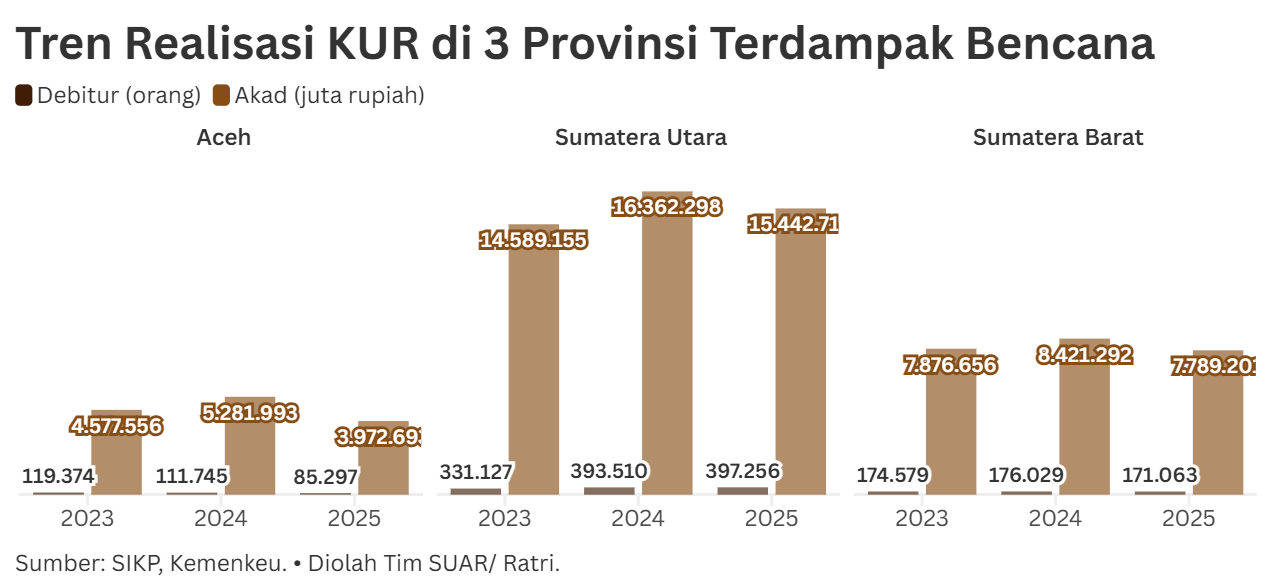
- Relaxation policies for People's Business Credit (KUR) debtors in areas affected by ecological disasters are urgently needed so that they do not become mired in debt when their businesses are unproductive. Of the three provinces affected by disasters in Sumatra, the largest number of debtors are in North Sumatra.Based on KUR realization data for 2025 in the Ministry of Finance's Program Credit Information System (SIKP), the burden of recovery in North Sumatra appears to be the greatest compared to the other two provinces. Until 2025, North Sumatra recorded a total of 397,256 debtors with a total credit value of Rp 15.44 trillion.
- Although this credit value has decreased compared to 2024, which reached Rp 16.36 trillion, the number of debtors has increased. This indicates that access to KUR is becoming more widespread in North Sumatra. It also means that the number of debtors who need relaxation due to disasters in this region is the highest. In contrast, in West Sumatra, KUR distribution tends to be stable. In 2025, there were 171,063 borrowers with a total credit value of Rp 7.78 trillion. The dominant sector receiving KUR disbursements in West Sumatra was agriculture, hunting, and forestry, amounting to Rp 3.57 trillion.
Read the full story here.

Launching Gig Economy Training for Gen Z and Soft Launching AI Open Innovation Challenge. The Coordinating Ministry for Economic Affairs, together with a number of strategic partners, is organizing this event at the Jakarta Creative Hub. The series of activities is scheduled to begin on Thursday, December 18, 2025, at 7:30 a.m. Western Indonesian Time for the launch agenda, followed by intensive training sessions from December 18-20, 2025, starting at 8:00 a.m. Western Indonesian Time. The program covers various relevant topics such as AI, Digital Marketing, CRM, Content Creation, and Entrepreneurship, featuring expert speakers from major institutions like Microsoft, IBM, Meta, and Salesforce. Further details about the event can be accessed through the Jakarta Creative Hub's Instagram social media account.
The 2025 National Road Day Webinar is titled Road Connectivity Supporting Food Self-Sufficiency. The Directorate General of Highways will hold the webinar online via Zoom and YouTube on Thursday, December 18, 2025, starting at 8:00 a.m. Western Indonesian Time. The event will open with a keynote speech by the Minister of Public Works, Ir. Dody Hanggodo, MPE, and will feature experts from various ministries as speakers to discuss the role of road infrastructure in strengthening national food security. Further information regarding the webinar can be accessed through the PUPR Binamarga Instagram social media account.

"Don't focus on the numbers. Focus on doing what you do well. It's about building a community that wants to visit your site every day because you create value and offer expertise." - Cassey Ho, Founder of Blogilates.com -
Have a good day, Chief.
Team SUAR