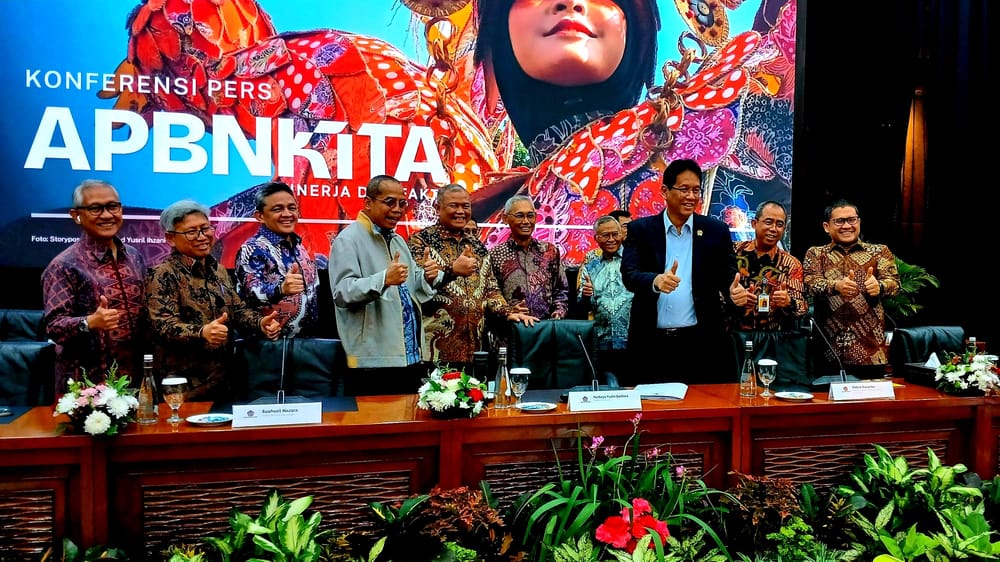


The injection of Rp 200 trillion in government funds into five member banks of the Association of State-Owned Banks (Himbara) on Friday (12/9/2025) was Finance Minister Purbaya Yudhi Sadewa's first big step to accelerate the economy's pursuit of growth. The readiness and creative strategies of banks will be tested to target potential and productive sectors so that the injection can be useful and right on target.
In a press statement delivered at the lobby of the Coordinating Ministry for Economic Affairs, Jakarta, on Friday afternoon, Purbaya stated that injection funds amounting to Rp 200 trillion will soon enter the banking system today.
"I make sure Rp 200 trillion of funds enter the banking system today," he told reporters.
In detail, Purbaya stated that Bank Mandiri, Bank Negara Indonesia (BNI), and Bank Rakyat Indonesia (BRI) each received IDR 55 trillion; Bank Tabungan Negara (BTN) received IDR 25 trillion; and Bank Syariah Indonesia (BSI) IDR 10 trillion.
The entire fund injection was channeled in the form of on-call deposits. This means that the government can withdraw the money at any time if the funds are needed.
"But I assure you that the government will not take the deposits in the near future. Even if tax revenue is below the target, there is no need to be afraid. Last year there was still quite a lot of budget surplus (SAL). So, you don't have to be afraid that the government doesn't have money to build," added Purbaya.
The accumulated SAL of the 2025 State Budget that Purbaya is referring to amounts to Rp 457.5 trillion. Of this amount, the government has stated that it will transfer IDR 16 trillion to the Red and White Village Cooperative and IDR 85.6 trillion to cover the widening of the 2025 State Budget deficit. Purbaya added that he is optimistic that tax absorption will improve in October to December 2025.
"If all the programs that I have planned are running, I am sure the targets will be achieved and economic growth will be as high as we gave it before," Purbaya concluded.
Himbara welcomes
Himbara member banks stated that they have prepared themselves to receive and distribute the injection to a number of sectors that are considered prospective and in accordance with government targets. Bank Mandiri Corporate Secretary Muhammad Ashidiq Iswara stated, Bank Mandiri sees the placement of SAL funds as strengthening the growth of third party funds which encourages lending.
"This condition will support the availability of healthier liquidity and increase the effectiveness of monetary policy transmission, so that the circulation of money in the economy can take place more optimally," Ashidiq wrote in a written statement received by SUAR, Friday (12/9).
Ashidiq stated that the Rp 55 trillion injection that Bank Mandiri has received is in line with its commitment to accelerate the banking intermediation function, especially to productive sectors that are in line with government priorities and President Prabowo Subianto's Asta Cita in encouraging sustainable economic growth.
The additional liquidity space which became a positive stimulus also received a positive response from BNI. BNI Corporate Secretary Okki Rushartomo emphasized that BNI is committed to further channeling credit in a healthy and productive manner for inclusive and sustainable economic growth.
"However, the effectiveness of this policy will depend heavily on further technical and implementation rules from regulators. A number of key aspects also still need clarity, such as fund placement schemes, governance, timeframes, risk mitigation, and sectors that are prioritized to receive," Okki wrote in a written statement to SUAR.
"The effectiveness of this policy will largely depend on further technical and implementation rules from the regulator. A number of key aspects still require clarity," Okki said.
The withdrawal of SAL funds, according to Okki, strengthens the banking sector to help accelerate national economic recovery. With stronger liquidity, banks have the opportunity to move aggressively to fund strategic and productive projects in the coming months.
One of the sectors targeted by banks receiving the injection is the property sector. BTN President Director Nixon LP Napitupulu stated that the Rp 25 trillion injection received by his bank will be disbursed in at least the next six months.
"BTN's subsidized mortgage quota still has to spend another 170,000 to 180,000 units, and BTN is channeling it into mortgages because the opportunity is still large. In addition, the construction sector for house building, credit for micro and small businesses, and we are currently exploring financing SPPG kitchens providing Free Nutritious Meals," explained Nixon when contacted by SUAR, Friday (12/9).
Nixon estimates that the turnover of injection funds by BTN will be faster because it is currently conducting a number of pilot projects in several regions for the distribution of MSE loans and MBG kitchens.
"The distribution is only in a few spots because we are still waiting for the standard financing rules. However, we are also still looking at it from the common sense of credit," said Nixon.
"We will see in the next 2 months-3 months. If the results of the pilot project are good, we will immediately copy and massively expand it to other places," he added.
Nixon does not deny that as a lender, the bank's lending is highly dependent on demand, which is currently declining. However, he is optimistic that with the new liquidity, BTN can push and find new loopholes so that the distribution of funds is optimal for the next few months.
Finish upstream
Apart from Purbaya's progressive policies that should be appreciated, an important aspect that should not be forgotten is to solve the problem of economic slowdown upstream. Economist and lecturer at the Indonesian Banking Development Institute (LPPI) Ryan Kiryanto reminded that the accumulation of SAL at BI cannot be separated from the problem of non-optimal budget absorption of ministries / institutions (K / L) in the first quarter of 2025.
"I appreciate the Minister's idea to put the SAL into Himbara bank. The intention is good, so that the bank is aggressive in lending. The question is, will it happen like that? In my opinion, not necessarily. Without injection alone, credit growth is sloping because business friends are not interested, and therefore do not apply for credit facilities to banks," said Ryan when contacted by SUAR, Friday (12/9).
Ryan explained that entrepreneurs are currently considering various risks that prevent them from expanding. Starting from tariff increases, geopolitical risks, post-riot turmoil, and so on. As a result, economic stimulus is likely to be ineffective if entrepreneurs do not have a sense of security to move.
"The government's first homework is to create an economic, business and investment climate that is entrepreneur-friendly and investor-friendly. If this climate is created, entrepreneurs without being forced will come to the bank themselves because they need it." Ryan said.
"From the bank's perspective, lending is easy. What is difficult is to extend credit carefully in the midst of this economic situation," he added.
Furthermore, according to Ryan, if the distribution target is not achieved, banks can channel excess liquidity by buying Government Securities (SBN) or Bank Indonesia Rupiah Securities (SRBI), which causes the funds to circle back to BI.
Therefore, improving the climate for entrepreneurs is an absolute prerequisite to drive the business world. This can be done by reducing the Incremental Capital Output Ratio (ICOR) value, bureaucratic reform, good governance, and creating regulations that motivate entrepreneurs to seek credit.
"If entrepreneurs are confident, they will definitely expand, either withself-financing, loans to banks, or if the bank's limit is stuck, they will borrow from the capital market. Under such circumstances, bank credit rises, the JCI rises, the number of issuers increases, liquidity in the stock market also increases. Currently, entrepreneurs are still worried," said Ryan.
"The government must be able to guarantee business security first, then the injection funds will be used productively," concluded Ryan.