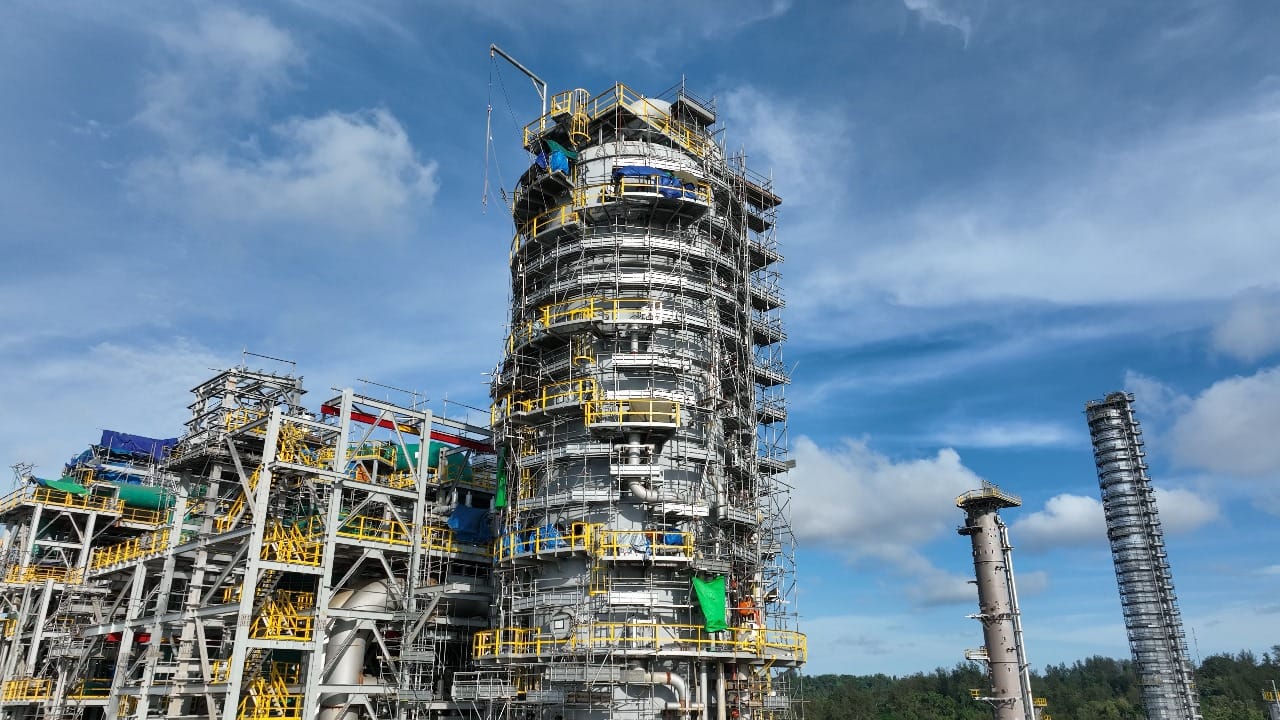
If nothing goes wrong, one of the largest refinery units in Indonesia will soon be operated by PT Pertamina (Persero). That is the development refinery included in the Balikpapan Refinery Development Master Plan (RDMP) project.
"Our target for the completion of the Balikpapan RDMP is to start on November 10, 2025 and it is expected that on November 17, 2025 it will be operational with a minimum capacity," said Pertamina's President Director, Simon Aloysius Mantiri, in a hearing with Commission VI of the House of Representatives, Thursday, September 11, 2025.
The Balikpapan Refinery expansion project has a total budget of Rp 114.5 trillion. The funds come from various sources, including loans from international financial institutions. Part of this budget comes from a loan of US$ 3.1 billion or around Rp 46.5 trillion, which is obtained in 2023. In finalizing project financing, the Balikpapan RDMP project involves 4 export credit agencies (ECAs) and 22 commercial banks.
The project financing was also successfully over-subscribed by US$ 4.39 billion (142%) despite the turbulent global economy. Balikpapan RDMP is one of Indonesia's National Strategic Projects (PSN) that will increase the capacity of the Balikpapan refinery from around 260,000 barrels per day to 360,000 barrels per day. The project will help meet the increasing demand for domestic fuel and petrochemical products.
As one of the largest investment projects in Indonesia, the Balikpapan project will reduce Indonesia's dependence on imported fuel and provide a multiplier effect for regional economic growth by involving local companies, creating local jobs, and targeting a domestic component level (TKDN) of 30%-35%.
In addition, with the addition of national fuel, LPG and petrochemical production, it is expected to save Indonesia's trade balance deficit of up to US$ 2 billion per year.
Currently, Balikpapan RDMP is in the preparation stage for the operation of one of the vital units, namely residual fluid catalytic cracking (RFCC). RFCC is an oil refinery unit that uses catalyst technology to convert heavy or residual oil into high-value products, such as gasoline, LPG, and propylene.
When the Balikpapan RDMP is completed, the Balikpapan Refinery will become the largest oil refinery in Indonesia. This is because the capacity of the Balikpapan Refinery will exceed the capacity of the Cilacap Refinery, which is currently the refinery with the largest capacity.
The Cilacap refinery processes 345,000 barrels per day (bpd), while the Balikpapan refinery will be able to process 360,000 bpd of crude oil. In addition to increasing oil processing capacity, there will be additional production of petrochemical products up to 225,000 tons per year.
Between needed and no longer important
Pertamina's oil refinery development is fully supported by the government. Through Presidential Regulation (Perpres) No. 56/2018, there were previously seven refinery projects included in the national strategic project (PSN), namely five refinery development master plan (RDMP) projects and two new refinery projects.
The five RDMP projects are RDMP Refinery Unit (RU) V Balikpapan, RDMP RU IV Cilacap, RDMP RU VI Balongan, RDMP RU II Dumai, and RDMP RU III Plaju. Meanwhile, two new refinery projects, namely the Tuban Grass Root Refinery (GRR) and Bontang GRR.
Based on Presidential Regulation (Perpres) Number 12 of 2025, the refinery projects that were included in the PSN in the era of President Prabowo Subianto's administration were only the RDMP RU VI Balongan, RDMP RU IV Cilacap, Cilacap Biorefinery, and Tuban Oil Refinery (expansion).
Oil refineries are urgently needed to cover imports, as the current refinery capacity is insufficient to meet the needs of domestic fuel consumption, leading to import dependence.
Refinery construction and rejuvenation can increase production capacity, product quality and efficiency, despite the high investment cost of building a new refinery. In addition to processing crude oil, refineries can also produce higher value-added products and improve national energy security.
The construction of refineries requires huge investment costs, which can reach as high as IDR 1,054 trillion to IDR 1,125 trillion. On the other hand, refinery construction projects are at risk of overcapacity if not matched by an increase in domestic crude oil production, coupled with the global trend moving towards electric and hybrid vehicles.
The Ministry of Energy and Mineral Resources (ESDM) said that oil refineries in the world are projected to stop operating in the next few years. According to Deputy Minister of Energy and Mineral Resources Yuliot Tanjung, one of the reasons is due to the massive adoption of electric vehicles in the world.
However, this condition is unlikely to impact the refinery business unit in the country. This is because Indonesia's fuel oil (BBM) needs currently reach around 1.5 million barrels per day and are partly met from imports. "So if this is our estimate, for one day's fuel needs, it is still around 1.5 million barrels per day. Some of this is processed in domestic refineries, some comes from imports," Yuliot said.
According to Yuliot, the government continues to monitor the performance of domestic oil refineries to meet national fuel needs. Meanwhile, if domestic refinery production is insufficient, fulfillment through imports is an option. "If it is not sufficient from domestic refineries, it means we have to import from abroad. But this is in the context of trade balance, so we also have to repeat our commitment," he said.
Capacity building across all divisions
Vice President Corporate Communication of PT Pertamina (Persero) Fadjar Djoko Santoso stated that currently, six Pertamina refineries in operation have met 70% of fuel needs from domestic production, with processing capacity reaching 1.05 million barrels per day. However, there is still a gap to meet all the fuel needs of the community. "Therefore, RDMP has become Pertamina's flagship program since 2014," he said.
According to Fadjar, in the 2019-2024 period, Pertamina through PT Kilang Pertamina Internasional (KPI) has completed 11 strategic refinery projects spread across five locations. Namely, the Cilacap Refinery, Balongan Refinery, Balikpapan Refinery, Dumai Refinery, and PT Trans-Pacific Petrochemical Indotama (TPPI) Refinery in Tuban.
In 2019, Pertamina completed the Pertamina Langit Biru Cilacap project. This project successfully increased the production of Gasoline RON 92 from 23,000 barrels per day to 53,000 barrels per day, improving the quality of fuel from Euro 2 equivalent to Euro 5 equivalent. The Cilacap refinery has now also become Green Refinery Cilacap Phase 1, which marks PT KPI's first step in processing bio-based fuels.
The project also produces hydrotreated vegetable oil (HVO) with a capacity of 3 kbpd by processing RBDPO(refined bleached deodorized palm oil) - refined palm oil. The refinery also produces sustainable aviation fuel (SAF) by processing RBDPKO(refined bleached deodorized palm kernel oil) - refined palm kernel oil - and used cooking oil, with a co-processing capacity of 9 kbpd.
By 2022, Pertamina has also completed the Balongan RDMP and increased the oil processing capacity of the Balongan Refinery from 125,000 barrels to 150,000 barrels per day.
The Balongan refinery is also the location with the most intensive activity in 2022. Two projects came onstream in May 2022, namely the Ultra Low Sulfur Diesel (ULSD) project with a production capacity of 15,000 barrels per day, with a maximum sulfur quality of 10 ppm.
Then the Residual Catalytic Cracking (RCC) Revitalization project with a production capacity of 63,000 barrels per day increased to 83,000 barrels per day. RCC itself is a unit capable of converting residue and producing high-value products such as LPG, propylene, and poly gasoline, which support the national petrochemical sector.
Meanwhile, in June 2022, KPI was able to increase the crude oil processing capacity at Balongan from 125,000 barrels per day to 150,000 barrels per day. Another important step at the Balongan Refinery is to improve its operational efficiency through the use of natural gas. In addition to operational efficiency, the natural gas usage program is in line with the decarbonization program.
Meanwhile, in Sumatra, the Dumai Refinery Platformer 1 project began operating in December 2022. This step is part of KPI's efforts to improve the quality and quantity of fuel production at the Dumai Refinery. With this project, the production capacity of the Platformer unit at the Dumai refinery will increase to 14,000 barrels per day.
The quality of the products produced also increased from RON 92 to RON 95. On the north coast of East Java, the TPPI Tuban Refinery is carrying out two KPI strategic projects, namely the OSBL Revamp and ISBL Revamp which are onstream in February 2024.
This project refers to the two main parts of the refinery facility upgrade project, particularly in the Aromatic Revamping project which aims to increase the production capacity of petrochemicals such as paraxylene and benzene.
In Kalimantan, three of PT KPI's strategic projects that are part of the Balikpapan RDMP project have been completed, namely the Senipah Balikpapan Pipeline which went onstream in December 2023, the Crude Distillation Unit (CDU) Balikpapan which went onstream revamp in July 2024, and the Central Crude Oil Terminal (CCOT) Lawe-Lawe which went onstream in December 2024.
In November 2025, the Balikpapan Refinery Phase 1 RDMP project is expected to start operating. Thus, Pertamina's processing production from all of its refineries will increase significantly, from 1 million barrels per day to 1.4 million barrels per day.
Pertamina has also completed the construction of the Lawe-Lawe tank, which is the largest tank in Southeast Asia with a total capacity of 2 million barrels. "The giant Lawe-Lawe tank is one of the important components of the Balikpapan RDMP project which aims to increase the refinery's processing capacity from 260,000 barrels per day to 360,000 barrels per day," Fadjar said.
New refinery, new challenges
Although it can be an alternative solution to control oil imports, the construction of new refineries is considered not the only way to reduce imports. According to Executive Director of the Institute for Essential Service Reform (IESR) Fabby Tumiwa, on the contrary, the opening of new refineries has the possibility of increasing crude oil imports, although on the one hand imports of fuel products can be reduced.
"There could even be more imports, because our crude oil production is down, so we will still have to import crude oil," he said as quoted by IDX Channel.
With declining production, while refinery capacity is larger, the need for oil imports will also be greater. It will be cheaper than importing fuel, but Indonesia will still be a large importer of oil.
Fabby also highlighted the risk of refinery overcapacity amid the global trend towards energy transition. According to him, the projection of Indonesia's fuel needs in 2030-2050 must be reviewed, given the rapid growth of electric and hybrid vehicles.
So it must be taken into account, for example, if you want to build a refinery this year and finish in 2029, then the refinery must operate for at least 30 years to return capital. "Imagine if in that period the demand for fuel drops dramatically due to transportation electrification. If so, it will be a loss," he said.
Therefore, he assessed that the refinery development strategy should not be solely linked to energy security. The government also needs to realistically assess the potential of domestic oil production and future energy consumption trends.
"New oil fields are also rarely found, while recent exploration findings are more in the form of gas. So we have to be honest, whether building refineries is a long-term solution or a burden," he said.
On the other hand, the construction of an oil refinery requires huge investment costs and the operating life can reach decades. Therefore, it is necessary to carefully calculate whether the project will actually be profitable in the future.
Mukhlison, Gema Dzikri, and Dian Amalia