The progress of a country is not determined by how much natural resources it has, but by its competent human resources. Singapore has proven this thesis; coupled with the importance of strengthening the trust of cooperation between the three pillars: government - business world - civil society.
The Indonesian Ambassador to Singapore, Suryopratomo, in his speech at the launch of the new digital media Suar.id, on August 21, 2025, hoped that Indonesia could emulate Singapore, which made a big leap from a third world country to a developed country within 50 years.
Suryopratomo said that Singapore is a miracle in economic development. Singapore is a success story of a country that has no natural resources, but is able to become a developed country with the second highest per capita income in the world - after Luxembourg.
Based on World Bank data, Singapore's per capita income during the period 1990-2024 increased sixfold. In 1990, Singapore's GDP per capita as measured by purchasing power parity (PPP) was 23,815.2 US dollars. In 2024, the figure will already be 150,689.3 US dollars.
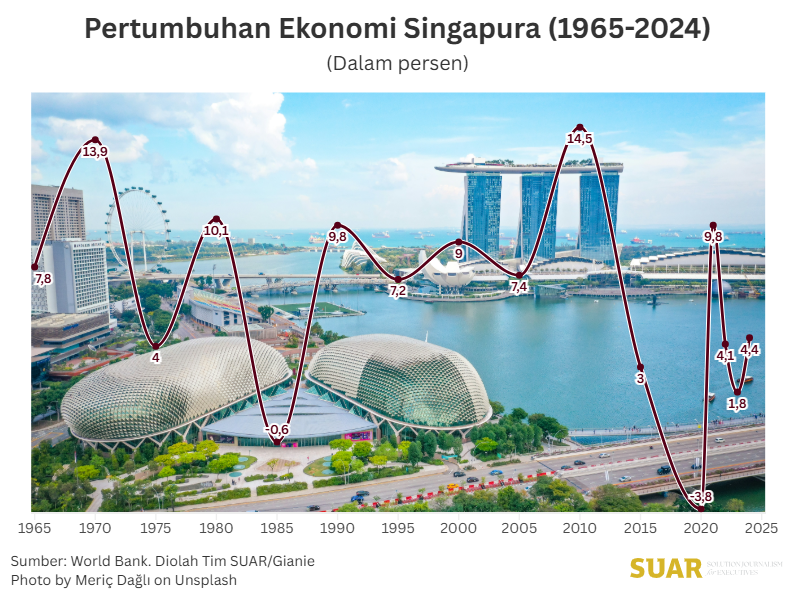
Since independence in 1965, Singapore's economy has grown by an average of 6.4% per year. The two highest growth peaks were in 1970 (13.9%) and 2010 (14.5%). Economic contractions have also occurred in 1985 (-0.6%) and during the 2020 pandemic (-3.8%), but recoveries have been swift.
Economic growth and high per capita income cannot be separated from the Singapore Government's policy of placing the business world as a pillar of the nation's progress. Entrepreneurs are placed in a central position.
The Singapore government has a very high regard for entrepreneurs. One proof is that there is no business activity that is not attended by government officials. Starting from the minister to the prime minister took the time to attend business-related activities.
The Singapore government has always supported entrepreneurs to grow their businesses bigger. This is based on the belief that the bigger the business, the greater the tax revenue received by the state. Of course, it will also improve the welfare of its people.
Not only focusing on entrepreneurs, the three pillars in Singapore, namely government-business-civil society, are key to the progress of the nation living in very high trust. These three pillars can play a role if they are filled with highly capable and competent people.
This is proven by Singapore, that the progress of a country is not determined by how much natural resources it has, but by competent and capable human resources.
Indonesia, which has abundant natural resources, needs to emulate Singapore's steps to get out of themiddle-income trap. In the next 20 years, when it reaches 100 years of independence, Indonesia must become a country with a high per capita income. For this reason, it is necessary to build cooperation between the three pillars with strong trust .